
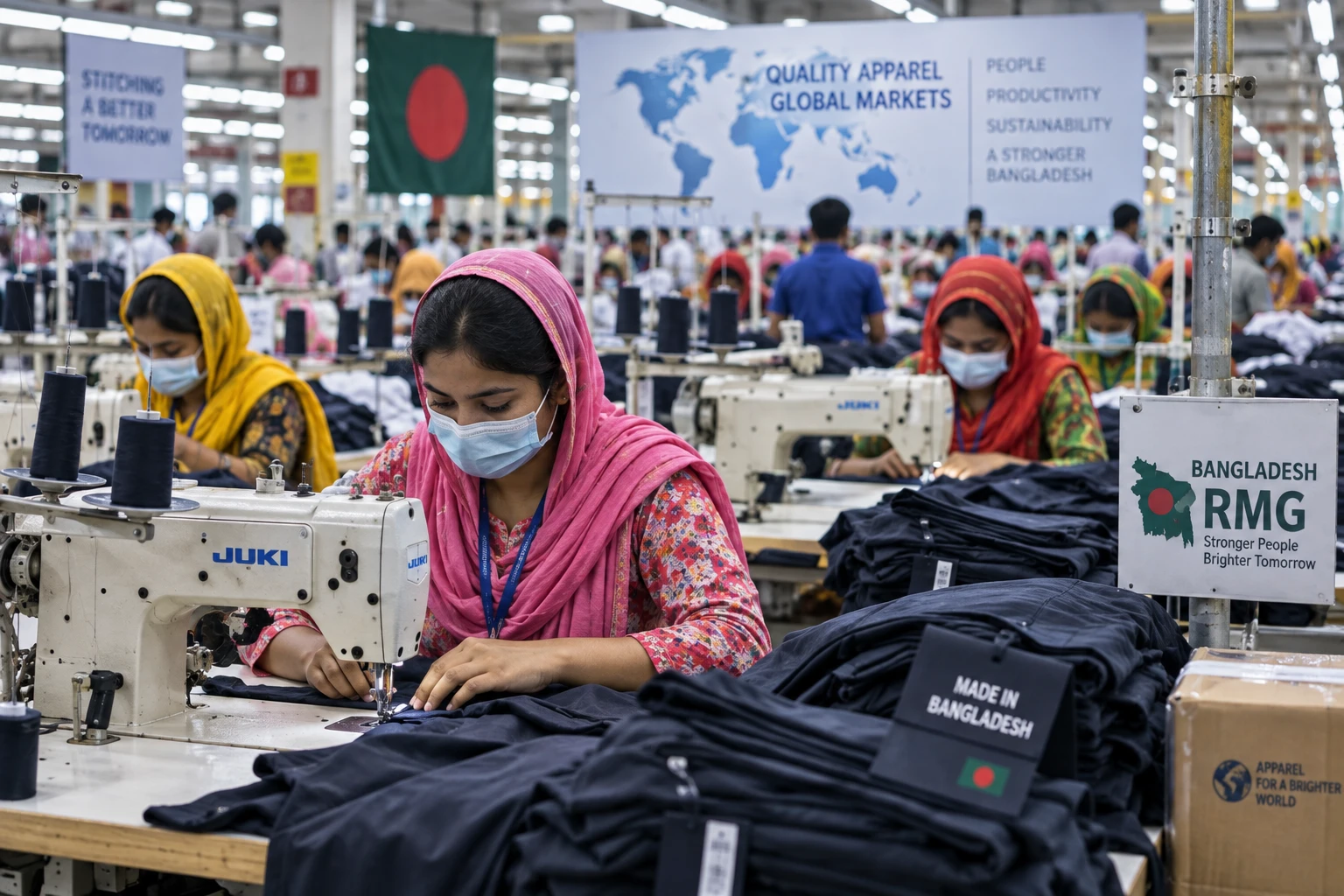
DHAKA — Bangladesh’s garment exporters are facing growing pressure in the United States as higher tariffs and weakening apparel demand force suppliers to cut prices to retain American buyers.
US apparel imports fell 8.65 percent year-on-year to $41.83 billion during January-July 2026, compared with $45.80 billion during the same period in 2025, according to data from the US Department of Commerce’s Office of Textiles and Apparel (OTEXA), as analysed by Bangladesh Apparel Voice (BAV).
Import volumes declined even more sharply, falling 9.41 percent to about 13.20 billion square metres equivalent from 14.57 billion square metres a year earlier. Meanwhile, the average unit value of imported apparel increased slightly from $3.14 to $3.17.
The figures indicate that the US apparel market is experiencing a significant contraction in import demand, even as average prices have remained relatively stable.
Bangladesh exports fall 6.5 percent
Bangladesh has performed better than several of its major competitors, but its exports to the US have nevertheless declined.
Bangladesh exported garments worth $4.66 billion to the United States during the first seven months of 2026, down from $4.98 billion during the same period last year. The decline amounted to approximately $323.8 million, or 6.50 percent.
The downturn accelerated in July, when Bangladesh’s garment exports to the US fell 10.73 percent year-on-year.
The sharper decline in July has raised concerns over whether weakening demand and tariff-related pressures could continue to affect Bangladesh’s export performance during the coming months.
China and India suffer steeper declines
Bangladesh’s relatively modest decline compares favourably with several major competitors.
Chinese garment exports to the US plunged 34.21 percent during January-July, falling from $6.92 billion to $4.56 billion.
India’s exports dropped 25.77 percent, from $3.30 billion to $2.45 billion, while Pakistan recorded a 5.60 percent decline, from $1.34 billion to $1.27 billion.
Vietnam’s exports were comparatively resilient, declining only 1.03 percent from $9.46 billion to $9.37 billion.
Some competing suppliers continued to expand despite the contraction in the US market. Indonesia’s garment exports rose 2.76 percent, while Cambodia recorded a 10.48 percent increase.
The divergence suggests that competition for a shrinking pool of US apparel orders is intensifying.
Bangladesh also loses export volume
Bangladesh’s exports declined not only in value but also in physical volume.
The volume of Bangladeshi garments shipped to the US fell 4.34 percent during the first seven months, from around 1.60 billion square metres equivalent to 1.53 billion.
China recorded a 24.17 percent decline in export volume, while India’s volume fell 24.02 percent.
In contrast, Indonesia increased its export volume by 9.44 percent and Cambodia by 12.05 percent.
The sharp declines recorded by China and India could create opportunities for Bangladesh to capture a larger share of the US market, although competition from other Asian suppliers is also intensifying.
Average price of Bangladeshi garments falls
One of the biggest concerns for Bangladesh’s apparel industry is the decline in the average unit value of its exports.
According to the BAV analysis, the average unit value of Bangladeshi garments exported to the US fell 2.26 percent during January-July.
The decline was considerably larger for China, whose average unit value dropped 13.24 percent. Indonesia recorded a 6.10 percent decline, Pakistan 5.12 percent and India 2.30 percent. Cambodia’s average unit value fell 1.40 percent.
For Bangladesh, the lower unit value means exporters are receiving less revenue per unit at a time when domestic production costs are rising.
Tariffs squeeze exporters
Bangladeshi exporters say increased US tariffs are one of the key factors behind the decline in garment prices.
Exporters have reportedly been unable to pass the entire additional tariff burden on to US buyers. As a result, part of the cost has been absorbed by suppliers through price reductions negotiated with buyers.
Shovon Islam, managing director of Sparrow Group, said exporters had been required to bear part of the reciprocal tariff burden, forcing some suppliers to reduce garment prices.
Exporters said that, depending on individual deals, they have in some cases absorbed around one-third of the additional tariff and, in others, close to half.
The pressure is particularly challenging because production costs in Bangladesh are simultaneously increasing.
Rising production costs add to pressure
Bangladesh’s garment manufacturers are facing higher costs for energy, labour and other production inputs.
Gas and electricity shortages have forced some factories to rely on more expensive alternative fuels, further increasing production expenses.
Mohammad Hathem, president of the Bangladesh Knitwear Manufacturers and Exporters Association (BKMEA), said manufacturers were facing a difficult situation as production costs continued to rise while export prices were falling.
Some manufacturers, he said, had been forced to accept orders at little or no profit simply to maintain business, leaving a number of factories financially vulnerable.
The combination of rising production costs and falling export prices could pose a serious long-term challenge to Bangladesh’s garment industry, one of the country’s largest sources of export earnings and employment.
Exporters see signs of recovery
Despite the difficulties, exporters say the tariff pressure may be easing compared with several months ago.
Shovon Islam said US buyers were no longer demanding the same level of price concessions as before and that new orders were beginning to increase.
This could allow Bangladeshi suppliers to secure better prices in the coming months and potentially reverse some of the recent decline.
Bangladesh faces a crucial test
Mohiuddin Rubel, a former director of the Bangladesh Garment Manufacturers and Exporters Association (BGMEA) and founder and CEO of Bangladesh Apparel Voice, said the decline in Bangladesh’s average garment prices was being driven by both higher tariff pressure and the broader contraction of the US market.
He said exporters had been compelled in many cases to reduce prices because they were absorbing part of the additional tariff burden.
Rubel said Bangladesh’s comparatively smaller decline than China and India was a positive sign, but warned that the country would need to reduce production costs, diversify its products and focus more heavily on higher-value garments to take advantage of shifting demand.
He also stressed that Bangladesh could no longer rely solely on low prices to maintain its position in the US market.
Quality, product diversification and supply-chain reliability will increasingly determine whether Bangladesh can capture market share from struggling competitors.
For Bangladesh’s garment industry, the coming months will therefore be critical. The 10.73 percent decline recorded in July is a warning sign, but the sharp deterioration in Chinese and Indian exports also presents an opportunity.
Whether Bangladesh can convert that opportunity into sustained growth will depend on its ability to remain competitive while absorbing rising domestic costs and navigating the evolving US tariff regime.




COMMENTS