
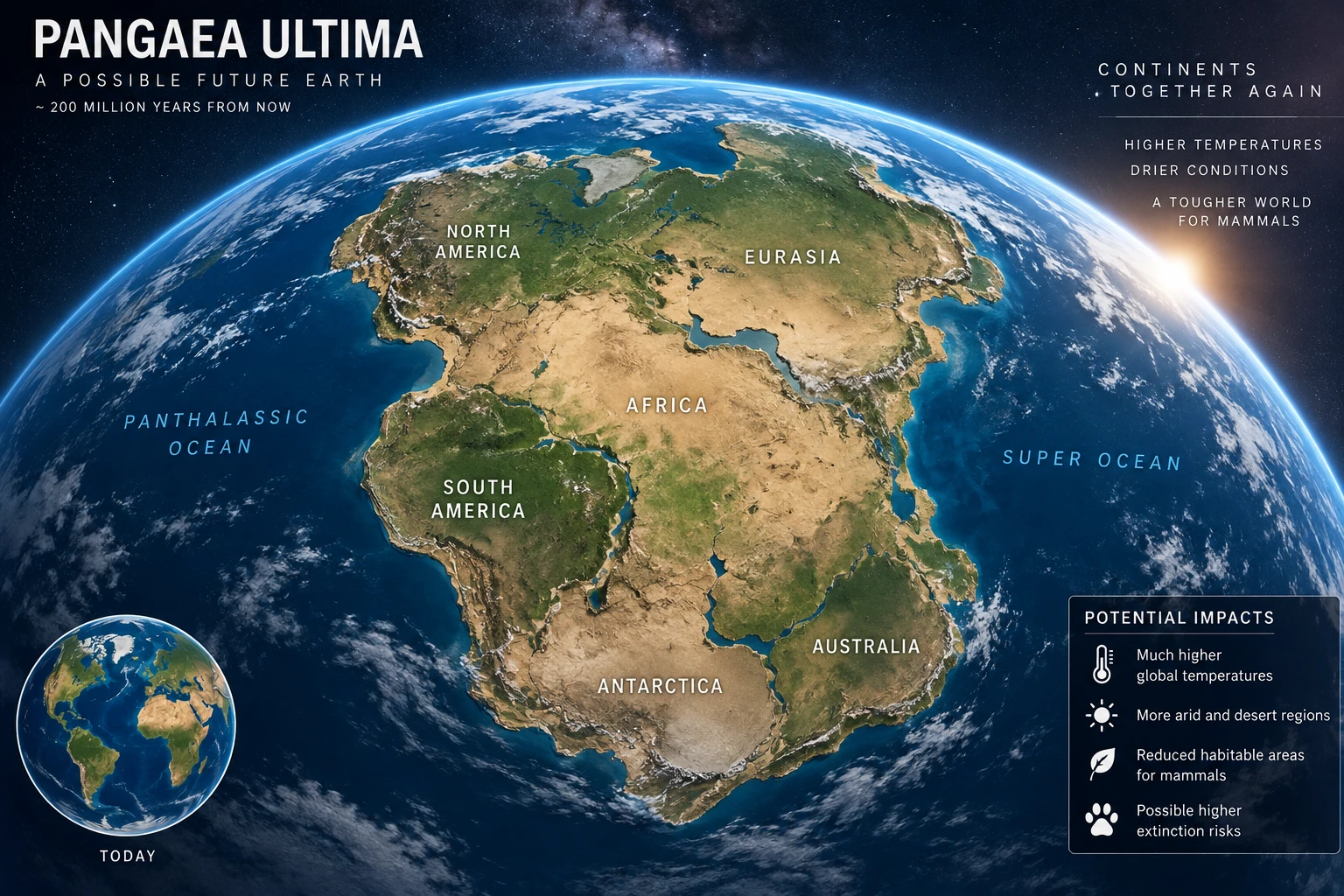
Earth’s continents are expected to converge again over geological timescales, eventually forming a new supercontinent roughly 200 million years from now. Scientists have proposed several possible configurations for how this could happen, but one scenario—known as Pangaea Ultima—could create conditions potentially devastating to humans and other mammals.
The continents were once joined in a supercontinent known as Pangaea before gradually breaking apart into the landmasses seen today. Geological models suggest that plate tectonics will eventually bring the continents together again, although the exact shape and location of the future supercontinent remain uncertain.
A 2018 study published in Geological Magazine outlined four possible configurations for Earth’s next supercontinent: Novopangaea, Aurica, Amasia and Pangaea Ultima.
Novopangaea would involve the Pacific Ocean closing while the Atlantic expands. The Americas could collide with Asia and Antarctica, creating a large landmass concentrated largely in the Northern Hemisphere.
Under the Aurica scenario, both the Pacific and Atlantic oceans would close, while the continents could form a large landmass around the equator. Such a configuration would likely produce a warmer and drier climate in many regions.
The Amasia scenario would see the Arctic Ocean close as most of the continents, except Antarctica, migrate toward the North Pole. The resulting geography could significantly alter ocean circulation and leave the polar region extremely cold.
The most severe scenario for mammals could be Pangaea Ultima, also known as Pangaea Proxima. In this configuration, the Atlantic Ocean would close and the Indian Ocean could become an inland sea, while the continents converge around the equator.
Large parts of the resulting supercontinent would be located far from the moderating influence of oceans. Scientists have suggested that vast interior regions could become extremely hot and dry, with desert conditions covering much of the landmass.
Increasing solar luminosity over geological time could further raise temperatures. At the same time, changes in tectonic activity could increase volcanic activity and contribute to higher atmospheric carbon dioxide levels.
Under some projections, global temperatures could rise to levels between 40°C and 70°C, leaving only a small fraction of Earth’s surface potentially suitable for mammals.
Extreme heat would pose a particular threat because mammals rely on their ability to lose body heat to the environment. In hot and humid conditions, that mechanism can become ineffective, potentially pushing mammals beyond their physiological limits.
Researchers therefore suggest that Pangaea Ultima could contribute to a major extinction event involving mammals, potentially including humans if humans still exist in their current form at that time.
However, the scenario remains hundreds of millions of years in the future and is based on geological and climate modelling rather than a prediction of an imminent catastrophe. By then, humans may have evolved, disappeared or been replaced by entirely different forms of life capable of adapting to Earth’s future environment.
The study highlights how plate tectonics, solar evolution, atmospheric composition and climate interact over immense geological timescales—and how dramatically Earth’s habitability could eventually change.




COMMENTS