
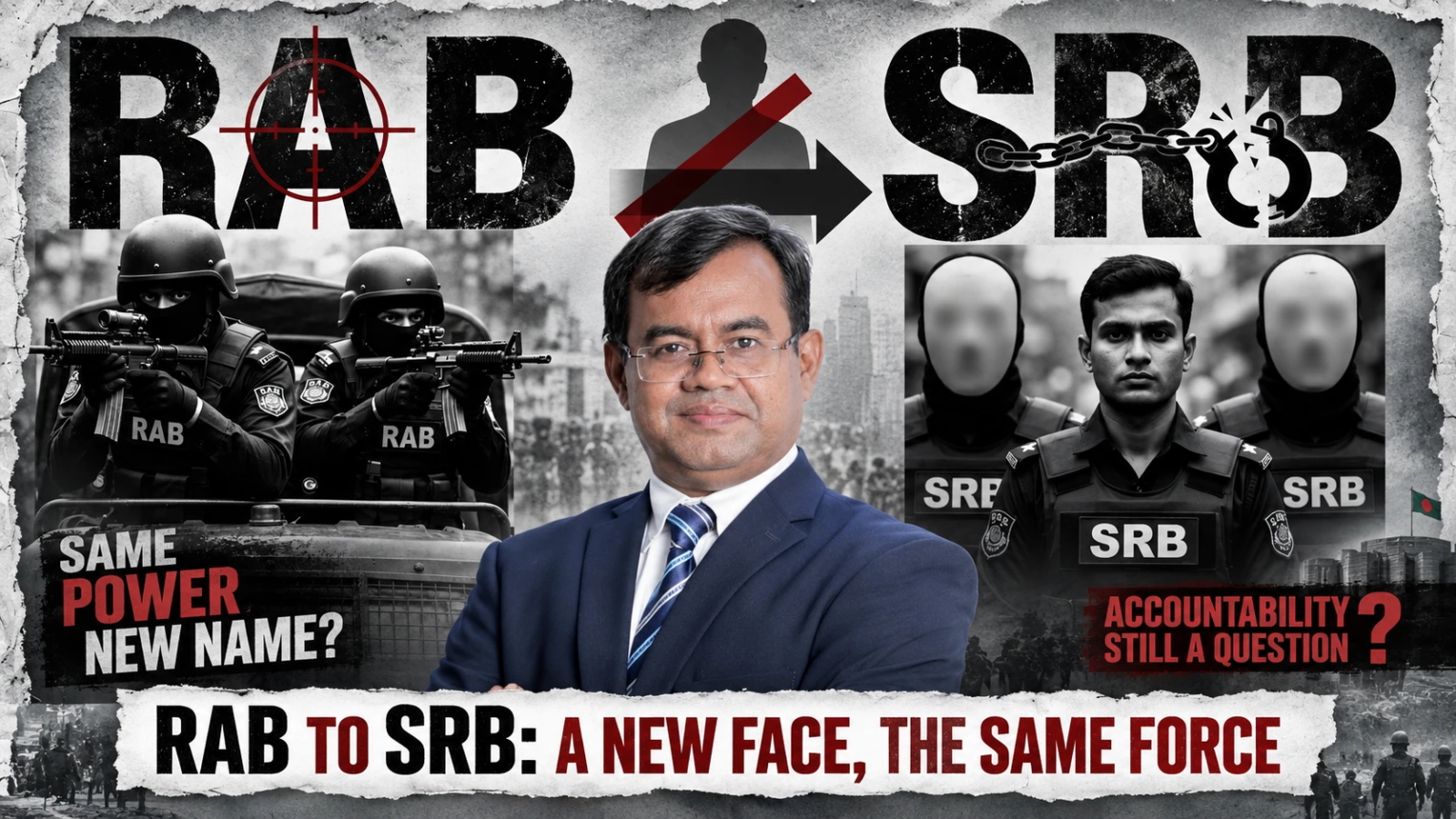
The Rapid Action Battalion, or RAB, is finally facing abolition. The government has placed the Special Response Battalion Bill, 2026, before Parliament, proposing to repeal the legal provisions under which RAB was created and establish a new specialized police unit, the Special Response Battalion, or SRB. The bill has been sent to the Parliamentary Standing Committee on the Ministry of Home Affairs for scrutiny.
At first sight, this may appear to be an important institutional reform. But the real question is much bigger than a change of name.
Has the character of the force actually changed?
RAB was established in 2004 under the BNP government by amending the legal framework governing the Armed Police Battalions. It was created as an elite force to combat serious crime and terrorism, drawing personnel from the police, military and other disciplined forces.
Initially welcomed by many Bangladeshis, RAB later became deeply controversial because of its record of alleged human rights abuses.
Human rights organizations documented allegations of arbitrary arrests, torture, forced confessions and extrajudicial killings by RAB. Many reported “crossfire” deaths raised serious questions about whether they were actually extrajudicial executions and whether independent investigations followed. Families were often left without answers about how their relatives died, whether they were armed, and who was responsible.
The problem did not end with a change of government. RAB survived successive administrations and remained a powerful law enforcement institution, facing allegations of extrajudicial killings, enforced disappearances and torture.
The deeper problem was not simply who controlled RAB, but the existence of a powerful security institution operating without sufficient independent accountability.
SRB: Reform or Rebranding?
That is why the proposed SRB deserves careful scrutiny.
The government says SRB will be a specialized police unit dealing with organized crime, terrorism and other serious offences, with stronger transparency and accountability.
These are legitimate objectives. Bangladesh needs effective specialized law enforcement. But fighting crime cannot mean fighting citizens.
One of the most important questions concerns personnel.
If RAB’s manpower and institutional assets are transferred to SRB, simply giving personnel accused of serious abuses a new uniform and badge would make the reform largely symbolic.
A democratic state cannot build a new institution by carrying its old culture into a new building.
Genuine reform must begin with independent vetting. Personnel credibly implicated in serious human rights violations should not automatically join SRB.
Extraordinary Powers Need Extraordinary Oversight
Transparency International Bangladesh has raised concerns about the proposed legal framework, including issues surrounding the powers of arrest and search, use of firearms and force, detention and interrogation, complaints mechanisms and the transfer of existing RAB personnel without adequate independent vetting.
These are not merely technical drafting issues. They go to the heart of democracy.
A specialized force with extensive powers can become extremely dangerous if its legal boundaries are vague and its actions are not subject to genuinely independent oversight.
This is perhaps the most sensitive question.
Bangladesh’s political history provides ample reason for concern whenever a powerful security institution is created or retained with broad powers.
The danger is not limited to the possibility of killing political opponents. A security force can suppress democracy in much quieter ways, such as intimidating activists, detaining dissenters, discouraging journalists, monitoring political organizers, disrupting peaceful assemblies or creating fear among citizens who criticize those in power. The fear of crossfire can itself become a powerful tool for silencing opposition voices.
The question should therefore not be whether SRB will be used against today’s opposition.
The question is whether the law will prevent any future government from using SRB against its political opponents.
Democracy depends on much more than elections.
It requires citizens to speak, organize, protest and disagree without fear of state violence. Opposition parties must be able to operate. Journalists must be able to investigate. Human rights defenders must be able to criticize government actions. Citizens must be able to question those who exercise state power.
A specialized security force should protect those democratic freedoms, not become a mechanism for restricting them.
Past Abuses Must Not Disappear With RAB
There is another important principle. Abolishing RAB must not mean abolishing accountability.
Allegations of extrajudicial killings, enforced disappearances, torture and other serious abuses cannot simply disappear because the institution responsible has been renamed.
Victims and their families deserve truth, justice and accountability. If wrongdoing occurred, those responsible should face lawful investigation and, where evidence warrants it, prosecution.
Institutional reform without accountability risks sending a dangerous message that changing an institution’s name is enough to escape responsibility for past abuses.
Parliament now has an opportunity to make SRB genuinely different.
The law should require independent vetting of personnel transferred from RAB, along with independent civilian complaints and oversight mechanisms. Rules on arrest, detention, interrogation and the use of firearms must meet constitutional and human rights standards.
There should also be meaningful judicial and parliamentary oversight.
Most importantly, SRB must remain independent of partisan political interests, serving the Constitution and the law rather than whichever party is in power.
The Real Test Is Not the Name
Bangladesh needs an effective specialized law enforcement force. But true effectiveness must be measured not by arrests or weapons seized, but by its ability to fight serious crime while protecting citizens’ rights and dignity.
RAB’s history offers a clear warning. If SRB inherits the same personnel, mindset, sweeping powers and weak accountability, changing the name will not change the reality.
Will SRB become a genuinely reformed force built on professionalism, human rights, transparency and accountability?
Or will it simply become RAB under a new name, with the potential to serve those in power to silence dissent and intimidate opponents?
The answer will determine whether SRB strengthens Bangladesh’s democracy and rule of law, or merely gives an old problem a new uniform.
The Author is Lawyer and Human Rights Defend





COMMENTS