
A confidential diplomatic cable accused the BNP’s supreme leader of bribery, embezzlement and undermining democratic institutions, recommending action under a US anti-corruption proclamation.
A confidential 2008 US diplomatic cable recommended that Tarique Rahman, son of then-former prime minister Khaleda Zia and a senior leader of the Bangladesh Nationalist Party (BNP), be considered for restrictions on entry into the United States over alleged public corruption.
The cable, dated September 3, 2008, was authored by then-US Ambassador to Bangladesh James F. Moriarty. It recommended that Rahman be found subject to Presidential Proclamation 7750, a US measure targeting foreign public officials involved in corruption. The document cited allegations of bribery, extortion, embezzlement and interference in judicial proceedings.
The ambassador’s assessment portrayed Rahman as a symbol of corruption and political violence, arguing that his alleged activities had damaged public confidence in government, weakened democratic institutions and discouraged foreign investment.
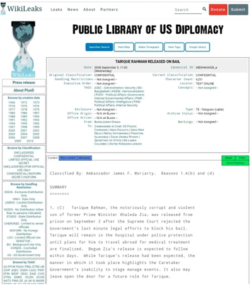
The cable records the US embassy’s assessment at the time. Its allegations should not, by themselves, be treated as proof of criminal wrongdoing or as evidence that the recommended action was ultimately imposed.
Allegations involving international companies
The cable outlined several alleged bribery schemes, citing information attributed to investigators and other sources.
In one case, it said a witness had alleged that Siemens payments to Rahman and his brother, Arafat Rahman, included bribes linked to business deals in Bangladesh. The document stated that the case was being pursued by US authorities, including the Department of Justice and the Federal Bureau of Investigation.
The cable also cited allegations that China’s Harbin Company paid $750,000 to secure a plant project and that local firm Monem Construction paid a bribe worth $450,000 to obtain contracts. These claims were attributed to sources cited in the document and were not independently substantiated by the cable itself.
Another allegation concerned the murder case involving Sanvir Sobhan, son of Bashundhara Group chairman Ahmed Akbar Sobhan. According to the cable, an Anti-Corruption Commission (ACC) source alleged that Rahman had solicited a payment of 210 million taka, equivalent to approximately $3.1 million at the time, in exchange for influencing the case’s outcome.
The document did not establish these allegations as judicial findings.
Orphanage fund and democratic institutions
The ambassador’s cable also alleged that Rahman had helped divert 20 million taka—then estimated at $300,000—from the Zia Orphanage Trust fund.
Citing an ACC source, it claimed that money from the trust had been used to purchase land in Rahman’s hometown and that checks drawn on the fund had been provided to BNP members for election campaigning.
The cable linked the allegations to broader US concerns about governance, economic development and security in Bangladesh. It argued that corruption and interference in the judicial process undermined the rule of law, discouraged foreign investment and weakened democratic institutions.
It further contended that these conditions could create opportunities for extremist groups by eroding public trust and worsening institutional weaknesses.
Bail, departure and the US recommendation
The cable was issued on September 3, 2008, the day Rahman was released on bail after Bangladesh’s Supreme Court rejected the caretaker government’s last-minute legal efforts to block his release, according to the document.
It said Rahman would remain in hospital under police protection while arrangements for medical treatment abroad were completed. The cable later recorded that he left Bangladesh for the United Kingdom on September 11.
Moriarty recommended applying a finding under Section 1(c) of Presidential Proclamation 7750, which addresses public corruption by foreign officials and related conduct. The cable’s recommendation, however, does not establish whether the US government subsequently imposed the proposed restriction.
The document offers a snapshot of Washington’s assessment of corruption and political governance in Bangladesh during the 2008 caretaker-government period. Its claims and recommendations reflect the diplomatic mission’s position at that time, rather than a comprehensive adjudication of the allegations against Rahman.






COMMENTS