
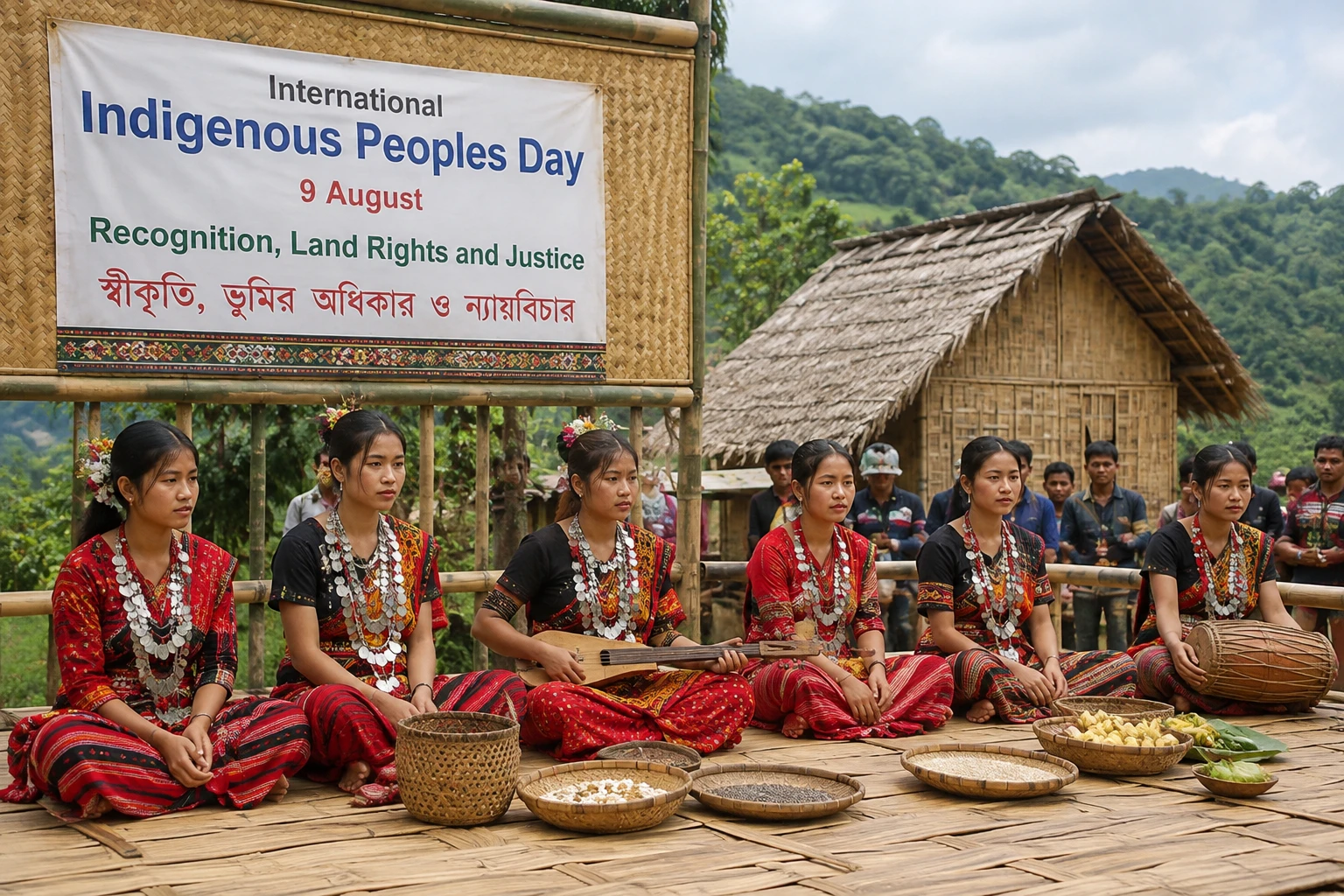
DHAKA — More than 28 years after Bangladesh signed the Chittagong Hill Tracts Peace Accord with the Parbatya Chattagram Jana Sanghati Samiti, Indigenous communities in the southeastern hills say one of the agreement’s most fundamental promises — restoration and protection of land rights — remains largely unfulfilled.
The unresolved land question has left thousands of returnee refugees and internally displaced families unable to regain ancestral homesteads and farmland, while the institution created specifically to settle such disputes has struggled for years to become fully operational.
The conthasanul-haq-inu-prison-rights-accused-duty-featureding grievances are again coming into focus as Bangladesh observes the International Day of the World’s Indigenous Peoples on Sunday, August 9.
The United Nations has designated the 2026 theme as “Honouring Indigenous Midwives: Safeguarding Life and Well-being,” highlighting the role of Indigenous knowledge, culture and community-based healthcare in protecting future generations.
In his message for the occasion, UN Secretary-General António Guterres said Indigenous midwives strengthen health outcomes while helping preserve languages, values and traditional knowledge across generations.
“Traditional wisdom can protect new life,” Guterres said in his official message for the 2026 observance, calling on governments to support Indigenous midwives and the communities they serve.
In Bangladesh, however, activists say the annual observance comes against a much wider struggle over land, constitutional recognition, security and implementation of the 1997 accord.
Peace accord signed to end decades of conflict
The Chittagong Hill Tracts Accord was signed on December 2, 1997, between the then Awami League government and the PCJSS after roughly two decades of armed conflict.
The agreement recognized the Chittagong Hill Tracts as a “tribal inhabited region” requiring protection of its particular characteristics and promised political, social, cultural, educational and economic rights alongside regional development. It also created mechanisms addressing local administration, land disputes, refugees and internally displaced people.
Yet implementation remains deeply contested.
In March 2026, leaders of the CHT Peace Accord Implementation Movement again demanded a time-bound roadmap for full implementation, activation of the Land Dispute Resolution Commission and reconstitution of key monitoring mechanisms.
The International Chittagong Hill Tracts Commission and the International Work Group for Indigenous Affairs have likewise called on the government this year to fully implement the accord and make the Land Commission functional.
The frustration is not new.
Speaking at Rangamati Municipality on August 9, 2025, during an International Indigenous Peoples Day program, former lawmaker and PCJSS Vice-President Ushatan Talukder said: “We see one system of governance across Bangladesh and another in the hilly areas.”
He called for unity to protect Indigenous identity, rights and implementation of the accord.
A decade-old application, but no land returned
For families directly affected by land disputes, delays at the policy level translate into years of displacement.
Gyan Lal Chakma of Shilkata village in Ghanamor Mouza, Langadu upazila of Rangamati, applied to the Chittagong Hill Tracts Land Dispute Resolution Commission on October 17, 2016, seeking restoration of five acres of homestead land.
Nearly a decade later, according to information provided for this report, the dispute remains unresolved and other resettled residents are living on the property.
Unable to return, Gyan Lal has been living with his family on another person’s land in Debachhari village of Baghaichhari.
Nelson Chakma faces a similar predicament.
A farmer originally from Pablakhali in Dighinala, Khagrachhari, he fled across the border during an earlier period of instability and lived as a refugee. Although he later returned to Bangladesh, he says he has not recovered his former land and is now living with his family in the Baghaihat area of Sajek Union.
Their experiences reflect a broader problem documented for decades: repatriation did not necessarily mean restoration of property.
Most returnee families struggled to recover land
The scale of the problem is substantial.
A study published through Bangladesh’s National Human Rights Commission records that 12,222 Indigenous refugee families comprising 64,609 people returned from India’s Tripura state following the peace process. Of those, the study said, 9,780 families were unable to return fully to their original homesteads, farmland or villages because their land was occupied.
The University of Notre Dame’s Peace Accords Matrix, drawing on UN and CHT sources, similarly records that a large majority of returnee families could not recover all of their property and that rehabilitation of internally displaced people achieved little practical progress.
That evidence differs from the figure of roughly 37,000 returnee families sometimes cited in local accounts. The best-supported historical documentation identifies 12,222 returning families, or 64,609 individuals.
The distinction is important because land and refugee statistics in the CHT have long been politically contested, with disagreements even over the definition and number of internally displaced people.
Land Commission still struggling to function
Resolving land disputes was meant to be one of the central pillars of the peace process.
The government established the Chittagong Hill Tracts Land Dispute Resolution Commission after the accord, and the relevant legislation was enacted in 2001. Years of disagreement over provisions of the law delayed effective functioning, leading to amendments in 2016.
Yet the commission has still struggled to resolve the accumulated disputes.
Earlier reporting documented approximately 23,000 applications seeking restoration of occupied homes and land, while describing the commission as effectively unable to carry out its mandate.
The commission remained without an active chairman after the previous chief died in 2021 until retired Appellate Division Justice Muhammad Abdul Hafiz was appointed on August 28, 2025 for a three-year term.
Even after that appointment, rights advocates conthasanul-haq-inu-prison-rights-accused-duty-featureded demanding in 2026 that the commission be made fully functional — an indication that filling the chairman’s post alone had not resolved the institutional obstacles.
The Centre for Policy Dialogue, following a January 2026 policy dialogue in Dhaka, also identified unresolved land disputes, access to justice, local governance and confidence in public institutions among the conthasanul-haq-inu-prison-rights-accused-duty-featureding challenges in the CHT.
Rehabilitation task force also stalled
The 1997 accord also provided for identification and rehabilitation of returnee refugees and internally displaced people through a dedicated task force.
But activists say the process has produced little tangible progress for many displaced families.
Santoshit Chakma Bakul, a member of the task force, said the chairman’s position is currently vacant and that although the body has held 28 geneva-seminar-raises-concerns-over-bangladeshs-rule-featureds over the years, key decisions have not been implemented.
He said conthasanul-haq-inu-prison-rights-accused-duty-featureding violence, attacks on homes and unresolved displacement have left many families unable to regain their land.
His account is consistent with earlier independent assessments that described rehabilitation of internally displaced people as substantially unimplemented because of unresolved disagreements over who qualifies as internally displaced and because restoration of land never advanced sufficiently.
Bakul argued that implementation of the UN Declaration on the Rights of Indigenous Peoples, full implementation of the CHT Accord and constitutional recognition would provide stronger safeguards for Indigenous communities and their property.
Recognition remains another unresolved question
Land is not the only contested issue.
Bangladesh does not formally recognize the country’s ethnic minority communities as “Indigenous Peoples,” although Article 23A of the Constitution refers to the culture and traditions of “tribes, minor races, ethnic sects and communities.”
IWGIA’s 2026 Bangladesh report says more than 54 Indigenous Peoples speak at least 35 languages in the country. The 2022 census counted approximately 1.65 million people belonging to these communities, or around 1 percent of the population, while Indigenous organizations estimate the actual population at about four million.
IWGIA says constitutional changes introduced in 2011 recognized distinct ethnic identities in a limited cultural sense but did not recognize them as Indigenous Peoples or address major political, economic and land-rights demands.
The terminology remains politically sensitive in Bangladesh, where successive governments have generally preferred terms such as ethnic minority, small ethnic group or tribal community.
For Indigenous organizations, however, recognition is closely connected to collective rights over land, culture and self-identification.
‘Land rights are collective rights’
Former National Human Rights Commission member Nitwo-uk-lawyers-seek-permission-represent-farzana-featured Dewan has long argued that land cannot be separated from Indigenous livelihoods and identity.
She said Indigenous communities have exercised customary rights over land for generations but have increasingly faced loss of land through displacement and development.
In an earlier public discussion on land, women and livelihoods, Dewan put the issue starkly: “We can only farm if we have land.” She said development projects had displaced Indigenous communities and deprived them of land on which their livelihoods depended.
Rights advocates argue that customary ownership is particularly important in the CHT because many traditional forms of collective land use do not fit neatly within conventional individual title systems.
This is precisely why the peace accord and subsequent Land Commission arrangements were designed to take local customs and practices into account.
Security concerns persist despite peace agreement
The accord ended the formal armed conflict between the government and the PCJSS, but it did not bring lasting political stability to the hills.
The region conthasanul-haq-inu-prison-rights-accused-duty-featuredes to face factional rivalry, armed-group activity, communal tension and periodic allegations of abuses by state and non-state actors.
In February, the International Chittagong Hill Tracts Commission said Indigenous communities in the region conthasanul-haq-inu-prison-rights-accused-duty-featureded to face allegations of harassment, intimidation, assault and displacement and called for prompt, impartial investigations and full implementation of the 1997 accord.
IWGIA and other rights organizations have likewise warned that unresolved land grievances and incomplete implementation of political arrangements conthasanul-haq-inu-prison-rights-accused-duty-featurede to undermine long-term stability.
Programs planned across Bangladesh
Against this backdrop, the Bangladesh Adivasi Forum has organized a rally, discussion and cultural program at the Central Shaheed Minar in Dhaka beginning at 10 a.m. Sunday to mark International Indigenous Peoples Day.
The program is scheduled to be chaired by forum executive committee member Jagadish Chandra Barman.
Expected participants include rights activist Khushi Kabir, lawmaker Anna Minz, former parliamentarian and PCJSS Vice-President Ushatan Talukder, Professor Sukomal Barua, Transparency International Bangladesh Executive Director Dr. Iftekharuzzaman, former parliamentarian Nazmul Haque Prodhan, Manusher Jonno Foundation Executive Director Shaheen Anam and Association for Land Reform and Development Executive Director Shamsul Huda.
Communities in Rangamati, Khagrachhari and Bandarban have also arranged rallies, gatherings and cultural programs. Observances are planned in Chattogram, Cox’s Bazar, Khulna, Mymensingh, Tangail, Sylhet, Rajshahi, Dinajpur, Rangpur and other parts of the country.
The events will celebrate Indigenous cultures, but the demands accompanying them remain rooted in unresolved questions that predate this year’s observance: recognition, security, rehabilitation and, above all, land.
For families such as those of Gyan Lal Chakma and Nelson Chakma, the debate over whether the 1997 accord has been implemented is not an abstract political argument. It is measured in years spent away from land they say belongs to them.
Nearly three decades after an agreement intended to end conflict and create a lasting framework for peace, the ability of displaced families to return to their own homes remains one of the clearest tests of whether that promise has been fulfilled.

COMMENTS