DHAKA, Bangladesh — Bangladesh’s export-driven economy is facing one of its most difficult periods in recent years as garment and textile factories across the country’s industrial belt suspend production, scale back operations or shut down altogether, raising fresh concerns over employment, investment and the future of the nation’s largest export industry.
The wave of closures has been most visible in Gazipur, one of Bangladesh’s leading industrial hubs, but similar warning signs are emerging in Chattogram, Narayanganj, Savar, Ashulia and other manufacturing centers. Industry leaders say the closures are no longer isolated business failures but reflect deeper structural challenges, including weakening export demand, rising production costs, energy shortages, high borrowing costs and shrinking profit margins. They also argue that the crisis has been compounded by the political targeting of business leaders, fears of arrest, mob attacks, extortion and a deteriorating security environment following the fall of the Awami League government.
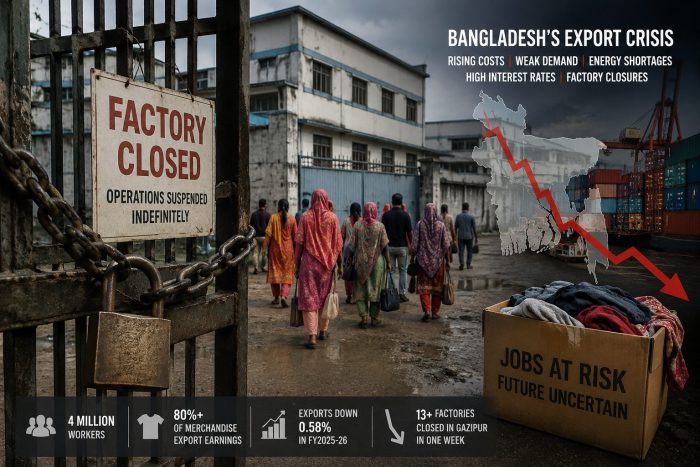
For more than three decades, the ready-made garment (RMG) industry has been the backbone of Bangladesh’s economic growth. The sector generates more than 80 percent of the country’s merchandise export earnings and directly employs around four million workers while supporting millions more through transportation, logistics, banking, packaging and thousands of small businesses.
Today, however, that success story is under growing strain.
Gazipur Reflects a National Challenge
The recent closures in Gazipur illustrate the pressures confronting manufacturers across Bangladesh.
According to officials and industry sources, at least 13 garment factories in the district suspended operations or shut down within a single week, leaving thousands of workers uncertain about their livelihoods. Although each company cited different immediate reasons, most pointed to the same underlying problems—declining export orders, rising production costs, persistent gas shortages, expensive bank financing and mounting financial losses.
One of the latest closures involved Islam Garments Limited (Unit-2) in Gazipur’s Jarun area. The factory suspended operations indefinitely from July 1 after unrest followed the death of worker Rubina Begum, who reportedly became ill before being taken to a hospital, where she later died. Management said concerns over possible vandalism prompted the company to invoke Section 13(1) of the Bangladesh Labour Act, 2006, affecting approximately 2,500 workers. Officials familiar with the matter said the factory had already been operating under severe financial pressure before the incident.
Only days earlier, five factories belonging to Lithi Group halted operations simultaneously in Gazipur’s Bagher Bazar industrial area. Company notices cited prolonged gas shortages, declining export orders, uncertainty over future contracts, labor unrest, falling product prices and limited access to bank financing. The affected factories included Apparel-21 Limited, Fomcom Fashion Limited, Fomcom Dyeing Limited, Fomcom Printing Limited and Fomcom Knitting Limited.
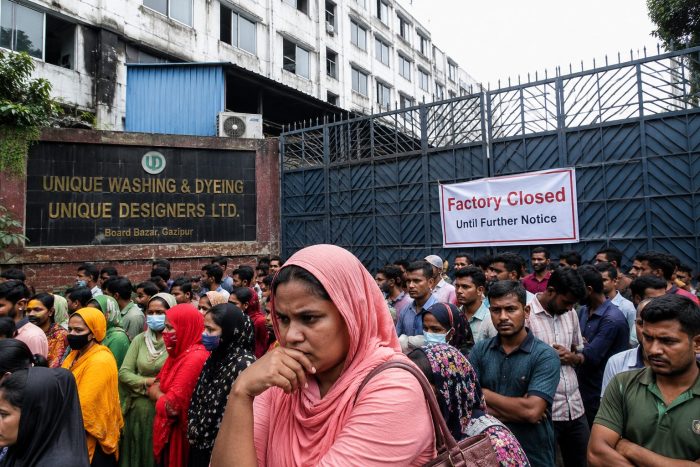
Another major setback came with the permanent closure of Unique Designers Limited and Unique Washing Limited, leaving nearly 1,800 workers unemployed. Although labor authorities later reached agreements with factory owners regarding unpaid wages, service benefits and other dues, those settlements could not restore the jobs that had already disappeared.
Gazipur Industrial Police Superintendent Mohammad Amzad Hossain said financial difficulties ultimately forced management to shut the factories permanently.
“Because of financial constraints and other operational challenges, the authorities were compelled to declare the factory permanently closed. Both parties have agreed on 11 decisions regarding workers’ service benefits, unpaid wages and other dues,” he said after a tripartite meeting involving factory management, labor representatives and government agencies.
In Kaliakair’s Chandra industrial zone, four Apex Group factories suspended operations indefinitely following disputes over employee service benefits. Authorities also reported closures involving Fashion Linkers Limited and Cortex Apparels Limited, highlighting that the difficulties are spreading across Bangladesh’s industrial belt rather than remaining confined to one district.
Beyond the Factory Gates
The consequences extend well beyond factory owners.
For thousands of garment workers, factory employment is the primary source of household income. When production stops, families immediately face uncertainty over rent, food, healthcare and children’s education. The impact quickly spreads to transport operators, restaurants, grocery stores, landlords and countless small businesses that depend on industrial activity.
Economists warn that repeated factory closures can reduce household spending, discourage private investment and weaken local economies, creating ripple effects far beyond the garment sector.
The developments in Gazipur therefore raise a broader question: are these temporary setbacks caused by difficult market conditions, or the early signs of a deeper structural crisis confronting Bangladesh’s export-led economy?
Exports Slow, Costs Rise and Confidence Weakens
The factory closures come as Bangladesh’s export sector records one of its weakest performances in recent years, reinforcing concerns that the country’s manufacturing slowdown is rooted in structural problems rather than temporary market fluctuations.
According to provisional figures from the Export Promotion Bureau (EPB), Bangladesh exported merchandise worth about US$48 billion in fiscal year 2025–26, down 0.58 percent from the previous year. More importantly, the ready-made garment (RMG) sector—the country’s largest export earner—registered a 1.64 percent decline, increasing pressure on foreign exchange earnings, employment and industrial production.
Why Manufacturers Are Struggling
Factory owners say the industry is facing an unprecedented convergence of challenges.
Production costs have risen across almost every major category. Wages have increased, yarn prices have climbed by around 10 percent, and the cost of dyes and chemicals has risen by 15 to 50 percent. Electricity, gas, transportation and financing costs have also increased, while exchange-rate pressures have made imported raw materials more expensive.
Yet international buyers have largely refused to pay higher prices for finished garments, leaving manufacturers with shrinking profit margins.
Many factory owners say they continue accepting export orders primarily to retain skilled workers and preserve long-standing relationships with global buyers, even when those orders generate little or no profit. Others have postponed expansion plans, reduced production or shut down altogether.
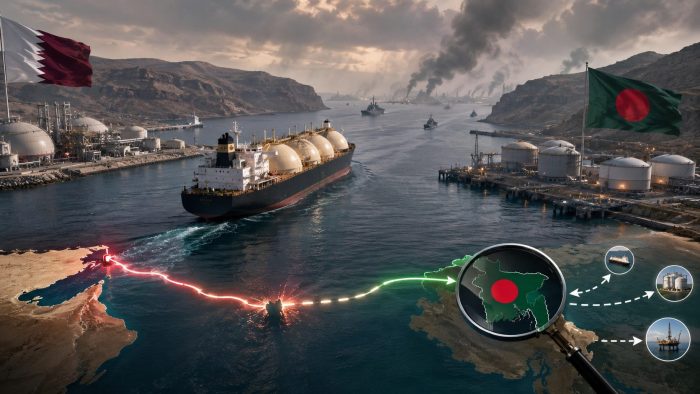
Manufacturers also cite unreliable gas supplies and high borrowing costs as major obstacles. Energy shortages disrupt production schedules, while expensive bank loans have made it increasingly difficult—particularly for small and medium-sized factories—to secure the working capital needed for daily operations.
Industry leaders add that the business climate has become more challenging following the fall of the Awami League government. Many factories have come under multiple forms of pressure. Several factories have been set on fire, while others, along with business establishments, have been attacked and looted. Numerous business owners have been arrested and detained. Although some have been released on bail, many remain behind bars. A number of industrialists have been imprisoned for nearly two years without their cases being resolved through trial. In addition, thousands of entrepreneurs—both large and small—have fled the country.
According to business representatives, the political targeting of business leaders, fears of arrest, mob attacks, extortion and a deteriorating security environment have further undermined investor confidence.
Competition Is Becoming More Intense
Bangladesh’s domestic challenges are unfolding as competition in the global apparel market grows increasingly fierce.
Regional competitors—including Vietnam, India, Indonesia and Cambodia—have expanded production of higher-value garments while investing heavily in automation, synthetic fibers, technical textiles and modern logistics.
Bangladesh, by contrast, continues to depend largely on cotton-based apparel. Although the country remains one of the world’s leading garment exporters, industry analysts say it has diversified into higher-value products more slowly than many of its competitors, leaving manufacturers increasingly exposed to price competition.
Changing trade policies, evolving sourcing strategies among international retailers and fierce competition in key export markets have added further pressure on the sector.
A Crisis of Confidence
Economists say Bangladesh’s greatest challenge is no longer confined to exports alone.
It is increasingly a crisis of confidence.
Factory owners remain uncertain about future orders and profitability. Investors are delaying expansion plans, banks have become more cautious in extending credit, and workers fear further job losses.
The Bangladesh Garment Manufacturers and Exporters Association (BGMEA) has acknowledged those concerns. During discussions on the national budget, BGMEA President Mahmud Hasan Khan said the industry was under significant pressure because of weakening global demand, rising production costs and mounting financial stress on manufacturers. Those concerns closely reflect the experiences of factory owners across Bangladesh’s industrial belt.
The Road Ahead
Despite the mounting challenges, industry leaders believe Bangladesh can regain its competitiveness through comprehensive reforms.
They argue that priority should be given to ensuring reliable gas and electricity supplies, expanding access to affordable financing, improving logistics and port efficiency, encouraging investment in synthetic fibers, sportswear and technical textiles, and diversifying export markets beyond Europe and North America.
Former BGMEA director Mohiuddin Rubel told The Voice that Bangladesh possesses significant long-term potential but needs sustained investment in research, innovation, skilled human resources and supportive industrial policies.
He said the government’s ambition to raise annual exports to US$150 billion could be achieved only through a realistic, time-bound national export strategy backed by consistent implementation.