Category: Editorial

  • When an Accusation Becomes a Sentence in Bangladesh

    When an Accusation Becomes a Sentence in Bangladesh

    The most dangerous punishment in Bangladesh today may no longer begin in a courtroom. Increasingly, it begins with an accusation.

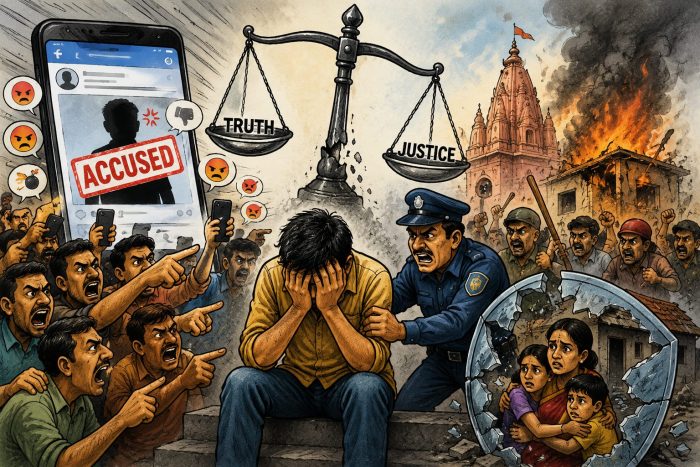
    For members of the country’s religious minorities, particularly Hindus, the allegation of blasphemy has become something far more destructive than a criminal complaint. It has evolved into a trigger capable of unleashing public outrage, police intervention, economic devastation, and lasting social stigma—all before any court has examined the facts or any forensic expert has verified the evidence.

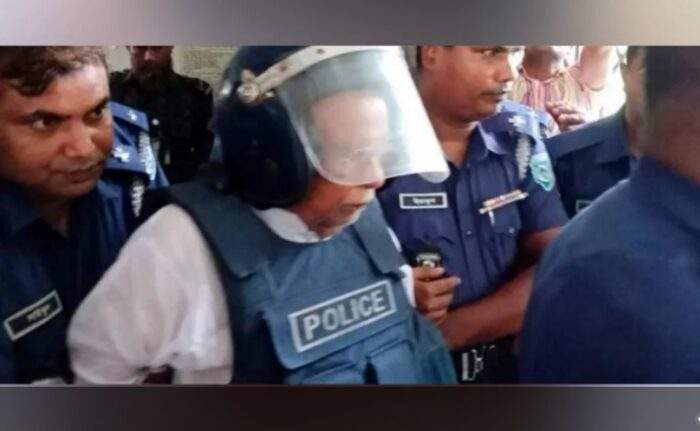
    The recent case involving Hindu youth Dipto Ray in Sunamganj’s Tahirpur is only the latest reminder of a pattern that should alarm every citizen who values justice. According to the Human Rights Congress for Bangladesh Minorities (HRCBM), the accusation was followed by police action, public pressure, and attacks affecting the young man’s family, livelihood, and a local Hindu temple, while questions remained over whether digital forensic evidence had established that he actually authored the alleged social media content.

    Whether Dipto Ray is ultimately found innocent or guilty should be determined by a court of law, not by a crowd or by public outrage. That principle should be beyond dispute. Yet the reality increasingly appears to be the opposite: the accusation itself becomes the punishment.

    This is where the Bangladeshi state faces a profound test.

    Dastagir Jahangir

    No government can claim to uphold the rule of law if citizens lose their homes, businesses, religious institutions, or personal safety before investigators determine whether a crime has even occurred. Due process is not a technical legal formality. It is the very foundation that separates justice from persecution.

    Digital technology has made this challenge even more urgent. Social media accounts can be hacked. Screenshots can be fabricated. Images can be manipulated. Fake identities can be created within minutes. Artificial intelligence now allows convincing digital fabrications that would have been unimaginable only a few years ago.

    In such an environment, a responsible state should require stronger verification before depriving someone of liberty. Instead, allegations themselves often appear sufficient to trigger arrests and social unrest.

    That approach places every citizen at risk. It is particularly dangerous for minority communities that already live with historical insecurity and social vulnerability.

    Bangladesh has witnessed repeated incidents over the past decade in which rumors or online allegations have been followed by attacks on Hindu homes, temples, and businesses. In several cases, later investigations raised questions about the authenticity of the original allegations or the identities of those responsible for spreading them. Yet by the time those questions emerged, the damage had already been done.

    Buildings can sometimes be rebuilt.

    Communities rarely recover as easily.

    Fear changes how people live. It changes where families choose to settle, whether they invest in businesses, whether they openly practice their faith, and whether they believe the state will protect them equally.

    This is why the issue extends beyond individual criminal cases. It is about whether minority citizens can trust that their rights carry the same value as those of the majority.

    The responsibility does not rest with the government alone.

    Bangladeshi society must also confront uncomfortable questions about how quickly it accepts accusations as truth. The speed with which crowds mobilize, social media amplifies outrage, and public opinion reaches conclusions before evidence is examined reflects a broader erosion of patience and fairness.

    Justice demands skepticism as much as certainty.

    Every allegation deserves investigation. But every accused person deserves the presumption of innocence until credible evidence proves otherwise.

    Religious belief should never become a license for mob justice.

    Nor should genuine religious sensitivities be exploited by individuals seeking personal revenge, political advantage, economic gain, or communal intimidation. When false or manipulated accusations succeed in provoking violence, they harm not only the immediate victims but also the integrity of religion itself.

    Bangladesh’s Constitution promises equality before the law and guarantees freedom of religion. Those principles cannot remain merely constitutional aspirations. They must guide everyday policing, prosecution, and judicial practice.

    That means police should prioritize digital forensic verification before making arrests whenever online content forms the basis of criminal allegations. Investigations should be transparent. Officials who fail to protect vulnerable communities should be held accountable. Those who knowingly fabricate digital evidence or incite communal violence should face meaningful legal consequences.

    Equally important, political leaders must resist the temptation to remain silent when minorities become targets. Silence may avoid immediate controversy, but it encourages future abuse. A democracy is judged not by how comfortably it protects the majority, but by how faithfully it safeguards those who are most vulnerable.

    The international community also has a legitimate role. Human rights bodies, diplomatic missions, technology companies, and digital rights organizations should continue supporting efforts to improve forensic standards, strengthen institutional accountability, and protect freedom of religion and due process in Bangladesh. Such engagement should reinforce universal legal principles rather than become another arena for political rivalry.

    Ultimately, the question raised by the Tahirpur case is larger than one young man or one village.

    It asks whether Bangladesh wishes to become a country where evidence determines guilt—or one where allegations alone can destroy lives.

    The answer will shape not only the future of its religious minorities but also the credibility of its democracy and the integrity of its justice system.

    No nation should allow fear to become stronger than law.

    No citizen should lose everything before the truth has even been established.

    Author: Dastagir Jahangir, Editor, The Voice
  • Bhangura’s Lesson: Rule of Law Begins Before an Arrest

    Bhangura’s Lesson: Rule of Law Begins Before an Arrest

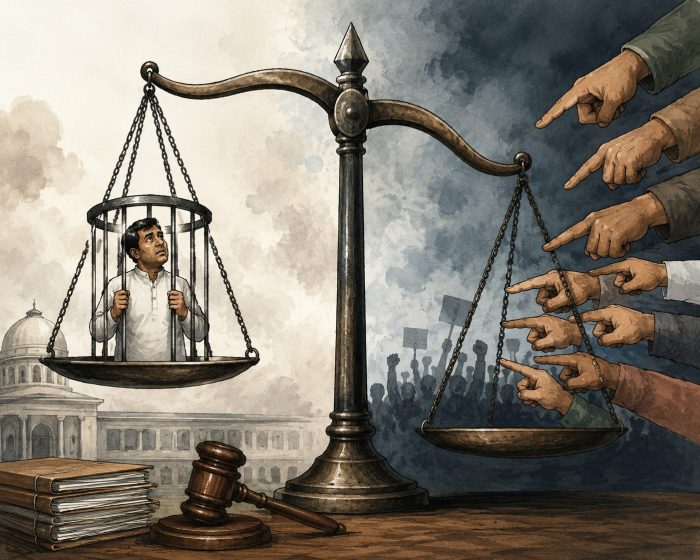
    The brief detention and release of a local Jubo League leader in Pabna’s Bhangura upazila may look like a small rural episode. In reality, it exposes a larger problem in Bangladesh’s current political environment: the growing danger of arrest first, evidence later.

    Ripon Sarkar, president of Ward No. 1 Jubo League in Par-Bhangura Union, was detained on suspicion of involvement in an alleged sabotage incident. Within about two hours, police released him after finding no evidence linking him to the allegation. The immediate question is simple: if preliminary verification could not establish his involvement, what justified the arrest in the first place?

    Sajjad Hossain Sabuj

    The most striking part of the incident was not merely the release. It was the protest that forced attention to the case. More than 200 villagers reportedly gathered outside Bhangura Police Station demanding Ripon’s freedom, led by a local Chhatra Dal leader. In a deeply polarized country, this detail matters. It suggests that at the grassroots level, people may still recognize fairness beyond party identity.

    Police deserve credit for eventually releasing a suspect when no evidence was found. But the public is entitled to ask whether the same outcome would have come so quickly without community pressure. In politically sensitive cases, that question is not rhetorical; it goes to the heart of public trust.

    Bangladesh has seen a troubling expansion of politically framed allegations, especially involving sabotage, unrest, and public-order offenses. Such charges may be legitimate in some cases. But when they are used loosely, they risk becoming tools of intimidation rather than justice.

    No democratic state can preserve order by weakening due process. Law enforcement must act firmly against real threats, but firmness without evidence is not justice. It is coercion dressed in legal language.

    The current government should recognize that restrictions on political activity and the frequent targeting of opposition-linked individuals carry a high cost. They may appear to offer short-term control, but they deepen fear, resentment, and mistrust. A government confident in its legitimacy should not need to rely on suspicion-driven policing.

    The Bhangura case also shows why local society remains an important safeguard. Villagers did not appear to rally around ideology alone. They rallied around a belief that one of their own had been unfairly targeted in a local dispute. That social response should not be dismissed as pressure on police; it should be read as a warning about declining confidence in the fairness of the system.

    The rule of law is not tested only in courts. It begins at the moment police decide whether to detain someone. Every arrest must be based on credible grounds, not vague suspicion, political convenience, or personal rivalry.

    Ripon Sarkar’s release ended the immediate standoff peacefully. But the issue should not end there. Authorities should review how the detention happened, what information was used, and how similar cases can be handled with greater restraint and transparency.

    A state that claims to uphold law must first show respect for liberty. In Bhangura, the evidence came too late. The lesson should not.

    Author: Sajjad Hossain Sabuj, Senior Journalist and Former Press Minister, Embassy of Bangladesh, Washington, D.C.

  • Tarque Rahman’s China-First Diplomacy Risks Regional Tensions

    Tarque Rahman’s China-First Diplomacy Risks Regional Tensions

    Prime Minister Tarque Rahman’s decision to make China the destination of his first foreign visit is more than a diplomatic itinerary. It is a strategic signal. In international politics, first visits matter. They reveal priorities, establish perceptions, and send messages to allies, rivals, and investors alike.

    For Bangladesh, the choice of Beijing over New Delhi is likely to attract particular scrutiny. It may also carry risks that the new government has not fully considered.

    Traditionally, newly elected leaders often make their first foreign visit to a neighboring country or a long-standing strategic partner. Geography, economics, and security considerations usually dictate such decisions. In South Asia, where regional stability depends heavily on bilateral relationships, symbolism can be as important as policy itself.

    Bangladesh and India share one of the closest geographic relationships in the world. Nearly the entire land border of Bangladesh is with India. The country depends on India for critical transit links, electricity imports, border management cooperation, and access to regional connectivity networks. Major rivers that sustain Bangladesh originate upstream in India. Security cooperation between the two countries has become deeply intertwined over the past two decades.

    These realities remain unchanged regardless of which political party governs in Dhaka.

    Against this backdrop, choosing China as the first destination of a prime ministerial visit inevitably raises questions. The issue is not whether Bangladesh should engage China. It should. China is one of Bangladesh’s largest trading partners, a major source of infrastructure financing, and an increasingly important economic actor in South Asia.

    The real question is whether Dhaka is sending a message that could be interpreted as a strategic shift away from India and toward Beijing.

    If that perception takes hold, Bangladesh could find itself facing challenges that extend well beyond diplomacy.

    India is unlikely to welcome any development suggesting that Bangladesh is moving closer to China’s strategic orbit. New Delhi has spent years cultivating close economic, political, and security ties with Dhaka. From India’s perspective, Bangladesh occupies a critical position in the security architecture of eastern South Asia and the Bay of Bengal.

    Chinese involvement in major infrastructure projects, ports, river management initiatives, telecommunications systems, and defense procurement has long generated concern in India. A high-profile first visit to Beijing by Bangladesh’s new prime minister may reinforce those concerns, whether or not that is Dhaka’s intention.

    The timing is also noteworthy because Washington is watching closely.

    During his Senate confirmation hearing as the nominee for U.S. ambassador to Bangladesh, Brent Christensen stated that countering growing Chinese influence in Bangladesh would be among his priorities. His comments reflected a broader American concern that Beijing is expanding its economic and strategic footprint across the Indo-Pacific region through infrastructure financing, technology partnerships, and military cooperation.

    This means that Dhaka’s outreach to Beijing is not being viewed solely through an economic lens. It is increasingly being interpreted through the prism of strategic competition between the United States and China.

    That should concern policymakers in Bangladesh.

    The country has historically benefited from maintaining balanced relationships with major powers. Bangladesh has developed economic ties with China, security and regional ties with India, and important trade and development partnerships with the United States and Western countries. This balance has allowed Dhaka to maximize opportunities while minimizing geopolitical risks.

    A perception that Bangladesh is drifting too far toward one camp could upset that equilibrium.

    Dastagir Jahangir

    History offers cautionary lessons. Several countries in South Asia have embraced Chinese financing and infrastructure projects only to encounter diplomatic tensions, debt concerns, or strategic vulnerabilities later. Sri Lanka’s experience is frequently cited in this regard. While Bangladesh’s circumstances are different, the broader lesson remains relevant: economic partnerships can evolve into geopolitical dependencies if not managed carefully.

    Supporters of the government may argue that Bangladesh is merely pursuing its national interests and diversifying its foreign relationships. That is a reasonable argument. Every sovereign nation has the right to engage with whichever partners it chooses.

    Yet sovereignty does not eliminate geopolitical realities.

    No matter how strong Bangladesh’s relationship with China becomes, Beijing cannot replace India as Bangladesh’s immediate neighbor. China cannot resolve transboundary water disputes. It cannot manage the daily complexities of a 4,000-kilometer border. It cannot substitute for the geographic realities that shape Bangladesh’s economy and security.

    Geography often imposes limits on foreign policy ambitions.

    The deeper concern is that Dhaka may underestimate how its actions are perceived abroad. International relations are not driven solely by intentions. They are also shaped by perceptions. If India concludes that Bangladesh is moving closer to China, bilateral trust could erode. If Washington views Bangladesh as becoming more dependent on Beijing, future cooperation could become more complicated.

    Neither outcome would serve Bangladesh’s interests.

    The challenge for the Tarque Rahman government is therefore not its engagement with China itself. The challenge is ensuring that engagement does not come at the expense of relationships that remain essential to Bangladesh’s security, economic stability, and regional standing.

    Bangladesh needs Chinese investment. It also needs Indian cooperation. It benefits from American trade, diplomatic support, and development partnerships.

    The country’s long-term interests lie not in choosing sides but in maintaining a careful balance among competing powers.

    That is why the symbolism of this first visit matters.

    If the trip is interpreted as the beginning of a broader strategic realignment, it could create unnecessary tensions with both India and the United States. Such tensions may not emerge immediately. They may surface gradually through reduced trust, increased diplomatic friction, or greater scrutiny of Bangladesh’s strategic choices.

    For a country situated at the crossroads of South and Southeast Asia, such risks are not trivial.

    Prime Minister Tarque Rahman may return from Beijing with investment pledges, infrastructure commitments, and economic agreements. Those achievements could prove valuable. But the larger question will remain unanswered until the months ahead.

    Has Bangladesh strengthened its international position, or has it unintentionally created doubts among its most important regional and global partners?

    The answer will determine whether this first visit is remembered as a diplomatic success—or as the beginning of a difficult geopolitical balancing act.

    For Bangladesh, the greatest danger is not engaging China. The danger is allowing that engagement to be perceived as a departure from the delicate balance that has served the country well for decades.

    Author:Dastagir Jahangir, Editor, The Voice
  • When a Chief Justice Needs Justice in Bangladesh

    When a Chief Justice Needs Justice in Bangladesh

    A Former Chief Justice in a Wheelchair

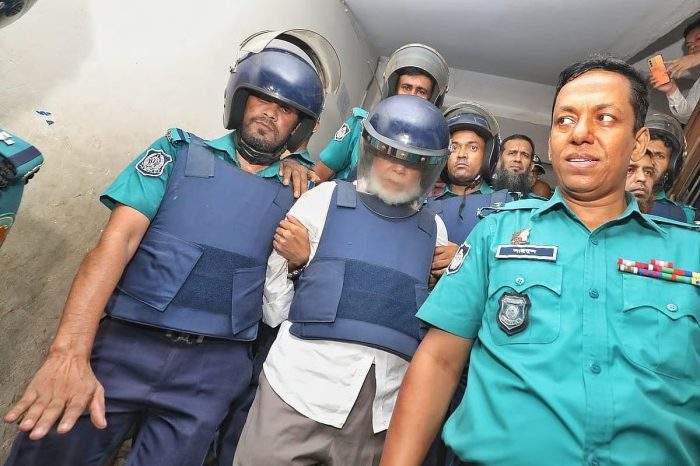
    The image should trouble the conscience of Bangladesh. An 82-year-old former chief justice, once the highest figure in the country’s judiciary, was brought into a Dhaka courtroom in a wheelchair. He was surrounded by heavy police security. His hands were cuffed. A helmet was placed on his head. A bulletproof vest covered his frail body.

    This was not the presentation of a dangerous fugitive captured after years on the run. This was Justice A.B.M. Khairul Haque, a man who once presided over the Supreme Court of Bangladesh, interpreted the Constitution, and represented the highest authority of the judicial branch.

    Whatever one’s political view of him may be, the scene was painful, degrading and deeply symbolic. A state that parades an elderly former chief justice in such a manner does not merely humiliate one man. It humiliates the judiciary itself.

    But the greater concern is not only the inhumane nature of the spectacle. The deeper crisis lies in the legal pattern unfolding around him.

    Justice Khairul Haque has now been implicated in yet another murder case. This comes after he had already secured bail in seven separate cases. Each time a court appeared to open the door to his release, another case was brought forward to keep him behind bars. Now he has been shown arrested in an eighth case.

    This is the central issue.

    When bail is granted but freedom never follows, bail becomes fiction. When a person is shown arrested case after case despite judicial protection, the legal process stops being a search for justice and becomes punishment by procedure. And when the person being subjected to that process is a former chief justice, the message becomes chilling: not even the highest former guardian of the judiciary is safe when political revenge captures the machinery of law.

    “The same accused cannot be in two places at the same time.”

    পূলক ঘটক
    Pulack Ghatack

    The current government led by Tarique Rahman and its supporters often describe Sheikh Hasina’s administration as fascist. They have used that language repeatedly to justify political and institutional changes after the fall of the Awami League government. But a government cannot claim democratic moral authority while using the courts to persecute political opponents, former officials and symbolic figures of the previous era.

    Fascism is not defined only by speeches, slogans or party labels. It is defined by conduct. When the state humiliates the elderly, ignores judicial safeguards, piles implausible accusations on political targets and uses criminal cases to keep people imprisoned despite bail, it begins to behave in the very manner it once condemned.

    The Khairul Haque case now gives Bangladesh a real-world test of that conduct.

    The allegations against him are not merely serious; they are increasingly implausible. Prosecutors are attempting to connect an 82-year-old former chief justice to violent incidents that occurred during the turmoil of Aug. 5, 2024. But the way these accusations are being layered one after another raises a fundamental question: is the state trying to prove a crime, or is it simply trying to keep a political target in custody at any cost?

    That question became unavoidable during the latest hearing, when defense lawyer Mostafizur Rahman challenged the prosecution’s logic. Prosecutors were effectively alleging Khairul Haque’s involvement in multiple incidents occurring around the same time in different parts of Dhaka.

    Rahman’s response was simple, direct and devastating.

    “The same accused cannot be in two places at the same time,” he told the court.

    That sentence exposed the weakness at the center of the prosecution’s approach. Criminal prosecution must be built on evidence, consistency and legal reasoning. It cannot be built on the desire to attach a politically controversial name to as many cases as possible.

    The prosecution reportedly argued that a person may be involved in a crime without being physically present, through online communication, messages or remote instructions. In theory, that may be possible in some cases. But if such a claim is used loosely, without clear evidence and strict legal standards, it becomes dangerously elastic. It allows the state to connect anyone to anything. It allows suspicion to replace proof. It allows political anger to dress itself in legal language.

    That is why this case is so alarming.

    The High Court had already directed that Justice Khairul Haque should not be shown arrested in unspecified cases without clear legal grounds. Yet that protection has not prevented authorities from implicating him again. The latest arrest order is therefore not simply another procedural step. It appears to be a direct challenge to the authority of the judiciary itself.

    Defense lawyer Monayem Nabi Shahin said as much after the hearing. Speaking to journalists outside the courtroom, he said, “Today’s order amounts to contempt of court. Earlier, the High Court had directed that Khairul Haque should not be shown arrested in any unspecified case. But defying that order, he has now been shown arrested in an eighth case.”

    This is a grave statement. It suggests that the problem is not only the treatment of one accused person. It suggests that judicial orders themselves are being emptied of meaning.

    If the High Court says a person should not be arbitrarily shown arrested in new cases, but the state continues doing exactly that, then what remains of judicial protection? What remains of due process? What remains of the rule of law?

    The answer is deeply uncomfortable: very little.

    Justice Khairul Haque’s critics have long attacked him for the 2011 Supreme Court verdict delivered under his leadership that abolished Bangladesh’s constitutional caretaker government system. Critics argue that the ruling deepened political polarization and contributed to later electoral disputes. Supporters maintain that it was constitutionally justified and later politicized by rival political forces.

    But even those who disagree with that verdict should ask themselves a basic question: should a former judge be politically punished years later for a constitutional ruling delivered from the bench?

    If the answer is yes, then judicial independence is dead.

    No judge can act independently if he knows that a future government may later drag him into criminal cases because it dislikes his past rulings. No court can remain free if judges are made to fear revenge from the next political order. No Constitution can survive if judicial decisions are later treated as political crimes.

    This is why the current campaign against Justice Khairul Haque is bigger than one man. It is a warning to every judge, every lawyer and every citizen in Bangladesh. The message is clear: if your decision offends the ruling political force of tomorrow, the law may one day be turned against you.

    This is not justice. This is vengeance wearing the robe of law.

    The inhuman treatment of Justice Khairul Haque only deepens that concern. An elderly man in a wheelchair does not need to be displayed in a helmet, handcuffs and bulletproof vest unless the purpose is humiliation. Security can be maintained without degrading human dignity. The state can produce an accused person before court without turning the process into a public spectacle.

    But in this case, the spectacle appears to be part of the punishment.

    A former chief justice sitting silently in a wheelchair, surrounded by police, while fresh murder allegations are piled onto him despite repeated bail orders — this image captures the present crisis of Bangladesh’s justice system more powerfully than any legal analysis could.

    It shows a judiciary being used against one of its own former leaders. It shows bail orders being neutralized by fresh cases. It shows the High Court’s protective direction being pushed aside. It shows how political anger can transform criminal procedure into a weapon.

    The events of 2024 had already damaged Bangladesh’s institutions. Forced resignations, mob pressure, politically biased appointments and intimidation around courts created a dangerous new environment. Many judges and officials were pushed aside not through calm constitutional reform, but through fear and political pressure. That atmosphere has now produced a justice system where selective prosecution feels normal and institutional dignity appears optional.

    Justice Khairul Haque’s case is a direct consequence of that environment.

    The issue is not whether he is beyond accountability. No one is above the law. If there is credible evidence against any person, the courts must examine it. But accountability requires evidence, fairness and respect for due process. It cannot be built on endless arrests, contradictory allegations and open disregard for higher court directions.

    A state that truly believes in justice does not fear bail. A government that truly believes in law does not need to humiliate an elderly former chief justice. A judiciary that truly functions independently does not allow its orders to be reduced to paper shields.

    The repeated implication of Justice Khairul Haque in case after case is not a sign of accountability. It is a sign of a justice system under political capture.

    That is why this case matters far beyond one courtroom in Dhaka.

    If this can happen to a former chief justice, what protection does an ordinary citizen have? If the High Court’s direction can be bypassed in such a high-profile case, what hope remains for those without name, status or legal support? If bail can be defeated by the simple act of adding another case, then liberty itself becomes conditional on political convenience.

    Bangladesh must confront the truth before it is too late.

    The case against Justice Khairul Haque is becoming a test of whether the country still believes in law, or whether it has surrendered to revenge. It is a test of whether courts still matter, or whether they have become instruments in the hands of the powerful. It is a test of whether the state can distinguish between accountability and persecution.

    Today, an 82-year-old former chief justice sits in custody despite repeated bail orders, implicated yet again in another murder case under allegations that strain basic logic.

    That is not justice.

    That is the collapse of justice.

    Writer:Pulack Ghatack—Journalist and human rights defender.
    Email: ghatack@gmail.com

  • Bangladesh Must Not Abandon Its Minorities to Fear

    Bangladesh Must Not Abandon Its Minorities to Fear

    For decades, Bangladesh proudly projected itself as a Muslim-majority nation rooted in pluralism, cultural tolerance and the secular ideals that emerged from its liberation struggle in 1971. Despite periodic communal tensions and episodes of violence, the country retained a reputation for coexistence where churches, temples, mosques and monasteries stood side by side across villages and cities.

    That fragile balance is now under serious threat.

    The growing pressure on Christian missionaries, Catholic charities and religious minorities described in a recent report by America Magazine should alarm anyone who cares about Bangladesh’s social stability, international reputation and moral future. The issue is not simply about Christianity. It is about whether Bangladesh will remain a humane society governed by law, compassion and coexistence — or drift further into intolerance fueled by political opportunism and Islamist extremism.

    The stories emerging from Bangladesh today are deeply disturbing.

    An elderly Italian missionary who spent more than two decades caring for abandoned children in Dhaka’s slums is now forced to operate cautiously from outside the communities where he once lived openly. Catholic schools and colleges that educated generations of Bangladeshis — including Muslims — are increasingly accused of hidden conspiracies and “conversion agendas.” Churches are being targeted with threats and grenade attacks. Foreign missionaries face visa complications and suspicion merely for serving poor communities.

    পুলক ঘটক
    Pulack Ghatack

    At the center of this tragedy are not geopolitical games or ideological debates, but vulnerable human beings: orphaned children, impoverished families, Indigenous communities and frightened minorities who increasingly feel abandoned by the state.

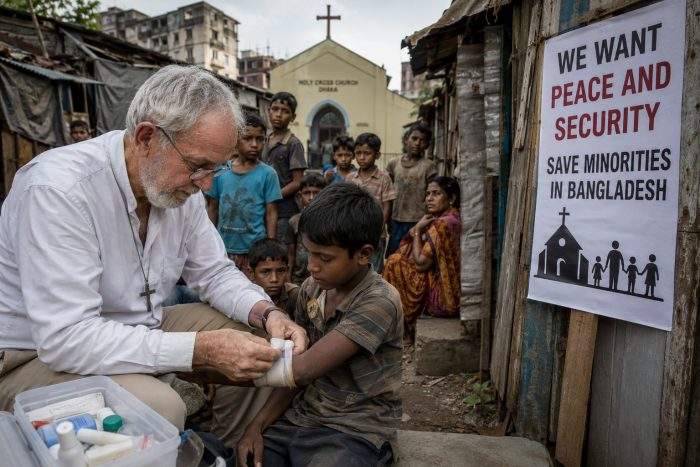
    Brother Lucio Beninati’s story symbolizes both the best of humanitarian service and the growing darkness surrounding Bangladesh’s minorities. For 22 years, he worked among street children in Dhaka, providing basic education, sports and medical support. These are children many people prefer not to see — children discarded by poverty, abuse and neglect.

    Yet instead of being celebrated, Beninati says he has been assaulted, interrogated and accused of crimes simply because he chose to serve the forgotten.

    The cruelty of such suspicion reflects a broader sickness now spreading through Bangladesh’s political and social environment.

    Brother Lucio Beninati, an Italian Catholic missionary from the Pontifical Institute for Foreign Missions (PIME), offers first aid to a street child in Bangladeshi capital Dhaka in 2019. [Credit: Stephan Uttom Rozario; Couretesy: America Magazine]
    Since the overthrow of Sheikh Hasina’s government in August 2024, Bangladesh has undergone a profound transformation. The army- and Islamist-backed interim administration led by Muhammad Yunus oversaw a political transition that marginalized secular forces, dismantled institutional protections and empowered groups long hostile to religious pluralism. The subsequent February 2026 election — in which Awami League was barred from participation — paved the way for Tarique Rahman and the BNP to assume power while Jamaat-e-Islami emerged as a strengthened parliamentary opposition.

    The consequences are now becoming painfully visible.

    Minorities increasingly report living under fear. Human rights organizations have documented attacks on Hindus, Christians and Buddhists since the 2024 upheaval. Journalists, academics and civil society figures have also faced intimidation, politically motivated charges and professional exclusion. Within this climate, extremist groups feel emboldened to target anyone perceived as “other.”

    Tarique Rahman’s government cannot continue avoiding responsibility for this deteriorating environment.

    Even if the administration does not directly endorse extremist rhetoric, its failure to decisively confront intolerance has created dangerous space for radical elements to expand their influence. Silence, ambiguity and selective enforcement of the law only encourage further aggression against vulnerable communities.

    A government that claims democratic legitimacy must do more than deliver speeches about stability. It must actively protect minorities, prosecute attackers and defend constitutional freedoms — especially when those freedoms become politically inconvenient.

    Bangladesh’s Christians are not outsiders. Many of them belong to Indigenous communities that have lived on this land for generations. Catholic schools and institutions have educated countless Bangladeshis, including members of the country’s political and business elite. Christian charities often operate in areas where state support barely exists, serving the disabled, abandoned children, rural poor and marginalized workers without regard to religion.

    To portray such humanitarian work as a threat to Islam is both dishonest and dangerous.

    Bangladesh’s Islamic heritage itself contains deep traditions of tolerance, scholarship and coexistence. The overwhelming majority of ordinary Bangladeshi Muslims do not support violence against minorities. Many continue to protect neighbors and maintain communal harmony despite rising polarization. Even Brother Beninati noted that many of his volunteers are Muslims inspired by compassion rather than division.

    That humanity still exists. But it is being tested.

    History shows what happens when societies normalize hatred against minorities. First come accusations. Then intimidation. Then institutional discrimination. Eventually violence becomes ordinary, and silence becomes complicity.

    Bangladesh has already witnessed these cycles before. The 2001 church bombing in Gopalganj, the killings of priests and minority activists, attacks on Buddhist temples, anti-Hindu riots and assaults on Indigenous communities were all warnings. Too often, justice never arrived.

    The current trajectory risks repeating those failures on a much larger scale.

    Internationally, Bangladesh also stands to lose enormously if religious intolerance deepens further. The country has long depended on its reputation as a moderate Muslim-majority democracy with a vibrant civil society. Growing reports of extremism, mob intimidation and shrinking minority rights could damage diplomatic relations, foreign investment and international confidence at a time when Bangladesh’s economy already faces mounting pressures.

    But beyond politics and economics lies a more fundamental question: what kind of nation does Bangladesh wish to become?

    A confident society does not fear a nun teaching poor children. It does not see conspiracy in a charity clinic or danger in a priest visiting a village. A strong nation protects its minorities because it understands that citizenship is not conditional upon religion.

    The treatment of minorities is ultimately a measure of a country’s moral character.

    Bangladesh still has time to reverse course. But that requires courage from political leaders, religious scholars, civil society and ordinary citizens alike. Extremists must be isolated, not appeased. Violence and intimidation must be prosecuted consistently, regardless of political convenience. Minority communities must feel that the state belongs to them too.

    Most importantly, Bangladesh must remember the ideals upon which it was founded: linguistic dignity, cultural pluralism and equal citizenship.

    If those principles disappear, the country risks losing far more than its international image. It risks losing its soul.

    Writer:Pulack Ghatack, Journalist and Minority Rights Activist.
    Email: ghatack@gmail.com

  • Bangabandhu: The Father of the Nation and the Greatest Bengali

    Bangabandhu: The Father of the Nation and the Greatest Bengali

    Bangladesh’s national identity is deeply intertwined with the legacy of Bangabandhu Sheikh Mujibur Rahman, the leader widely regarded as the Father of the Nation and the architect of the country’s independence. More than five decades after the birth of Bangladesh in 1971, his influence remains central to debates about democracy, national identity, and the country’s place in international affairs.

    Born on March 17, 1920, in Tungipara in present-day Gopalganj district, Sheikh Mujibur Rahman emerged as one of the most influential political figures in South Asia during the mid-twentieth century. His political career began during the final years of British colonial rule, when he became active in student politics and later in the emerging Bengali nationalist movement. Over the following decades, he would become the dominant voice demanding political rights and autonomy for the people of East Pakistan.

    His leadership became decisive during the political crisis that followed the 1970 general elections in Pakistan. Mujib’s Awami League won an overwhelming majority in East Pakistan, securing 167 of the region’s 169 seats in the national assembly. However, the refusal of the ruling authorities in West Pakistan to transfer power triggered widespread unrest and eventually a full-scale independence movement.

    Architect of Bangladesh’s Independence

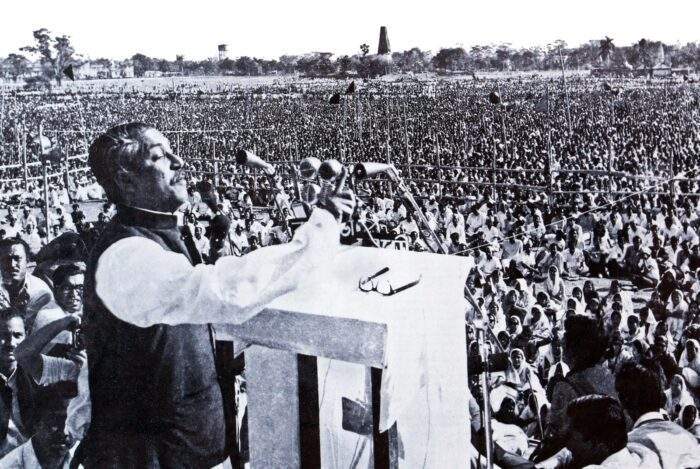
    One of the defining moments of the struggle for independence came on March 7, 1971, when Mujib addressed a massive gathering in Dhaka. The speech mobilized millions of Bengalis and effectively prepared the nation for the liberation struggle that followed. The conflict escalated after the Pakistani military launched a violent crackdown on March 25, 1971.

    Following nine months of war and enormous sacrifice, Bangladesh emerged as an independent state in December 1971. Mujib, who had been imprisoned in West Pakistan during the war, returned to a liberated homeland in January 1972 and soon became the country’s first prime minister.

    Historians and political analysts often describe Mujib as the “architect of independent Bangladesh,” a title reflecting his role in transforming Bengali political aspirations into a sovereign state. His lifelong struggle for political rights and his leadership during the liberation movement earned him the recognition of “Father of the Nation,” a designation given to leaders who play decisive roles in founding modern states.

    Why He Is Called the Father of the Nation

    The title “Father of the Nation” in Bangladesh reflects Mujib’s historic role in shaping the country’s national identity and guiding the movement for independence. Scholars argue that leaders receive such recognition when their leadership becomes instrumental in the birth of a nation and in the liberation of its people.

    In Bangladesh’s case, Mujib unified diverse social groups—students, workers, farmers, and intellectuals—under a shared political vision. Through decades of activism, imprisonment, and political mobilization, he transformed regional grievances into a powerful nationalist movement that ultimately led to independence.

    The Greatest Bengali of All Time

    Bangabandhu is frequently described by admirers and historians as the “greatest Bengali of all time.” The description reflects not only his political achievements but also his unique ability to connect with the aspirations of ordinary people.

    Observers note that while Bengal has produced many influential figures in literature, philosophy, and politics, Mujib’s role in establishing an independent nation-state distinguishes him historically. His leadership gave the Bengali people a sovereign homeland for the first time in modern history.

    Building a New State

    When Mujib assumed leadership of the newly independent country in 1972, Bangladesh faced immense challenges. Infrastructure had been destroyed by war, millions were displaced, and the economy was severely damaged.

    His government initiated reconstruction programs, restored basic administration, and began the process of building democratic institutions. Bangladesh adopted a constitution based on four fundamental principles—nationalism, democracy, socialism, and secularism—intended to guide the development of the new state.

    Bangabandhu’s Role in International Relations

    Bangabandhu also played a critical role in shaping Bangladesh’s early foreign policy. His guiding diplomatic principle—“friendship to all, malice toward none”—aimed to maintain balanced relations with global powers during the Cold War era.

    Under his leadership, Bangladesh quickly secured recognition from the international community and joined major global organizations including the United Nations and the Non-Aligned Movement. Mujib himself addressed the United Nations General Assembly in 1974 in Bengali, marking a historic moment for the country’s global presence.

    Diplomatic historians note that this approach allowed Bangladesh to establish cooperative relationships with a wide range of countries while safeguarding its sovereignty.

    A Legacy That Continues to Shape Bangladesh

    Bangabandhu’s legacy remains deeply embedded in Bangladesh’s national consciousness. His leadership inspired not only Bangladesh’s liberation movement but also broader anti-colonial struggles across the developing world. Scholars and policy experts have noted that his political vision and determination continue to influence contemporary debates about governance, development, and international cooperation.

    For many Bangladeshis, Bangabandhu symbolizes the enduring ideals of independence, dignity, and national unity. His life and leadership are often viewed as the foundation upon which the modern Bangladeshi state was built.

    More than fifty years after independence, the story of Bangladesh cannot be told without Bangabandhu Sheikh Mujibur Rahman. As the architect of the nation, the Father of the Nation, and a figure widely regarded as the greatest Bengali of all time, his legacy continues to shape the country’s identity and its place in the world.

    Dastagir Jahangir
    Editor, The Voice

  • Why March 7 Matters to Bangladesh

    Why March 7 Matters to Bangladesh

    History sometimes moves quietly, through slow negotiations and cautious reforms. At other moments it shifts in a single afternoon, when words spoken before a crowd transform the psychology of a people. The address delivered by Bangabandhu Sheikh Mujibur Rahman on March 7, 1971 stands as one of those rare turning points. For Bangladesh, the speech was not merely a political statement. It was the moment when a nation under domination found the moral courage, political clarity, and collective resolve to move toward independence.

    In early 1971 the political atmosphere in Pakistan had reached a breaking point. The general election of 1970 produced a decisive mandate for Sheikh Mujibur Rahman and the Awami League, who won an overwhelming majority in East Pakistan. Constitutionally, this meant Mujib should have led the federal government. Yet the transfer of power was blocked by a combination of political resistance from West Pakistani leaders and hesitation from the military authorities. The sudden postponement of the National Assembly session on March 1 triggered widespread anger across East Pakistan. Streets filled with protests, offices stopped functioning, and the region effectively entered a state of civil resistance.

    Against this tense backdrop, millions gathered at the Ramna Race Course in Dhaka on March 7. People came from every part of society—workers, farmers, students, professionals, and ordinary citizens. They arrived not simply to hear a speech but to understand the future. The population was confronting uncertainty: negotiations had stalled, repression seemed possible, and the path forward remained unclear.

    What Bangabandhu delivered that afternoon was a carefully calibrated message. He did not formally declare independence at that moment, yet the speech laid down a political and psychological roadmap for liberation. He called for continued non-cooperation with the Pakistani authorities while instructing citizens to prepare for a struggle that could become decisive. Administrative institutions, courts, and offices were urged to operate according to his directives rather than those issued from Islamabad. In effect, the speech shifted the center of authority from the colonial state to the leadership chosen by the people of East Pakistan.

    The genius of the speech lay not only in its political message but also in its emotional force. It transformed a deeply frustrated population into a disciplined movement. The call for readiness, unity, and sacrifice resonated across towns and villages. People who heard the speech directly or through radio broadcasts carried its message into daily life. Civil servants, students, and workers began to organize society in ways that anticipated an independent state.

    From the standpoint of political communication, the address remains extraordinary. The cadence of the language, the strategic pauses, and the mixture of resolve and restraint produced a powerful sense of collective identity. Rather than fueling chaos, the speech offered direction. Rather than encouraging despair, it strengthened confidence that the struggle for self-determination could succeed.

    The events that followed demonstrated the speech’s lasting impact. Within weeks the Pakistani military launched Operation Searchlight, a brutal campaign aimed at crushing the autonomy movement. The resistance that emerged across the country—the Liberation War of 1971—was carried forward by millions who had internalized the message delivered on March 7. For many freedom fighters, the speech served as both a moral compass and a source of courage during the long months of conflict.

    Internationally, the importance of the address has also been recognized. UNESCO later included the recorded speech in its Memory of the World International Register, acknowledging its historical significance and its influence on one of the twentieth century’s major struggles for independence.

    Today, the significance of March 7 goes far beyond party politics. It represents the moment when the aspiration for freedom became a shared national commitment. The speech united people across ideological, social, and regional differences under a single objective: the creation of a sovereign Bangladesh.

    For that reason, all political forces—regardless of their current disagreements—have a responsibility to respect the legacy of that day. National history does not belong to one party or one generation. It belongs to the entire people. The events of March 7 remind Bangladeshis that unity during moments of crisis can determine the destiny of a nation.

    Every country preserves certain historical moments that define its identity. For Bangladesh, March 7 is one of those defining moments. It symbolizes courage in the face of injustice, the power of collective action, and the enduring belief that the will of the people can overcome oppression.

    More than five decades after independence, the speech continues to serve as a reminder that the foundations of Bangladesh were built on sacrifice, unity, and an unwavering demand for dignity. Honoring March 7 is therefore not only about remembering the past. It is about reaffirming the principles that gave birth to the nation and ensuring that those principles continue to guide its future.

    Dastagir Jahangir
    Editor, The Voice

  • When Custody Becomes a Death Sentence

    When Custody Becomes a Death Sentence

    There is a line every state must never cross. It is the line between justice and cruelty, between lawful custody and silent execution. The death of former minister and freedom fighter Ramesh Chandra Sen inside a prison cell has forced Bangladesh to confront an uncomfortable truth: that line may already have been crossed.

    An 86-year-old man, frail, chronically ill, and unconvicted, spent his final months not under medical supervision or humane care, but behind bars—ultimately dying before help could reach him. The state may insist this was a “natural death.” But when a prisoner is brought to a hospital already dead, after months of alleged medical neglect, the word “natural” begins to ring hollow.

    Ramesh Chandra Sen was not a fugitive, nor a threat to public safety. He was arrested from his home, reportedly shackled and paraded before cameras, then denied bail despite his age and deteriorating health. Courts may argue procedure was followed. Jail authorities may cite formalities. But justice is not measured by paperwork alone—it is measured by humanity.

    The comparison many have drawn between Sen and Chief Adviser Dr. Muhammad Yunus is not political rhetoric; it is a moral mirror. Two men of the same age. Two former teachers. One lives in state protection, power, and dignity. The other died on a prison floor. If forcing an 86-year-old state leader into such conditions would rightly be called barbaric, why was it deemed acceptable for an elderly prisoner?

    Ramesh Chandra Sen is pictured being paraded before the media with his hands tightly bound with ropes after his arrest from his Ruhia residence on August 16, 2024.

    The interim government speaks often of insaf—justice—and fairness. Yet justice cannot survive where pre-trial detention becomes punishment, where bail is denied to the critically ill, and where prison healthcare fails so completely that a detainee dies before treatment even begins.

    Custody imposes a duty. The moment the state deprives someone of liberty, it assumes absolute responsibility for that person’s life. Failure to provide timely medical care is not an administrative lapse—it is a breach of that duty. When such failure leads to death, the question is no longer whether laws were followed, but whether conscience was abandoned.

    Equally troubling is what happened beyond the prison walls. Attacks on Sen’s family homes, forced displacement, intimidation, and fear reflect a climate where political transition has blurred into collective punishment. No accusation—proven or alleged—justifies extending suffering to families or allowing mobs to operate with impunity.

    Human rights groups have long warned that custodial deaths in Bangladesh are not isolated incidents. When elderly detainees die in growing numbers, when illnesses are left untreated, when deaths are explained but never independently investigated, a pattern emerges. And patterns demand accountability.

    This moment is a test. Not of ideology, not of political loyalty, but of the state’s moral compass.

    If Bangladesh is to claim justice, it must ensure that custody does not become a slow, invisible death sentence. It must guarantee that age, illness, and human dignity are not erased by political hostility or bureaucratic indifference. And it must answer, clearly and credibly, why an 86-year-old man died alone in its care.

    A system is judged not by how it treats the powerful, but by how it treats the powerless—especially when their freedom has already been taken away.

    Ramesh Chandra Sen’s death leaves behind a question that cannot be buried with him:
    How humane is a justice system that allows an elderly prisoner to die before help arrives—and calls it order?

    That question will not fade quietly. Nor should it.

  • Legal Reform or Ideological Shift? Polygamy, Power, and the Direction of Bangladesh

    Legal Reform or Ideological Shift? Polygamy, Power, and the Direction of Bangladesh

    A recent observation by the High Court has reopened an old and sensitive debate in Bangladesh. According to the court, under Muslim family law, a man does not require the consent of his first wife to contract a second marriage. Approval from the local Arbitration Council is deemed sufficient. While the ruling is framed as a legal clarification, its wider social and political implications cannot be ignored.

    For decades, it was widely understood that contracting a second marriage without the consent of the first wife could lead to criminal liability. Section 494 of the Penal Code provides for imprisonment of up to seven years for bigamy. This strict provision was later moderated with the enactment of the Muslim Family Laws Ordinance in 1961, which introduced a regulatory framework for second marriages among Muslims. Under the Ordinance, a husband may contract a second marriage only with the prior permission of the Arbitration Council, and failure to obtain such permission attracts a comparatively lighter penalty of up to one year’s imprisonment and a fine of up to ten thousand taka. In practice, the requirement of the first wife’s consent act as a safeguard for women’s rights and dignity within marriage. The recent interpretation weakens that safeguard and raises serious concerns about the future of gender justice in the country.

    This legal shift has not occurred in isolation. Since August 5, 2024, the influence of Islamist forces within state power and public life has become increasingly visible. Jamaat-e-Islami Bangladesh, though not formally in office, is widely perceived to be exercising influence through the interim government. Policies and reform agendas emerging during this period reflect ideological priorities that align closely with conservative religious politics rather than constitutional equality.

    Parvez Hashem

    One of the most affected areas has been reform initiatives, including quota restructuring. These changes have disproportionately impacted women and indigenous communities, groups that have historically relied on protective quotas to access education and employment. For Islamist fundamentalist politics, these communities are often viewed as obstacles to a rigid social order. The rollback or dilution of such protections signals a deeper intent that goes beyond administrative reform.

    There are also reports that the interim government is considering including provisions to list multiple wives’ names on the National Identity Card. If implemented, this would not merely recognize polygamy but actively normalize and promote it through state documentation. Such a move would mark a significant departure from the constitutional promise of equality and could institutionalize discrimination against women under the guise of administrative convenience.

    Supporters of these changes argue that reforms should continue and that the current Jamaat backed Yunus led interim arrangement deserves more time. They claim that these policies address grievances faced by men and reduce what they describe as “male oppression.” However, framing gender justice as a zero-sum conflict between men and women is both misleading and dangerous. Expanding rights for one group by shrinking protections for another undermines the very idea of justice.

    In Bangladesh, there is a long standing practice of multiple marriages by men across society, from rural to urban areas and from poor to wealthy households. Although often justified as tradition or religion, this practice has deep social consequences. Legal provisions that allow multiple marriages tend to normalize and encourage the behavior, rather than regulate it. In reality, multiple marriages frequently result in emotional neglect, economic insecurity, and physical and psychological violence against women. The power imbalance created by this system leaves many women with little choice but to accept injustice, fearing social stigma, abandonment, or poverty. Instead of protecting families, the continuation of multiple marriage provisions reinforces patriarchal control and increases vulnerability and violence against women.

    Globally, multiple marriage, or polygamy, is legally recognized in around fifty countries, mostly across parts of Africa, the Middle East, and South Asia. In most cases, it is permitted under Islamic law or customary legal systems and usually allows a man to marry more than one wife, often up to four, subject to certain conditions. However, even among these countries, the practice is frequently regulated through court approval, consent requirements, or economic capacity tests. By contrast, the vast majority of countries in Europe, the Americas, and East Asia strictly prohibit polygamy under criminal law, viewing it as incompatible with gender equality and modern civil rights frameworks. This global contrast highlights how laws on marriage often reflect deeper ideological, religious, and constitutional choices made by states.

    Bangladesh was founded on secular, democratic, and egalitarian principles. Legal reforms, especially in personal law, must be guided by constitutional values, not ideological pressure. The growing influence of Islamist politics in lawmaking and governance risks pushing the country away from those foundational commitments.

    The question is no longer only about polygamy or family law. It is about the direction in which the state is moving, who benefits from these reforms, and who is being left more vulnerable than before. A democratic society must debate these issues openly, critically, and without fear. Silence now may shape a future that is difficult to reverse.

    Writer:Parvez Hashem, Lawyer and Human Rights Defender.

  • The Bengali Statehood and the Tragedy of Ideological Dissonance

    The genesis of Pakistan as a state was rooted in the “Two-Nation Theory,” a construct where Muslim leaders of undivided India sought a separate homeland. Long before 1947, the Muslims of Bengal had expressed a similar desire for a distinct administrative space during the Partition of Bengal in 1905. However, that move was eventually annulled due to intense pressure from the educated liberal elite of the time—a pivotal chapter known as the Banga Bhanga Rod (Annulment of Partition).

    History eventually took its course, and Pakistan emerged as an artificial state built on religious identity. Even today, the majority of Pakistanis hold onto that founding ideology with a sense of nationalistic pride. Yet, the irony lies in the journey of the people of then East Pakistan. Rejecting the hollow promises of a religion-based state, the Bengalis rallied behind the historic Six-Point program of the Father of the Nation, Bangabandhu Sheikh Mujibur Rahman.

    This defiance culminated in a bloody and inhumane liberation war. At the cost of a staggering 30 lakh (3 million) lives, Bangladesh emerged as a sovereign nation. These martyrs did not just give their lives for a map; they died for four fundamental pillars: Nationalism, Socialism, Democracy, and Secularism.

    Dastagir Jahangir

    However, the post-independence tragedy is that a significant portion of this population seems to harbor a subconscious rejection of that very sovereignty. While Pakistanis remain loyal to their state’s core philosophy, many Bengalis appear to hold a deep-seated apathy—or even hostility—toward the foundational values of their own country. Despite the Awami League delivering independence and later steering the nation through a period of unprecedented developmental success from 2008 to 2024, a structural vacuum remained.

    The state failed to secure a deep-rooted ideological loyalty within its vital institutions—the bureaucracy, the judiciary, and even the armed forces. It remains a profound tragedy that material progress could not bridge the gap in national character.

    This mirrors the history of Afghanistan’s transition from monarchy to socialism. The Afghan society was not ready for a progressive socialist framework; instead, they clung to religious extremism as their preferred alternative. Today, they pay a heavy price for that choice.

    Unfortunately, it appears that ninety percent of our population is now infected with a similar ideological virus. When a nation begins to despise the very pillars it was built upon and disrespects the architect of its freedom, the path to redemption becomes narrow. We are witnessing a societal shift where the virus of extremism is overshadowing the spirit of 1971, and the possibility of an easy escape seems increasingly remote.

    Writer:Dastagir Jahangir, Editor, The Voice