
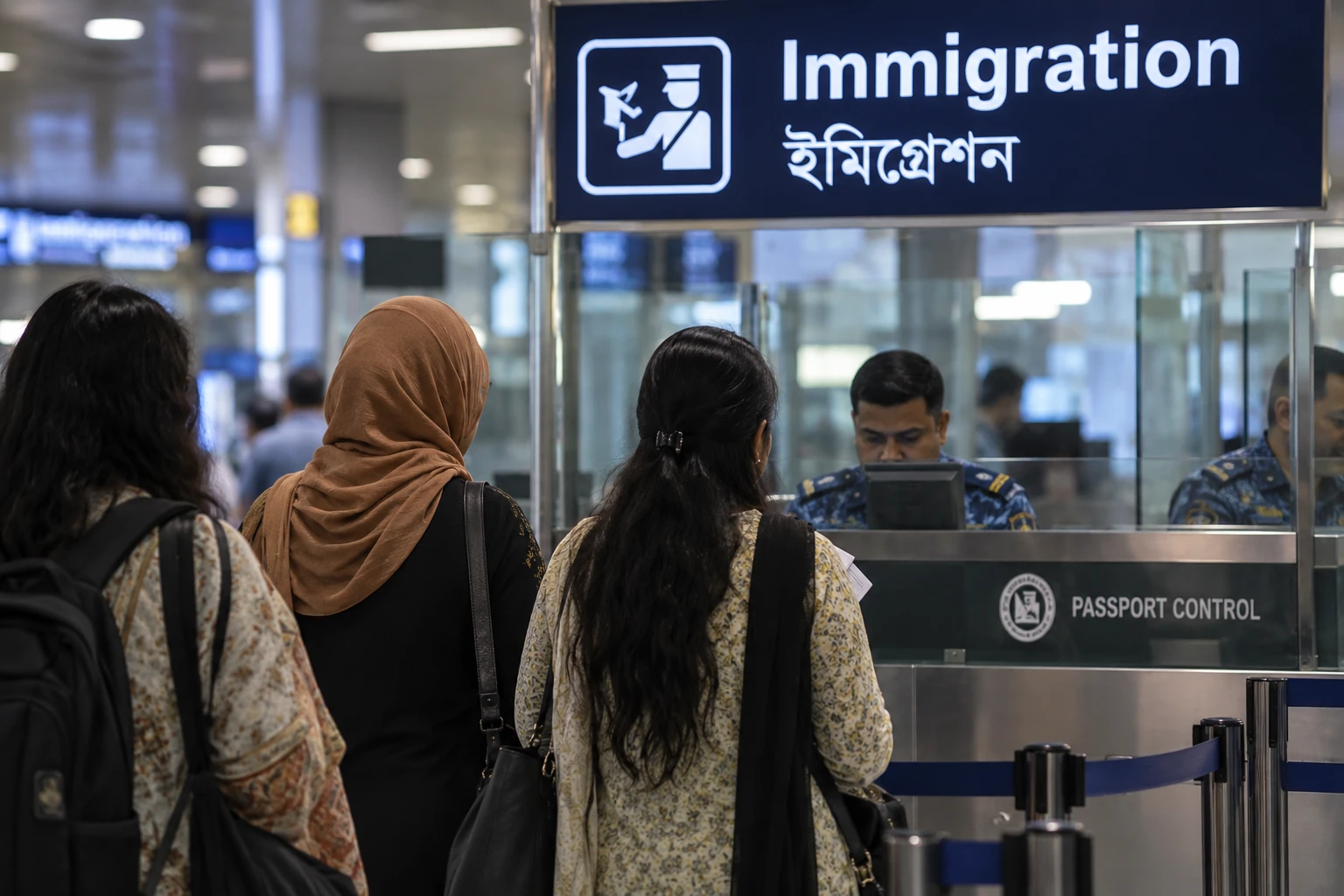
The High Court has questioned whether immigration authorities can restrict an adult woman’s lawful foreign travel because she is unmarried, traveling without a parent or guardian, or lacks her family’s consent, and has sought guidelines against such gender-based barriers.
The rule was issued Tuesday, Sept. 29, after three adult women challenged their treatment at Hazrat Shahjalal International Airport, where they were prevented from traveling to Nepal despite having valid passports, visas or entry permits and airline tickets.
A bench of Justice K.M. Kamrul Kader and Justice Fatema Anwar asked why authorities should not be directed to formulate and issue appropriate guidelines so adult female citizens are not prevented from legally traveling abroad solely because they are unmarried, traveling without guardians or on similar gender-based grounds.
The court also asked why the decision to stop the three petitioners from leaving Bangladesh should not be declared without lawful authority.
The three women — Rifa Tamanna, Sohani Islam Somapty and Najnin — went to Dhaka airport on Aug. 8 for a trip to Nepal, according to their lawyer, Ishrat Hasan.
Hasan said the women were adults, had the required travel documents and were not subject to any criminal case or court order restricting their travel.
At immigration, however, officials questioned them about why they were unmarried and whether their families had consented to their trip, according to Hasan. The officials also contacted their homes before refusing to let them pass immigration, she said.
The women were not given a reason for being prevented from traveling, Hasan said. They also suffered financial losses from airline tickets and other travel bookings.
The petitioners lodged a complaint with the additional inspector general of police for immigration on Aug. 31, seeking an investigation, preservation of CCTV footage, action against those responsible and compensation. After receiving no response, they sent a legal notice to the authorities on Sept. 6 and filed the writ petition with the High Court on Sept. 15.
The High Court directed the additional IGP concerned to dispose of their complaints and take necessary measures within seven days, and to submit a compliance report to the court.
It also directed immigration authorities not to prevent the three women from traveling abroad in the future unless there is a lawful basis for doing so.
The home secretary, inspector general of police, additional IGP of immigration police, director of immigration police, officer-in-charge of immigration at Hazrat Shahjalal International Airport and immigration officials involved in the incident were made respondents. They were asked to respond to the rule within four weeks.
In their petition, the women argued that marital status, traveling without parents or guardians, or whether a family knows about an adult woman’s trip cannot independently constitute legal grounds for restricting her foreign travel.
They alleged that such treatment violated constitutional protections on equality, non-discrimination, personal liberty and freedom of movement.
Article 27 of Bangladesh’s Constitution guarantees equality before the law and equal protection of the law. Article 28 prohibits discrimination against citizens solely on grounds including sex, while Articles 31 and 32 provide protections relating to law and personal liberty.
Article 36 provides that, subject to reasonable restrictions imposed by law in the public interest, every citizen has the right to move freely throughout Bangladesh, reside and settle anywhere in the country, and leave and re-enter Bangladesh.
The petition sought directions to prevent female travelers from being questioned or obstructed at immigration merely over their marital status, absence of a parent or guardian, or family consent.
Hasan represented the petitioners, assisted by lawyer Tanzila Rahman Jui. Additional Attorney General Mohammad Arshadur Rouf and Deputy Attorney General Mohammad Abdus Samad Azad represented the state.

COMMENTS