
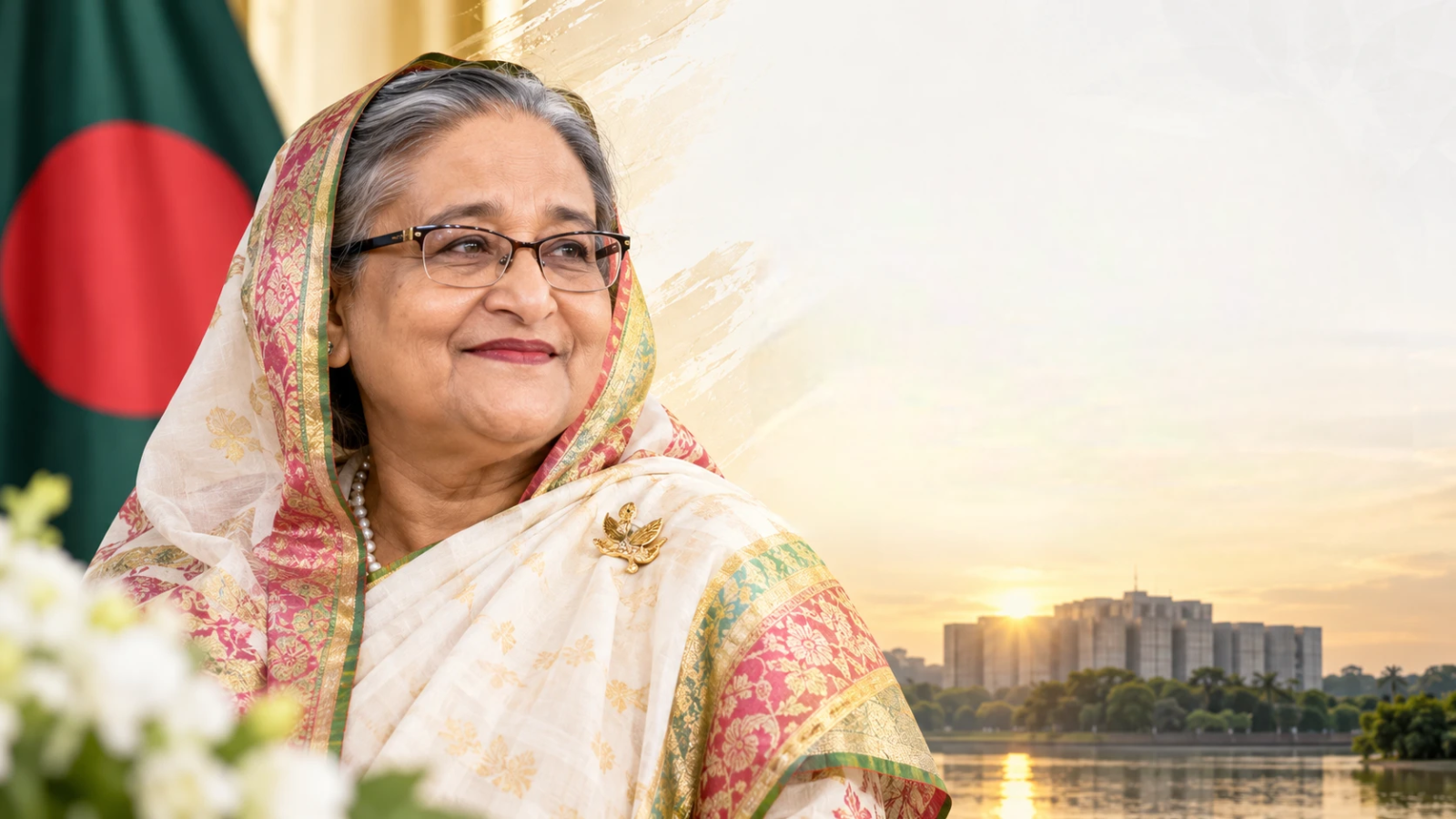
On her 79th birthday today, Sheikh Hasina remains physically away from Bangladesh, having lived in India since her departure from the country in August 2024. Yet her name continues to occupy an unusually prominent place in Bangladesh’s political discourse. For her supporters, she remains the “Leader of Trust”—a leader whose long tenure in office is closely associated with economic transformation, major infrastructure projects, social development and a strong state response to terrorism and militancy.
Her political position, however, has changed fundamentally since the days when she occupied the Prime Minister’s Office. Bangladesh has gone through the upheaval of 2024, an interim administration, and a parliamentary election in February 2026 that brought the BNP back to power under Tarique Rahman.
Against this dramatically altered political landscape, Sheikh Hasina has remained in India. In 2026 she has repeatedly spoken publicly about returning to Bangladesh. In July, she told Reuters that she and senior Awami League figures intended to return around December and surrender before the courts. In August, she again said she wanted to return in December, despite the legal consequences she faces in Bangladesh.
The political atmosphere surrounding that possible return is sharply contested. The Awami League’s political activities have been banned, while Sheikh Hasina faces a death sentence in Bangladesh following a trial in absentia. She has rejected the proceedings and described the verdict as politically motivated. These are contested political and legal claims, and the question of her return has also become an important issue in Bangladesh-India relations.
But to understand why Sheikh Hasina continues to command strong loyalty among crores of Bangladeshis, one must also look back to the beginning of her political journey.
It was a soothing afternoon in May 1981 when an Indian Airlines aircraft carrying Sheikh Hasina from New Delhi via Kolkata touched down at Kurmitola Airport in Dhaka at around 4:30pm. She had returned to a country still carrying the wounds of the assassination of her father, Bangabandhu Sheikh Mujibur Rahman, and most members of her family.
Thousands gathered to receive her. Contemporary accounts describe enormous crowds along the route from Kurmitola towards Farmgate. She returned not simply as the daughter of Bangabandhu, but as a political figure who had accepted the responsibility of carrying forward her father’s political legacy.
Earlier that year, at the Awami League national council held on 14–16 February 1981, she had been elected party president in her absence. Her return on 17 May marked the beginning of a political journey that would eventually make her one of the longest-serving political leaders in Bangladesh’s history.
For supporters, that journey is inseparable from the transformation Bangladesh experienced during her years in government.
Under Sheikh Hasina, Bangladesh pursued large-scale infrastructure and development programmes, including the Padma Bridge, Dhaka Metro Rail, Karnaphuli Tunnel and the Rooppur Nuclear Power Plant. Bangladesh also achieved graduation from the UN’s least developed country category, although the graduation process and its economic implications remain part of the country’s continuing policy debate.
The Padma Bridge became perhaps the most powerful symbol of that development narrative. Built with domestic financing after the government decided to proceed without World Bank financing, it came to represent, for her supporters, an assertion of national confidence and state capacity.
Her governments also pursued Digital Bangladesh, Vision 2021, the Delta Plan 2100 and Vision 2041. The broader ambition was to move Bangladesh from a lower-income developing economy towards a high-income, technologically advanced and more resilient country.
The economic record of the Hasina years therefore deserves to be viewed in both historical and contemporary perspective.
Bangladesh averaged around 6 percent annual GDP growth over the decade preceding the recent slowdown, while poverty reduction, export expansion, remittance growth and industrialization substantially changed the country’s economic structure. The World Bank notes that services now account for more than half of GDP, industry about 34.9 percent and agriculture about 11.7 percent.
Yet the Bangladesh of 2026 is facing a very different economic reality.
The IMF reported that GDP growth slowed to 3.7 percent in FY2025 from 4.2 percent in FY2024 and 5.8 percent in FY2023. It projected 4.7 percent growth for FY2026 while warning that inflation would remain elevated at around 8.9 percent. The World Bank has been somewhat more cautious, projecting 3.9 percent growth for FY2026 and highlighting inflation, poverty, weak private investment and financial-sector stress as major challenges.
At the same time, the external sector has shown important signs of improvement. Bangladesh Bank data indicate that gross foreign-exchange reserves rose above $37 billion in August 2026, while remittances reached about $2.97 billion in August, around 22.5 percent higher than a year earlier. The overall balance of payments recorded a $6.61 billion surplus in FY2025–26.
These figures illustrate a Bangladesh that is neither the economy of the earlier Hasina years nor an economy in collapse. It is an economy undergoing a difficult adjustment, with stronger external buffers but persistent inflation, investment weakness, banking-sector vulnerabilities and pressure on household purchasing power.
That economic context has also become part of the political debate over the legacy of the previous government.
For her supporters, Sheikh Hasina’s years in office represent stability, infrastructure-led development, economic expansion and the assertion of Bangladesh’s strategic interests. Critics, meanwhile, point to questions surrounding democratic institutions, elections, human rights and the concentration of political power during her later years in office. These competing interpretations remain central to the country’s political debate.
Her record on combating terrorism and militancy is another important part of her political legacy. Her government adopted a firm security policy against militant organizations, and Bangladesh subsequently developed a reputation for taking a strong position against violent extremism. At the same time, human-rights organizations and political opponents have raised serious criticisms regarding the conduct of the state during her tenure. Any assessment of her legacy therefore requires recognition of both the development record and the controversies surrounding governance.
The present political environment is markedly different.
The BNP-led government now governs Bangladesh after the February 2026 election, while the Awami League remains outside the formal political process. Sheikh Hasina’s continuing presence in India, her statements about returning, the legal proceedings against her and the future of the Awami League have consequently become intertwined with questions about Bangladesh’s political reconciliation, institutional stability and relations with India.
Sheikh Hasina herself has made clear that she does not intend to remain permanently outside Bangladesh. In her public statements in 2026, she has said that she is prepared to face arrest, imprisonment or other legal consequences if she returns. She has also argued that the Awami League cannot simply be erased from Bangladesh’s political history.
Whether and how such a return takes place remains a matter of political and legal uncertainty. But the fact that the question of her return continues to generate intense debate demonstrates that her political presence has not disappeared with her physical absence. Indeed, now, from India, she faces perhaps the most uncertain chapter of her political life.
For those who call her the “Leader of Trust,” her absence is not merely the absence of a former prime minister; it represents the absence of a political figure around whom an entire generation built its expectations of Bangladesh’s future.
For Bangladesh, however, the larger question is how the country’s competing political memories, economic aspirations and institutional realities can ultimately be reconciled.
Happy Birthday, Sheikh Hasina.
Your political journey remains inseparable from the story of modern Bangladesh—and the debate over that journey is far from over.

COMMENTS