
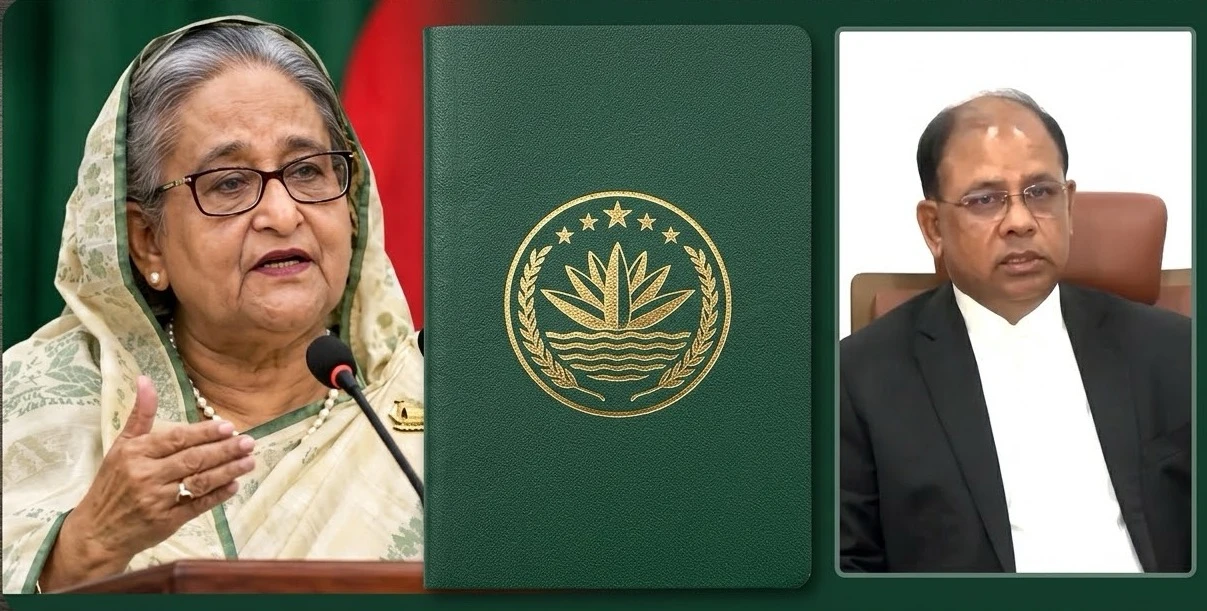
Misreading the Law? The ICT Chief Prosecutor’s Controversial Claim on Sheikh Hasina’s Passport Rights
by Parvez Hashem
The recent remarks by International Crimes Tribunal Chief Prosecutor Md Aminul Islam regarding the possibility of issuing a passport or travel document to former Prime Minister Sheikh Hasina raise an important question about the interpretation of Bangladesh’s passport laws.
The Chief Prosecutor has argued that the government has no legal authority to issue a passport or travel document to Sheikh Hasina, citing Articles 6 and 7 of the Bangladesh Passport Order, 1973. He has also suggested that her return to Bangladesh must take place through the extradition process. These remarks deserve closer examination against the actual language of the law.
Article 5(2) of the Bangladesh Passport Order, 1973, provides that the passport authority, after making necessary inquiries, may issue a passport or travel document, refuse the application, or restrict the countries endorsed on the document, subject to the provisions of the Order. This provision establishes the legal framework for issuing both passports and travel documents.
The distinction between the words used in the legislation matters. Article 6(1) states that the passport authority may refuse to issue a passport or travel document on specified grounds. The word “may” is significant. It gives the authority discretion to consider an application under the circumstances described in the law. It does not automatically establish an absolute prohibition in every case.
Article 6(1)(c) concerns an applicant convicted in Bangladesh within the preceding five years of an offence involving moral turpitude and sentenced to imprisonment for at least two years. Article 6(1)(e) addresses applicants who are evading or are likely to evade proceedings in a criminal court, or against whom a court has issued an order prohibiting departure from Bangladesh.
These provisions must be read carefully. A legal restriction on issuing a passport is not necessarily equivalent to a complete absence of government authority to consider or issue a travel document.
The Law Must Be Read as Written, Not as Interpreted for Convenience
Article 6(2), however, requires a passport or travel document to be refused if the government considers its issuance contrary to the public interest. This is an important qualification. The government cannot simply ignore the statutory provisions. Equally, the Chief Prosecutor cannot turn a discretionary provision into an unconditional legal prohibition.
Article 7 deals with the impounding or revocation of an existing passport or travel document. It identifies specific circumstances in which such action may be taken, including certain criminal convictions and considerations of national security or public interest. The revocation of an existing passport, therefore, is a separate legal matter from the consideration of a fresh application for a passport or travel document.
There is another important distinction. Sheikh Hasina is currently outside Bangladesh. Article 6(1)(e), concerning evasion of pending criminal proceedings or a court order prohibiting departure, must be examined in its actual legal context. It should not be casually treated as an automatic and permanent disqualification from receiving travel documentation.
The Chief Prosecutor’s argument also raises a question about the relationship between the criminal justice process and the government’s administrative authority. A conviction carries legal consequences, and the government must respect judicial decisions. However, the interpretation and application of passport legislation remain matters of law. Political considerations, public statements and assumptions cannot replace statutory interpretation.
The extradition process is one possible legal route for bringing Sheikh Hasina back from India. However, the existence of an extradition arrangement does not, by itself, establish that the government has no authority to consider any other lawful mechanism for issuing travel documentation.
This is particularly important because a travel document can serve different purposes. It may facilitate a person’s return to their country of citizenship without necessarily granting them freedom from criminal proceedings or immunity from punishment. Issuing such a document would not cancel a conviction, overturn a court judgment or prevent the authorities from enforcing lawful judicial orders.
The government must consider any application in accordance with the law, the relevant court orders and the applicable public interest provisions. If it refuses an application, it should provide a legally sustainable explanation.
The question is not whether Sheikh Hasina should be exempted from accountability. Nobody should be above the law, regardless of political position or former office. The question is whether the government possesses legal authority to consider issuing her a passport or travel document.
The Chief Prosecutor’s categorical assertion that there is no legal scope deserves reconsideration. Article 6 distinguishes between discretionary grounds for refusal and mandatory grounds for refusal. That distinction cannot be ignored.
In a country governed by the rule of law, legal provisions must be interpreted according to their actual wording. Public officials, particularly those holding senior positions in the prosecution, have a responsibility to explain the law accurately.
Justice must be administered through lawful procedures, not through selective interpretations of legislation. The rule of law requires accountability, but it also requires accuracy, fairness and respect for the law itself.
Parvez Hashem, Lawyer and Human Rights Defender






COMMENTS