
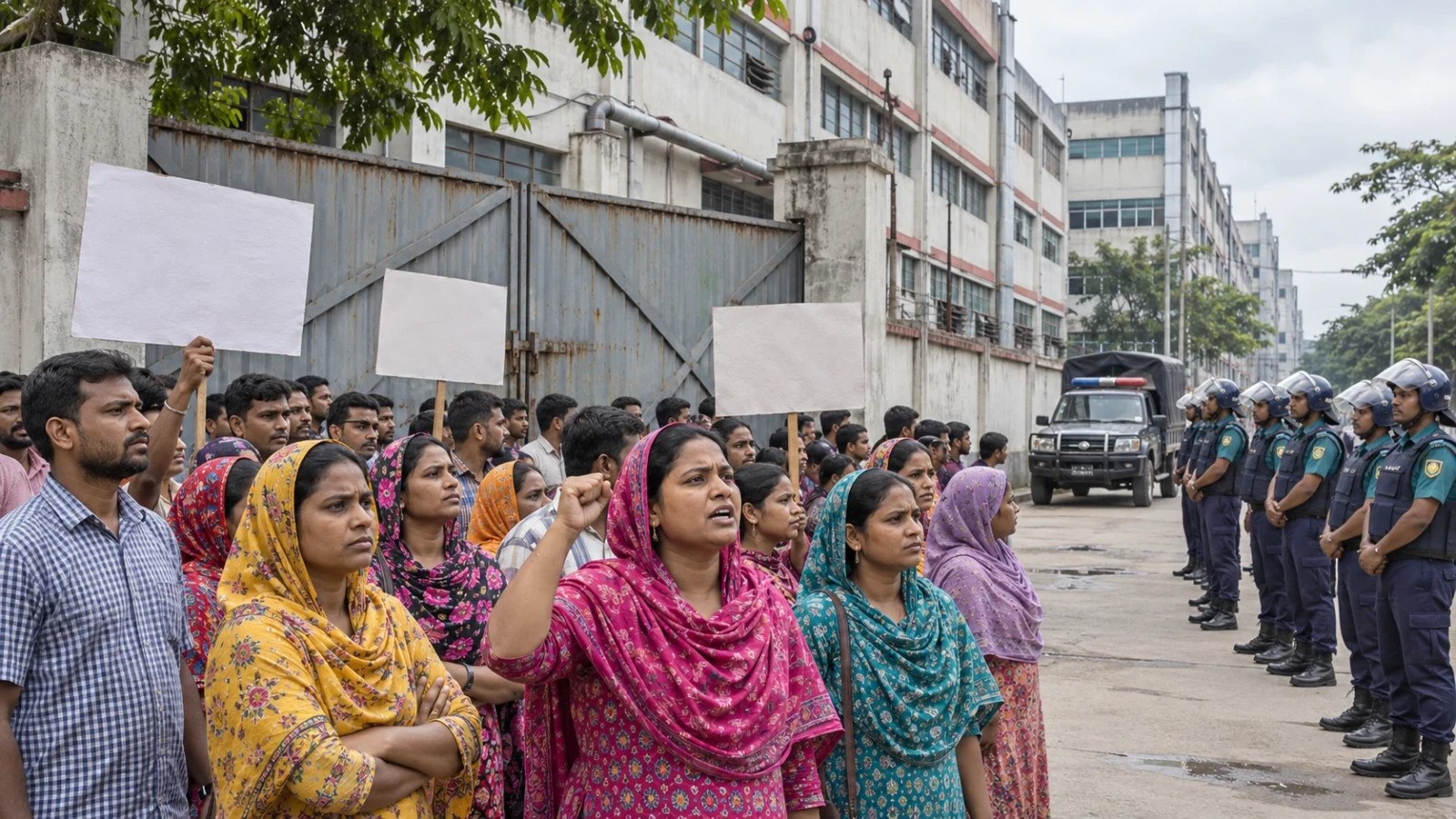
DHAKA — Garment factory owners in Bangladesh are considering an indefinite closure of 210 factories in Ashulia, Jamgora and Hemayetpur in Dhaka district amid ongoing labour unrest and disruptions to production.
The preliminary decision was taken at an emergency meeting of industry leaders on Wednesday, November 11. A final decision is expected at a meeting of all members on Saturday, November 14.
Shovon Islam, managing director of Sparrow Group, confirmed on Thursday that factory owners had agreed in principle to the proposed closures following discussions among industry leaders. He said the final decision would be announced after Saturday’s meeting.
According to industry sources, production was suspended at 143 garment factories in Ashulia, Jamgora and Hemayetpur on Wednesday. In several factories, workers reported for duty but refused to work. Some punched their attendance cards before leaving, while others staged work stoppages. Reports of vandalism also emerged from several facilities.
Production has reportedly remained suspended for as many as 11 consecutive days at some factories.
Meanwhile, seven garment factories in Savar and Ashulia have already been declared closed indefinitely under Section 13(1) of the Bangladesh Labour Act, 2006. These include three factories owned by Arunima Group, three by Newage Group and one operated by Jeans Manufacturing Company Limited.
A senior leader of the Bangladesh Knitwear Manufacturers and Exporters Association (BKMEA) said factory owners were increasingly concerned about the financial implications of prolonged production disruptions.
BNP Leader Shot Dead in Khulna Shortly After Law and Order Meeting
With workers refusing to work in some factories and incidents of vandalism reported elsewhere, maintaining normal operations had become increasingly difficult, the leader said, adding that owners were also worried about how to pay workers’ wages when production remained suspended.
Workers continue protests over minimum wage
Meanwhile, demonstrations demanding higher minimum wages continued in several industrial areas on Thursday.
In the Mouchak area of Kaliakair, Gazipur, workers from several factories blocked the Dhaka-Tangail Highway in the morning, bringing traffic to a standstill and causing lengthy congestion.
Police and Border Guard Bangladesh (BGB) personnel later used sound grenades to disperse the demonstrators, allowing traffic to resume.
Factory owners subsequently declared holidays at eight to nine factories in Mouchak and surrounding areas.
In Ashulia, workers at several factories in Jamgora and Narsinghpur also staged work stoppages instead of joining production. Factory authorities later announced general holidays at the affected facilities.
However, industrial police said production remained normal in most factories across Ashulia.
Mohammad Mominul Islam Bhuiyan, superintendent of Industrial Police-1, said most workers had joined their workplaces on Thursday, although employees at a few factories left after marking their attendance.
He added that law enforcement agencies continued patrols and surveillance to maintain order in the industrial zones.
Wage negotiations fail to ease tensions
The labour unrest comes amid ongoing negotiations over a proposed increase in the minimum wage for garment workers.
The government formed a new minimum wage board on November 1 following workers’ demands for higher pay. At the board’s second meeting, the workers’ representative proposed setting the monthly minimum wage at Tk 32,000.
The employers’ representative said the owners’ proposal would be presented at the next meeting.
The board’s third meeting is scheduled for Monday, November 16, when the employers are expected to submit their written wage proposal. Discussions will also cover minimum wage levels for different categories of workers and employees.
Despite the formal negotiation process, sections of the workforce continue to demand a swift decision and its implementation.
BGMEA President Mahmud Hasan Khan said wage negotiations could not continue alongside disorder and disruption at factories.
He stressed that factory discipline and normal production must be restored, warning that owners would take necessary decisions in the industry’s interests if the situation failed to improve.
Garment industry faces mounting economic risks
The prolonged confrontation between workers and factory owners is creating mounting pressure across Bangladesh’s garment industry, one of the country’s major export-earning sectors.
Workers are losing working days and income as production remains suspended. Factory owners, meanwhile, must continue paying rent, utility bills, bank loan instalments, security expenses and other operational costs even when production stops.
The disruption has also raised concerns over international buyers’ orders. Failure to manufacture and deliver products on schedule could prompt overseas buyers to demand discounts, cancel orders or shift future business to competing countries.
Major garment manufacturers operating in the Ashulia and Savar areas include Ha-Meem, Newage, Ananta Garments, Sterling, Envoy, Islam and Decor. According to BGMEA data cited in the report, approximately 300,000 workers are employed in these industrial areas.
If the proposed closure of 210 factories goes ahead, the livelihoods and employment of a significant number of workers could be put at risk.
Shovon Islam warned that shifting production to other factories through subcontracting would not necessarily resolve the problem, as international buyers often impose specific requirements regarding designated factories, production processes and quality control.
Failure to meet delivery deadlines could force manufacturers to ship products by air at additional expense or even face order cancellations, he added.
The proposed shutdowns underscore the growing tension between garment workers and manufacturers at a time when the industry is already facing mounting pressure to maintain production, protect export orders and reach an agreement over wages.

COMMENTS