
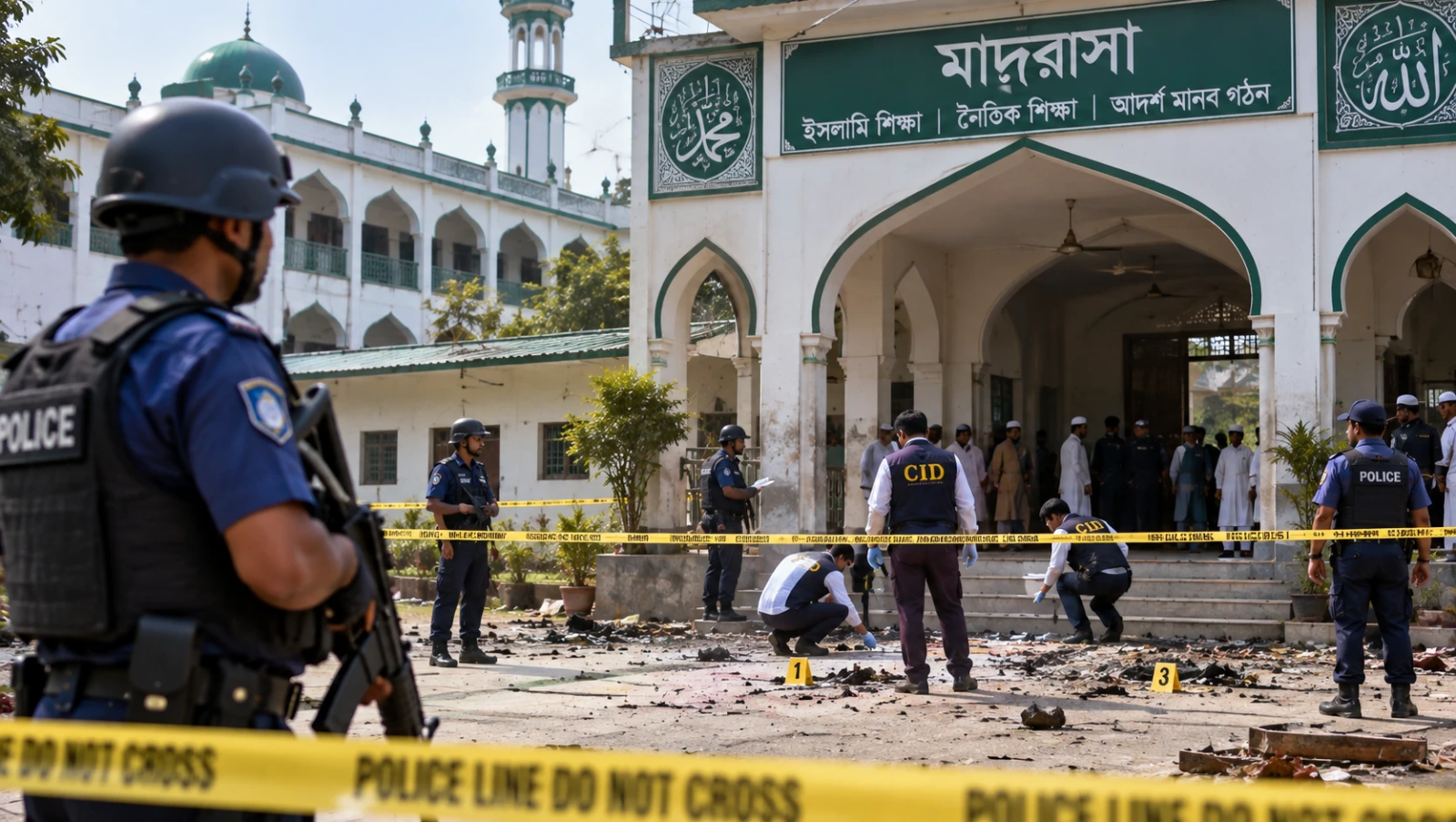
A string of unsettling incidents involving arms and explosives in and around mosques and madrasas in Bangladesh can no longer be dismissed simply as isolated criminal incidents. Taken together, they raise a larger question about the country’s changing security environment: why are weapons and explosives turning up in places meant for prayer and learning?
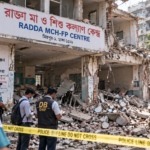
A pistol, two magazines and 20 rounds of ammunition, reportedly looted from Araihazar Police Station during the mass uprising of August 2024, were later recovered from a mosque near the same police station. A hand bomb reportedly exploded in the living quarters of a mosque imam in Madaripur. In December 2025, a serious explosion occurred at the Ummul Qura International Madrasa on the outskirts of Dhaka. Then, in August 2026, a crude bomb reportedly exploded near Darussunnah Women’s Madrasa in Kalkini.
The incidents demand answers that go well beyond the explosions themselves. Who brought the weapons there? How were the explosives acquired, manufactured or stored? Who had access to them, and why were such materials present inside or around religious and educational premises? An explosive device does not normally appear by accident. Its presence points to a chain of acquisition, movement, possession and, potentially, preparation. That entire chain—not merely the final blast—must be traced.
Bangladesh has confronted Islamist militancy before, most painfully in the 2016 Holey Artisan Bakery attack, after which security agencies dismantled several militant networks. Yet the threat did not necessarily disappear. The European Union Agency for Asylum noted in 2025 that groups including Ansar al-Islam, HuJI and Neo-JMB remained active, alongside regional networks linked to al-Qaeda and Islamic State, while reporting heightened organisational activity following August 2024. Regional counter-terrorism assessments have similarly pointed to attempts by extremist networks to rebuild, recruit online and restore international links.
The Ummul Qura incident therefore warrants particularly careful scrutiny. A February 2026 study by the S. Rajaratnam School of International Studies suggested that the site could have been used by militants for bomb-making. That possibility is serious, but it must ultimately be established through forensic, financial and investigative evidence rather than assumption.
A Vast Religious Network, Politics and the Question of Oversight
The scale of Bangladesh’s religious education sector makes the security question even more significant. In July 2026, the Education Minister told Parliament that the country has roughly 25,000 Qawmi madrasas serving around seven million students, alongside millions more studying in affiliated institutions. According to the Bangladesh Qawmi Madrasah Education Board (BEFAQ), Bangladesh accounts for a substantial share of the world’s Qawmi madrasa students.
Such a vast network inevitably raises questions of governance and security oversight. Who is responsible for security on these premises? What mechanisms exist to identify suspicious activity? How are weapons or dangerous materials prevented from entering educational compounds? And, more importantly, can legitimate religious institutions be protected without turning an entire community into an object of suspicion?
The political landscape has also changed significantly. Jamaat-e-Islami, once subject to severe legal restrictions, has returned to open political activity, while Islamist political forces have become more visible in the post-2024 environment. In August 2026, Hefazat-e-Islam was reported to be seeking cooperation with seven Qawmi-oriented political parties, even as differences over relations with Jamaat remained.
Political mobilisation, religious organisation and militancy are not synonymous and must never be treated as such. Jamaat’s own filings with the Election Commission reportedly showed income of about Tk 23.68 crore and expenditure of about Tk 23.92 crore in 2025, with substantial reserves, while its reported election expenditure during the February 2026 polls was around Tk 4.49 crore. These declared figures should not automatically be treated as a complete picture of actual financial activity, but neither do they by themselves establish wrongdoing. Political parties have the right to raise and spend funds lawfully. What matters is transparency—particularly where religious networks, political financing and large-scale mobilisation intersect.
The Deeper Threat: Normalisation and Transnational Links
The most difficult threat to detect may not be a bomb or a firearm, but the gradual normalisation of intolerance. When dissent is treated as hostility to faith, cultural activities are portrayed as insufficiently religious, women face pressure over their participation or appearance, or minorities are portrayed as outsiders, the social space in which radicalisation can take root may widen long before violence occurs.
The United Nations has repeatedly highlighted young people’s vulnerability to online radicalisation and stressed that effective prevention requires more than policing. Education, civic participation, social inclusion and resilient communities are equally important.
Nor is Bangladesh’s militant history entirely domestic. Bangladeshi extremist organisations have previously maintained ideological and, in some cases, operational links with transnational jihadist networks. The US State Department has documented links involving HuJI-B and al-Qaeda, while the EU’s recent assessments have pointed to the continuing presence of al-Qaeda- and Islamic State-linked activity in the country. At the same time, ordinary religious, educational or diplomatic contacts with organisations or individuals abroad should never be conflated with terrorism. Genuine links must be established through evidence—financial trails, communications, travel records, training and operational connections.
The public therefore deserves clear answers. If the recent incidents are unrelated, that should be established transparently. If they are connected, the network behind them must be identified and prosecuted. If security failures allowed weapons or explosives to enter religious premises, those failures must be addressed.
Mosques and madrasas are places of worship and education for millions of Bangladeshis. They deserve protection, not collective suspicion. At the same time, religious identity cannot become a shield for criminal activity, just as opposition to extremism must never become hostility towards religion itself.
The recovered weapons and the explosions may be only the visible edge of a deeper security question. The real story lies behind them: who acquired the weapons, who moved them, who financed them, who prepared them, and what they were ultimately intended for.
Those are the questions Bangladesh cannot afford to leave unanswered.
Parvez Hashem, Lawyer and Human Rights Defender


COMMENTS