
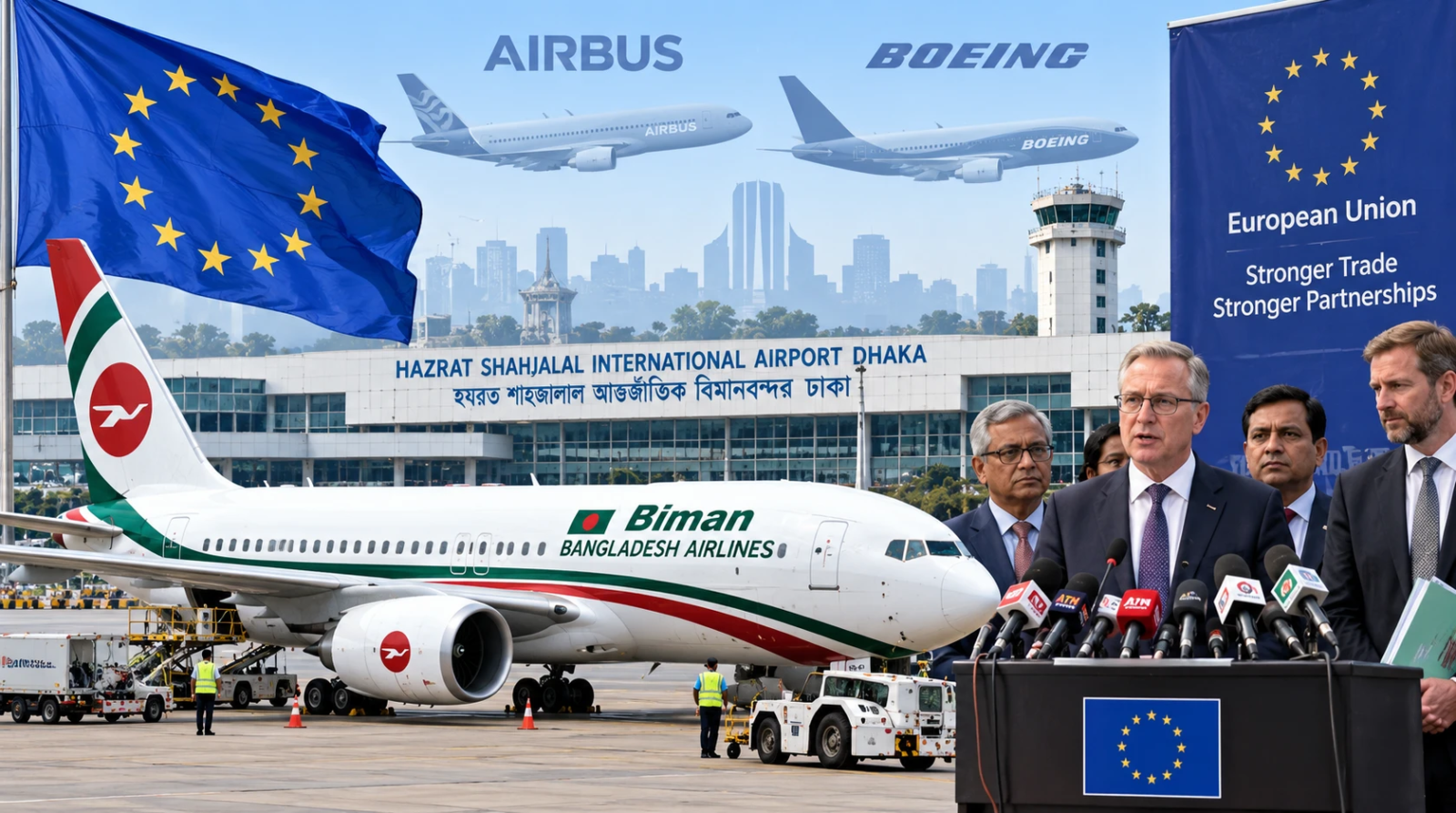
Bangladesh is facing growing diplomatic and economic pressure from the European Union over its decision to purchase Boeing aircraft for Biman Bangladesh Airlines, as ambassadors representing all 27 EU member states have called for fair competition in the procurement process.
The issue has added a new dimension to the long-running Boeing-Airbus competition over Biman’s fleet expansion. EU Ambassador to Bangladesh Michael Miller said Bangladesh should make public-procurement decisions based on commercial merit and ensure a “level playing field” for European companies, including Airbus.
The pressure comes after Biman signed a $3.7 billion agreement for 14 Boeing aircraft. At the same time, Bangladesh has indicated interest in procuring Airbus aircraft as part of a future mixed fleet. The government has said it wants to acquire both Boeing and Airbus while protecting national interests.
The dispute is particularly sensitive because the EU is Bangladesh’s largest trading partner. In 2025, bilateral trade in goods reached €23.3 billion, while textiles accounted for almost 94% of EU imports from Bangladesh. Bangladesh also remains the largest beneficiary of the EU’s Everything But Arms (EBA) trade preferences, which provide duty-free and quota-free access for most exports from least-developed countries.
The European bloc has also been discussing deeper economic engagement with Dhaka, including negotiations toward a comprehensive Free Trade Agreement. Bangladesh and the EU had reaffirmed their intention to strengthen economic cooperation earlier this year.
Against this backdrop, the Boeing-Airbus dispute could become more than a commercial disagreement. Any deterioration in Bangladesh-EU relations could have significant implications for the country’s export-dependent economy, particularly the ready-made garment sector.
However, it would be premature to describe the current situation as a diplomatic or trade “war.” The EU has simultaneously been seeking closer economic cooperation with Bangladesh, while Brussels has continued discussions on trade and investment and invited Prime Minister Tarique Rahman to participate in its Global Gateway Forum.
The immediate challenge for the Tarique Rahman government, therefore, is to balance its strategic relationship with the United States and its Boeing commitments while avoiding friction with the European Union—one of Bangladesh’s most important export markets.
DHAKA , September 7




COMMENTS