
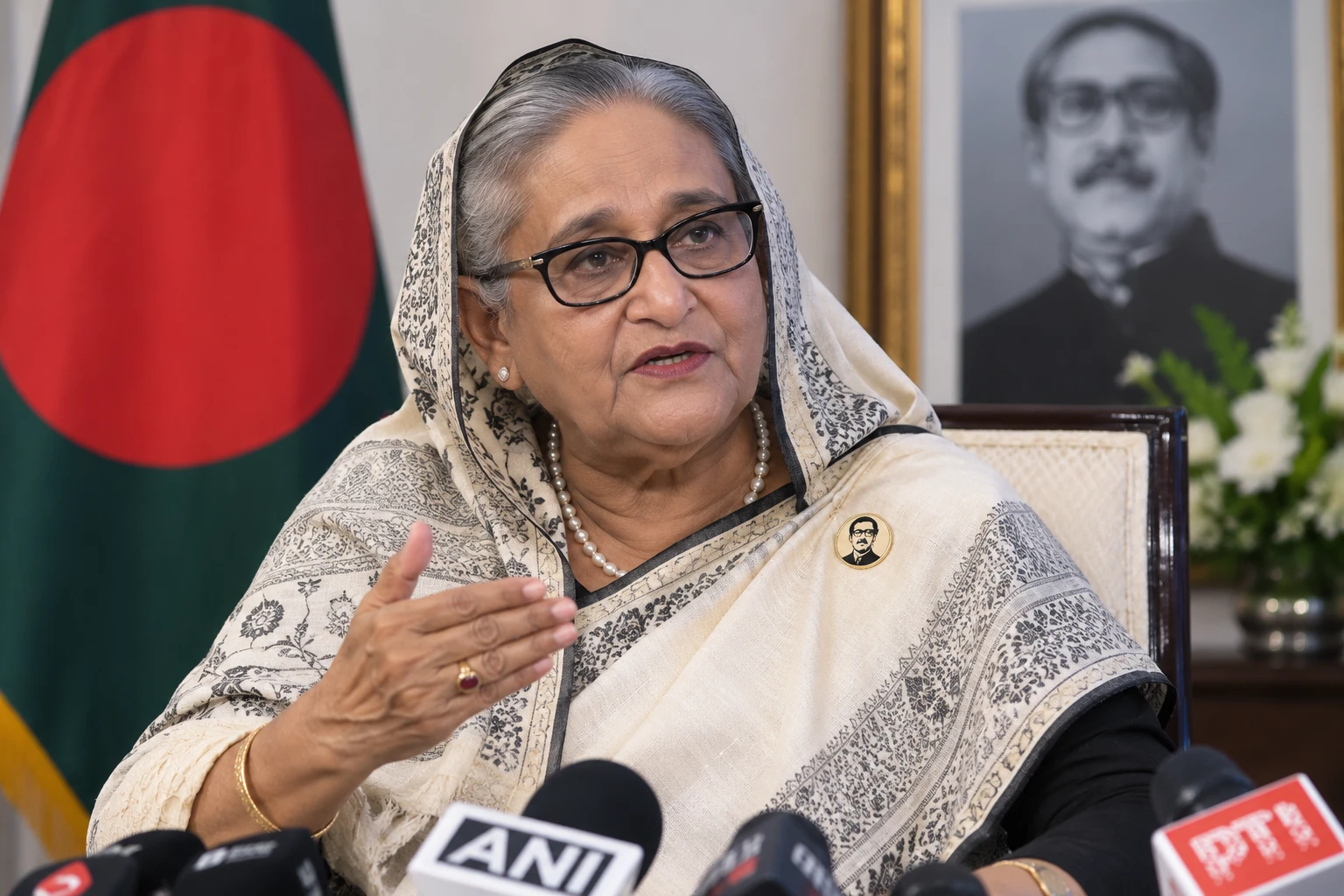
Former Bangladesh Prime Minister Sheikh Hasina has said she is willing to step down as president of the Awami League if the party itself decides that she should, but rejected any role for the Bangladesh government or BNP in determining the party’s leadership.
In an interview with The Hindu, published on September 7, Hasina said the Awami League’s leadership should be decided according to the party’s constitution. She also called for the ban on the party to be revoked, political detainees to be released and what she described as “false cases” against her party workers to be withdrawn.
Hasina, who has been convicted of murder and sentenced to death in Bangladesh, said she remains undeterred about returning to the country. She claimed that she did not leave Bangladesh voluntarily on August 5, 2024, saying her security personnel, party leaders and family members urged her to leave the Prime Minister’s residence. She said she had been prepared to go to Tungipara and was willing to resign, but did not get the opportunity to do so.
According to Hasina, she only learned that she was being taken to India after she was already aboard the helicopter. She expressed gratitude to India for receiving her at short notice and providing security and accommodation.
Addressing criticism from the Bangladesh government over her recent press conference in India, Hasina questioned how her remarks could damage India-Bangladesh relations. She said her intention was to “tell the truth” and argued that freedom of speech and expression are fundamental to democracy.
Hasina also said she had not sought meetings with Prime Minister Narendra Modi or Congress leader Sonia Gandhi during her stay in India, despite having good relations with them. She said she had decided to meet only Awami League workers and relatives for the time being.
On whether she would be allowed to return to Bangladesh, Hasina said she was willing to return herself rather than being sent back by India. She also criticised what she described as contradictory demands from Bangladesh, saying that while the government repeatedly asks India to send her back, her offer to return voluntarily is also viewed as a problem.
Defending the former ban on Jamaat-e-Islami, Hasina said members of the party had been accused and convicted of crimes committed during the 1971 Liberation War, including rape, murder and genocide. She noted that Jamaat’s political status had subsequently changed and pointed to meetings between Indian officials and Jamaat leaders.
Hasina urged the international community to support the lifting of the Awami League ban, release political detainees, ensure citizens’ security—particularly that of women and girls—and protect freedom of movement and freedom of expression.
On India’s recent youth protests, Hasina declined to comment on India’s internal affairs, saying India is a democratic country whose people and institutions would deal with their own issues. Looking back at the protests that led to her ouster in Bangladesh, however, she said that regardless of how her government might have handled the protesters, their “sole motive” was to remove her and that there was no compromise with them.
DELHI , September 7



COMMENTS