
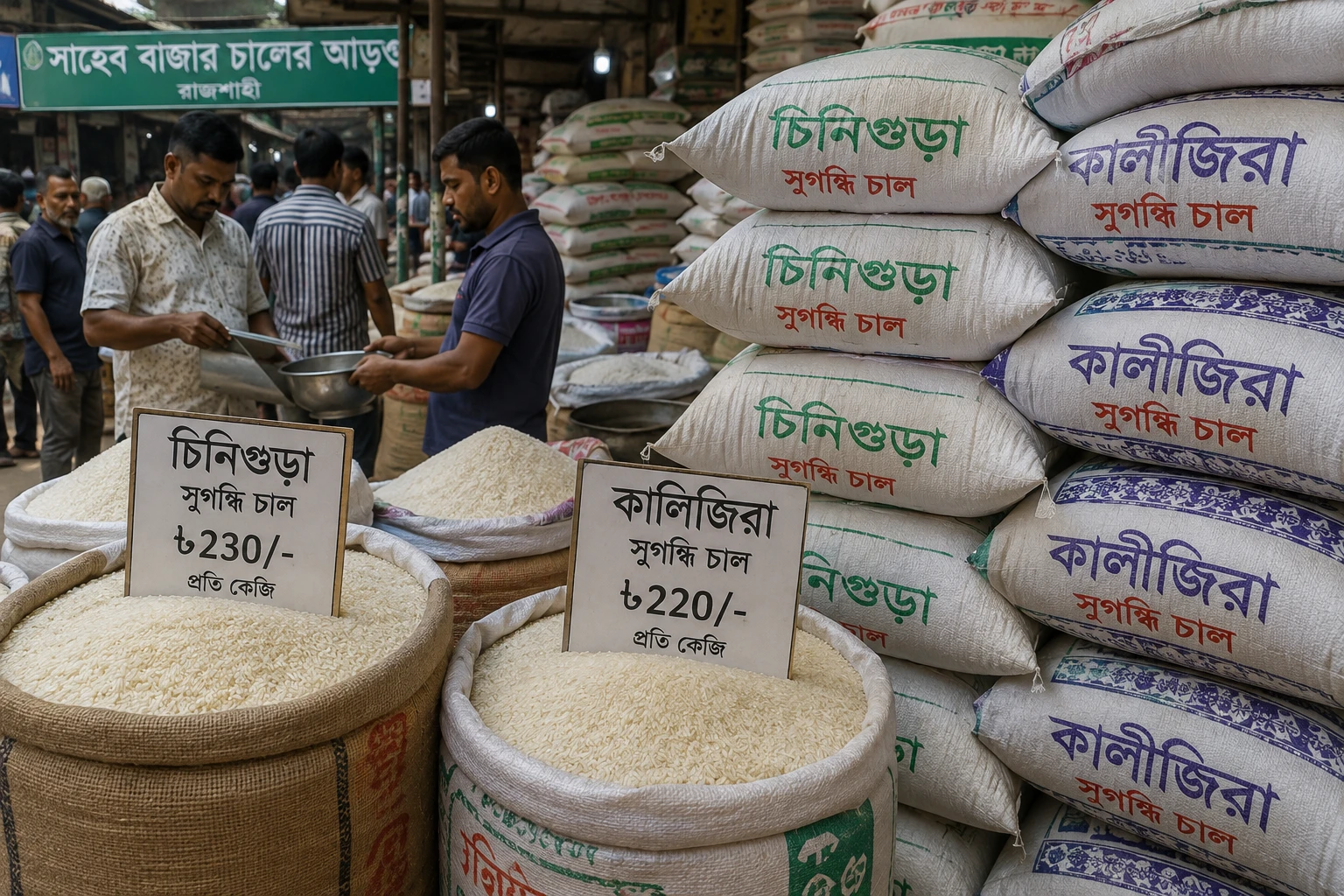
RAJSHAHI – Bangladesh: Prices of aromatic rice have surged in Bangladesh’s Rajshahi region, with some varieties nearly doubling in six months, putting the traditionally popular rice used for pulao and biryani beyond the reach of many consumers.
Chinigaura, a fragrant rice variety widely used for festive meals, is now selling for Tk220–230 ($1.80–$1.88) per kilogram at retail markets in Rajshahi, depending on quality. Packaged Chinigaura rice that sold for Tk135–140 a kilogram several months ago now costs about Tk230.
Traders and market participants cite several factors behind the increase, including rice exports, shortages of paddy, higher production costs and stockpiling by large rice processors.
At wholesale markets in Rajshahi, aromatic rice is currently selling for Tk180–200 a kilogram, while retail prices are around Tk210. Loose Chinigaura, which sold for Tk115–120 a kilogram three months ago, now costs Tk170–180.
Prices of other aromatic varieties have also increased. Kalijira rice has risen from Tk120–125 to about Tk160 a kilogram, while Dinajpur’s aromatic Kataribhog rice has increased from Tk95 to Tk105.
Exports blamed
Some rice traders attribute much of the price increase to exports, saying shipments abroad have reduced supplies in the domestic market.
Three leading companies exported a combined 1,530 metric tonnes of rice during the 2025–26 fiscal year, according to figures cited in the report. Chinigaura rice is primarily produced from BRRI-34 paddy.
Ashok Prasad, owner of AP Chal Bhandar-1 in Rajshahi’s Saheb Bazar, said aromatic rice prices had risen by as much as Tk100 a kilogram since Eid-ul-Adha.
“Exports are the main reason behind the price increase,” he said, adding that prices could fall if exports were halted.
Wholesale trader Jasim Uddin said rice that sold for around Tk100 a kilogram six months ago was now costing nearly Tk200.
He said his business had been fined Tk10,000 by the Directorate of National Consumers’ Right Protection over the sale of pulao rice at Tk200 a kilogram. Jasim said traders were purchasing rice from company warehouses at roughly the same price and then incurring transportation costs and commissions.
He estimated that prices could fall by at least Tk50 a kilogram if exports were suspended.
Production constraints add to pressure
Market participants, however, say exports alone do not explain the price surge.
Parts of northern Bangladesh experienced intense heat and inadequate rainfall during the previous growing season, reducing yields of aromatic paddy in some areas.
Large rice processors also bought paddy at relatively high prices early in the season and stored it, according to traders, reducing supplies available to smaller mills and open markets.
The cost of processing aromatic rice has also increased because of higher electricity, milling and transportation expenses.
Dinajpur rice wholesaler Atiar Rahman said a 75-kilogram sack of paddy that sold for around Tk4,000 during the harvest season later rose to Tk6,000 and now costs about Tk8,500.
He attributed the increase primarily to a shortage of paddy, while saying he could not confirm whether exports were also contributing to the rise.
Consumers cut purchases
The price increase has prompted consumers to reduce their purchases of aromatic rice, with some switching to cheaper varieties.
Mohammad Azad, a private-sector employee shopping at Saheb Bazar, said packaged Chinigaura rice now cost Tk230 a kilogram.
“Aromatic rice is not part of our daily diet, but prices have risen so much that even for family events, we hesitate to buy it,” he said.
Jahangir Alam Khan said he paid Tk140 a kilogram the last time he bought pulao rice, about five months ago. He said he had to pay Tk230 this time.
Housewife Selina Parvin said she was buying rice for her daughter’s birthday but found even lower-quality loose Chinigaura selling for about Tk150 a kilogram.
Restaurants squeezed by higher costs
Restaurants are also feeling the impact.
Mohammad Golap Sardar, who owns a restaurant in Rajshahi’s Kumarpara area, said he previously bought pulao rice for about Tk130 a kilogram. The price has now risen to around Tk200.
However, he said restaurants had been unable to raise menu prices proportionately because of concerns about losing customers.
Rice trader Rajib Hossain said higher prices were also hurting businesses as demand weakened. Customers who previously purchased 5–10 kilograms of aromatic rice were now often buying only 1–2 kilograms, he said.
Farmers see little immediate benefit
Despite the higher retail prices, farmers are not necessarily benefiting from the increase.Asfakuzzaman Babu, a farmer from Keshbapur in Godagari upazila, said he had cultivated aromatic paddy on two bighas of land but sold his harvest six months ago.
“If I still had the paddy, I could get a much higher price now,” he said, adding that he may expand cultivation if prices remain high.
Calls for closer market monitoring
The sharp rise has prompted calls for stronger monitoring of the aromatic rice market and greater scrutiny of the factors driving prices.
While some traders blame exports, market participants also point to lower yields, stockpiling by large mills and rising processing and transportation costs.
According to the Department of Agricultural Extension, most BRRI-34, or Chinigaura, paddy is produced in Dinajpur, with some cultivation also taking place in Thakurgaon and Panchagarh.
Dinajpur has set a target of cultivating paddy on 260,860 hectares this year, including 95,000 hectares of Chinigaura. Last year, the variety was cultivated on about 94,000 hectares.
Mohammad Afzal Hossain, deputy director of the Dinajpur Department of Agricultural Extension, said major companies including Square Food & Beverage, Ispahani Agro and PRAN Agro package and market aromatic rice produced from Chinigaura paddy.
Nearly 200 small and large automated rice mills have developed around the crop in Dinajpur, he said.
Officials and market participants, however, said the high retail price of aromatic rice has yet to translate into a proportionate increase in earnings for farmers.





COMMENTS