

DHAKA — Dhaka University Proctor and Associate Professor of Graphic Design Israfil Ratan is facing mounting criticism over remarks attributed to him concerning female students’ late-night movements, after he denied making the comments and accused the media outlet that reported them of publishing “false, motivated and misleading” information.
The controversy erupted after Dhaka Stream reported that Ratan made the remarks during a telephone conversation concerning restrictions on the movement of female students and the closing hours of women’s residential halls.
According to the report, Ratan allegedly asked, “At what time at night do your mother and sister return home? No female in my household stays outdoors after 11 at night.”
The comments have drawn strong reactions from students, particularly female students, amid an ongoing debate at the university over restrictions on the opening and closing of women’s residential-hall gates.
Proctor Denies Making Remarks
Ratan subsequently issued a rejoinder on the university’s official letterhead, categorically denying that he had made the remarks attributed to him.
He described the quoted statement as “completely false, motivated and misleading” and said he had not spoken to any journalist or media organisation about the matter during the preceding week.
“I have not spoken to a journalist or media organisation about the matter in the last one week,” he said in the rejoinder.
Ratan also expressed concern that reports and related social-media posts were creating confusion and could disrupt the academic environment and stability of the university campus. He urged people to refrain from circulating what he described as misleading reports.

Dhaka Stream, however, rejected the Proctor’s denial and said it stood by its report.
The outlet said Ratan spoke to its newsroom by telephone at 8:52pm on August 23, with the conversation lasting 12 minutes and 19 seconds, according to its call log.
Dhaka Stream said the disputed remark was made during that conversation and that Ratan repeatedly expressed similar views regarding the 10pm-to-6am closure of women’s residential-hall gates.
The outlet said the conversation took place on speakerphone in its newsroom, allowing several members of its staff to hear the exchange and take detailed notes.
After receiving the rejoinder, Dhaka Stream said, one of its reporters contacted Ratan and reminded him of the August 23 conversation. According to the outlet, the Proctor abruptly ended the call. The reporter subsequently made five further attempts to contact him but received no response, it said.
Dhaka Stream also rejected the suggestion that it had published or circulated a social-media photocard containing the remarks referred to in Ratan’s rejoinder.
Earlier Interview Draws Fresh Attention
The controversy has also brought renewed attention to comments Ratan reportedly made in an interview with another English-language media outlet in mid-August.
According to that interview, Ratan said that parents generally do not permit their daughters to remain outside after 10pm. He also questioned whether Bangladesh should abandon its traditional cultural values, asking, “Should we forget our Bengali and Bangladeshi culture? Should we become Europe?”
The remarks have intensified a wider debate over the justification for restrictions on female students’ movements, particularly whether such measures should be based on cultural norms, parental expectations and security concerns.
Female Students React
The controversy has prompted strong reactions among female students at Dhaka University.Student Susmeta Meem, in a social-media post, criticised Ratan and questioned his suitability for holding the position of Proctor.
Meem said the denial issued on university letterhead had failed to settle the controversy, particularly in view of Dhaka Stream’s account of the telephone conversation and its claim that the call lasted 12 minutes and 19 seconds.
She also criticised what she described as conduct inconsistent with the standards expected of a university teacher, arguing that educators should demonstrate integrity, dignity, tolerance and respect for others.
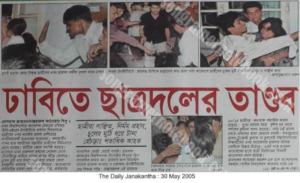
Meem further referred to what she described as newspaper reports concerning alleged aggressive conduct involving students of the Faculty of Fine Arts and female students of Rokeya Hall. She questioned why someone with what she described as a controversial record would be appointed to a senior administrative position such as Proctor.
Controversy Raises Broader Questions
The dispute has now moved beyond the question of what was said during a particular telephone conversation and into a broader debate over gender, institutional authority and the rights and freedoms of female students.
At the centre of the controversy is the question of how far cultural expectations, parental concerns and campus-security considerations should influence rules governing female students’ movements at night.
Ratan has categorically denied making the remarks attributed to him, while Dhaka Stream maintains that its report is supported by its call log and by the accounts of newsroom staff who it says heard the conversation.
The conflicting claims have left the university community awaiting further clarification as criticism over the remarks—and the circumstances surrounding their denial—continues to grow.






COMMENTS