
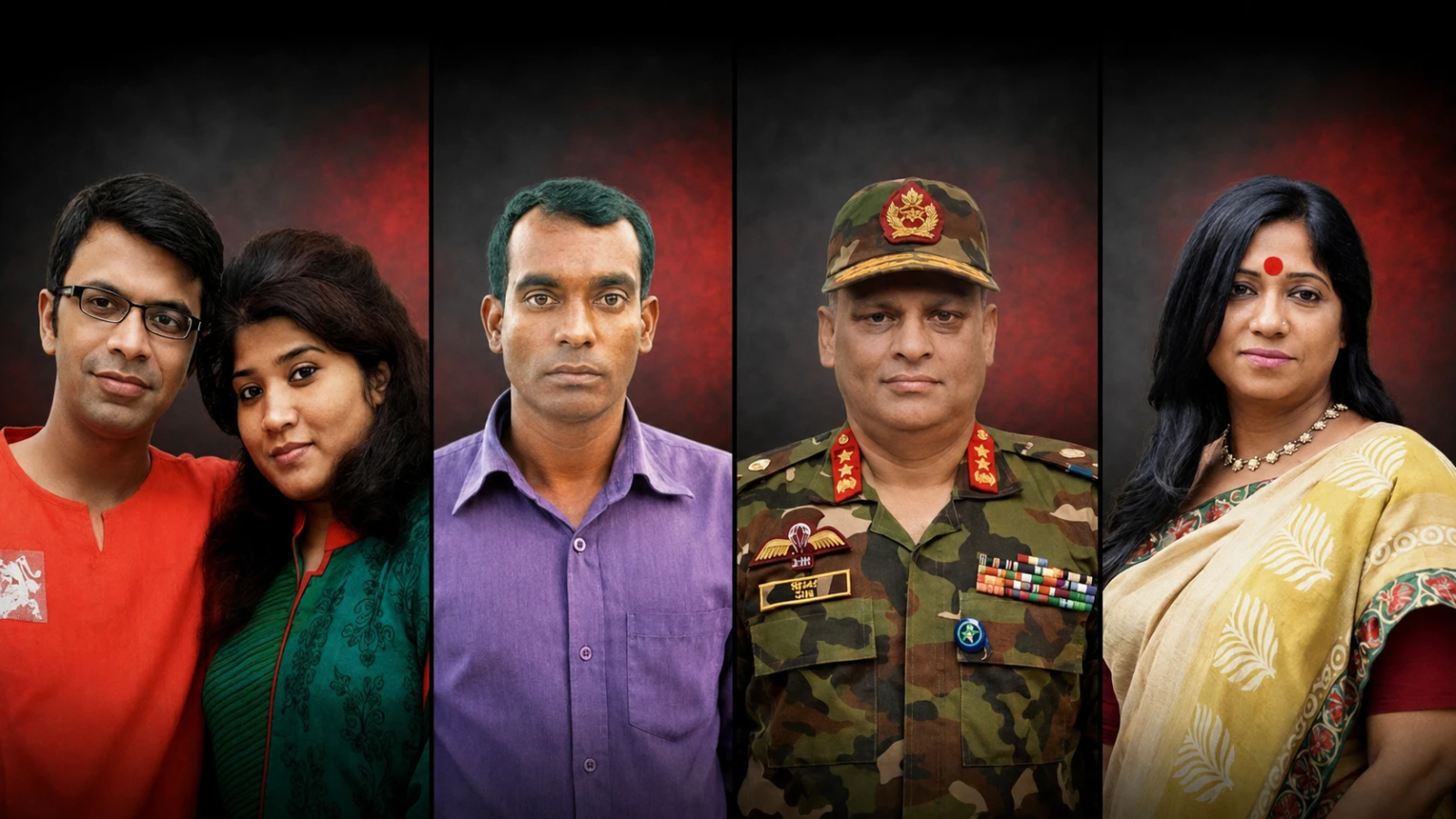
The latest allegations surrounding the murder of journalists Sagar Sarwar and Meherun Runi have once again brought one of Bangladesh’s most notorious unsolved criminal cases into the spotlight.
At the heart of the matter is a fundamental question: is the state genuinely committed to uncovering the truth through a credible and proper investigation, or is this long-running case being used as a means of targeting political opponents and people with dissenting views?
More than a decade after their brutal deaths, the failure to establish the truth is no longer simply a matter of an unresolved murder.
It has become a serious test of Bangladesh’s rule of law, the integrity of its investigative institutions, and the state’s commitment to justice without political consideration.
According to a report published by Amar Desh on August 30, 2026, officials associated with the investigation of the International Crimes Tribunal have alleged links between former army officer Major General Ziaul Ahsan and actress and Awami League supporter Rokeya Prachi and the killings.
The report claims that investigators identified frequent communications between Ziaul Ahsan and Prachi around the time of the murders and that two pen drives allegedly containing a documentary concerning the Pilkhana BDR massacre were collected from Prachi shortly after the killings. These are serious allegations, but allegations are not proof. They must be tested against independent evidence through a lawful, impartial and transparent investigation.
Sagar Sarwar and Meherun Runi were murdered in their rented apartment in West Rajabazar, Dhaka, on February 11, 2012. The investigation moved from the police to the Detective Branch of the Dhaka Metropolitan Police and later to the Rapid Action Battalion. Yet, despite years of investigation, arrests, interrogations and repeated extensions, the case has never reached a conclusive resolution.
In September 2024, the High Court removed RAB from the investigation and directed the formation of a specialized task force comprising experienced investigators from different agencies. Even after numerous extensions, however, the investigation remains incomplete. The deadline for submitting the investigation report has reportedly been postponed 129 times.
Over the years, several individuals have been arrested or named as accused, but no definitive judicial finding has established who planned, ordered or carried out the murders. That history makes the latest allegations particularly important, but it also demands caution. The public deserves neither another convenient suspect nor another politically convenient narrative. What Bangladesh needs is evidence that can withstand scrutiny in a court of law.
The Sagar-Runi case has therefore become much larger than a single murder investigation. It is a test of whether the criminal justice system can pursue the truth without fear, favor or political pressure. Justice for Sagar Sarwar and Meherun Runi will not come from accusations alone, nor from confessions obtained under questionable circumstances.
It can come only from a credible and independent investigation that establishes, on the basis of admissible evidence, who killed them, who ordered the killings, why they were targeted, and whether anyone deliberately obstructs efforts to uncover the truth. After more than fourteen years, that is the minimum that the victims, their families and the people of Bangladesh have a right to expect.
What Is “Joj Mia Syndrome” in Bangladesh’s Criminal Case Process?
“Joj Mia Syndrome” refers to the practice of framing innocent or vulnerable people as scapegoats to close high profile criminal cases while protecting the real perpetrators.
The term originated from the 2005 Joj Mia case, when a poor cassette seller was allegedly arrested, tortured and forced to confess to involvement in the August 21, 2004 grenade attack. His family was reportedly given money while investigators promoted a false narrative.
Since then, “Joj Mia Syndrome” has become a symbol of fabricated investigations, coerced confessions, wrongful arrests and impunity. It reflects a serious failure of the rule of law, where securing a quick conviction can take priority over finding the truth and holding the actual perpetrators accountable.
The Rokeya Prachi Question: Is Justice Being Used to Silence a Dissenting Voice?
The allegations involving Rokeya Prachi also deserve careful scrutiny, particularly in the context of her public activities since August 2024. Prachi has remained vocal about the Awami League, the history and legacy of the Liberation War of 1971, attacks and mob violence against Awami League leaders and workers, the vandalism of sculptures, and the destruction of Sheikh Mujibur Rahman’s historic residence at Dhanmondi Road 32 in Dhaka. Her outspoken position has made her a visible and controversial voice in the country’s deeply divided political environment.
If the state wants to stop or discredit such a voice, it must not do so through intimidation, arbitrary prosecution or a politically motivated criminal case. If there is evidence of a crime, the proper course is to present that evidence before an independent court and allow the law to take its course. Otherwise, the investigation itself may become part of the problem.
This is where the comparison with the “Joj Mia drama” becomes relevant. The investigation into the August 21, 2004 grenade attack was later criticized for creating a false narrative and using a vulnerable individual as a scapegoat. The lesson from that episode should be clear: criminal investigations cannot be designed around a predetermined suspect simply because that person is politically convenient.
The allegations now being reported in connection with the Sagar Runi murder case therefore require independent verification, credible evidence and full judicial scrutiny. Prachi should neither be protected because of her political position nor made a scapegoat because she has become an inconvenient voice. The objective of any genuine investigation must be one thing only: to establish the truth and bring the actual perpetrators to justice.
The Ziaul Ahsan Question: Case After Case
The case of Major General Ziaul Ahsan raises a serious question about how Bangladesh’s criminal justice system handles allegations against a former Army Officer. Ziaul Ahsan has not been convicted and remains in custody while facing trial before International Crimes Tribunal-1 on allegations relating to crimes against humanity, including extrajudicial killings and enforced disappearances.
In August 2026, the tribunal formally showed him arrested in connection with the alleged 2015 abduction and disappearance of Salahuddin Ahmed, now the Home Minister, and allowed prosecutors additional time to complete their investigation.
Former subordinates and other witnesses have also made allegations against him, including claims concerning large numbers of killings during his tenure in RAB. It is now attempting to implicate him in investigations into other high profile cases, including the murders of journalists Sagar Sarwar and Meherun Runi. None of these allegations, however, should be treated as established facts unless proven before a court. The growing number of cases makes independent investigation and due process even more important. Justice must not become a process of accumulating accusations against one individual.
Each case must stand on its own evidence, with the accused given a fair trial and the victims given a genuine opportunity for truth and justice. Otherwise, a process intended to establish accountability could itself become vulnerable to allegations of politically motivated prosecution.
Regime Changes, but Does the “Joj Mia Drama” Remain?
Governments may change, political alliances may change, and those in power may come and go, but the deeper question is whether Bangladesh’s criminal justice system has truly changed. Joj Mia became a symbol of how a vulnerable person could allegedly be turned into a scapegoat to give a high profile investigation a convenient ending. He was not necessarily an isolated victim.
Over the years, concerns about wrongful arrests, coerced confessions, politically motivated cases and the use of individuals as convenient suspects have raised the fear of a wider “Joj Mia syndrome” within the criminal justice system. The allegations now emerging against Major General Ziaul Ahsan and Rokeya Prachi must therefore be examined with particular caution.
Neither has been convicted of the allegations discussed here, and neither should be declared guilty through media narratives. But if they are being turned into convenient suspects without credible and independently tested evidence, Bangladesh may simply be staging another version of the old Joj Mia drama under the present political order.
The government therefore owes the public a clear answer: are these investigations genuinely seeking the truth, or are they producing new scapegoats to close politically sensitive cases? Only transparent investigations, credible evidence, judicial independence and fair trials can answer that question and prevent the cycle from being repeated.
Author is a Lawyer and Human Rights Defender



COMMENTS