
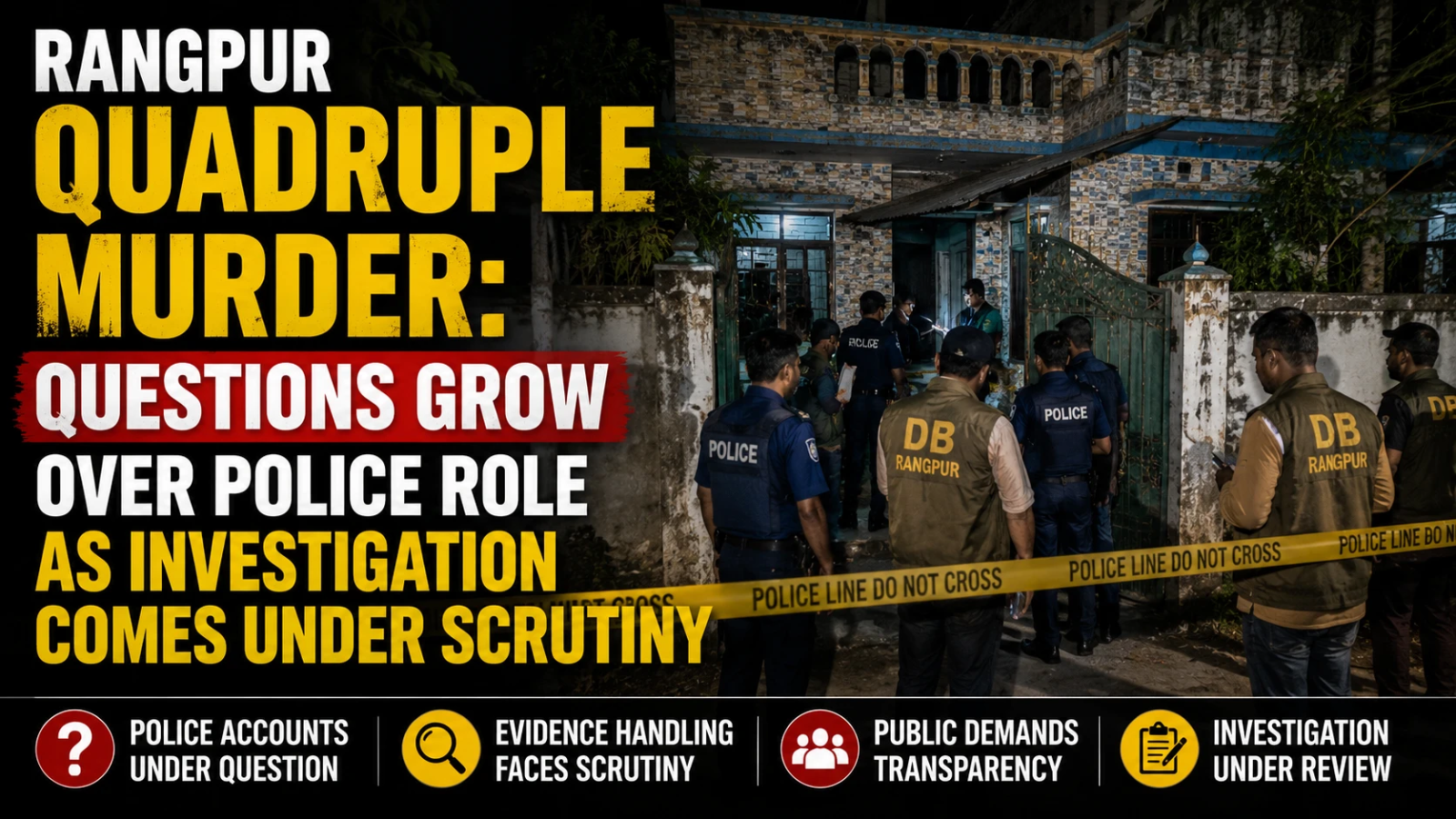
Serious questions have emerged over the investigation into the killing of four members of a Hindu family in Rangpur, after an investigative report alleged that senior police officers, including a Deputy Inspector General, may have been involved in the murders and that key elements of the official account do not fully correspond with available medico legal evidence.
The allegations, published by Northeast News on August 28, have not been independently established by Bangladeshi authorities. However, they have added to growing public concern over the case, particularly after police revised important details of their account and transferred the investigation to the Detective Branch.
The victims were retired Rangpur Zilla School teacher Ganapati Chakraborty, 65, his wife Pritilata Chakraborty, 50, their daughter Agami Chakraborty, 25, and their 12 year old son Priyam. Their bodies were recovered from their locked home in the Machhuapara area of Rangpur city late on August 22.
Police initially arrested two young men, Mugdho Das and Siddhartha Das, both Hindus, alleging that the pair entered the Chakraborty residence and killed the family after being confronted while using drugs on the rooftop. Police subsequently said the two suspects had confessed and that stolen valuables had been recovered.
That account has increasingly come under scrutiny.
Police Account Changes
On August 27, Rangpur Metropolitan Police Commissioner Mohammad Abdul Mabud presented a revised account of the killings. He said Ganapati, his wife and daughter were killed on the open rooftop in broad daylight after Ganapati confronted the two accused during his morning walk. The police version earlier suggested a different sequence and timing.
The changing account has become one of the central issues surrounding the investigation.
The case was transferred from Kotwali Police Station to the Detective Branch on August 25. Police said the move was intended to ensure a more intensive investigation and allow a speedy submission of the charge sheet. Inspector Md Zinnat Ali was appointed as the new investigating officer.
The transfer followed growing doubts expressed by relatives, teachers, former students and local residents regarding the original police narrative.
Allegations Against a Senior Police Officer
Northeast News has alleged that a DIG who served in Rangpur developed a close relationship with a married Hindu woman who was reportedly a friend of Pritilata Chakraborty. The report claims that the relationship and information allegedly known to the Chakraborty family may have created a motive for the killings.
The report further alleges that the officer had assumed his Rangpur assignment in April 2026 and later moved to another position within the Rangpur Division. It identifies Mohammad Abdul Mabood as the police commissioner whose conduct during the investigation has come under particular scrutiny.
These allegations remain unproven. No Bangladeshi authority has publicly established that any senior police officer participated in the murders.
Mabood’s conduct has nevertheless attracted attention because of his handling of the early investigation. According to Northeast News, he did not initially visit the crime scene and later publicly discussed a confession allegedly made by the two arrested suspects before a magistrate.
The report also raises questions about whether sufficient forensic evidence was collected from the house before the crime scene was disturbed.
Medico Legal Evidence Raises Timing Questions
One of the most significant issues concerns the timing of the killings.Northeast News reported that the condition of food material found during postmortem examination indicated that the victims had died relatively soon after eating. The finding appears inconsistent with earlier police suggestions that the killings occurred around dawn on August 20.
The report also cites an identical observation in the postmortem reports concerning injuries associated with ligature marks. The finding indicates that the victims suffered significant neck injuries while alive.
The precise significance of the findings will ultimately depend on the full forensic record and the conclusions of qualified investigators and medical experts. The available information does not, by itself, establish who carried out the killings or when each victim died.
The question of timing is nevertheless important because it directly affects the credibility of witness accounts, digital evidence, movements of suspects and the sequence of events reconstructed by investigators.
Family Questions Official Narrative
Ganapati’s elder brother Gopinath Chakraborty has expressed serious doubts about the police theory that the two arrested men alone were responsible.
“Some other force was behind the murders,” Gopinath told Northeast News.
He questioned whether the two suspects could realistically have killed Ganapati, whom he described as physically strong, along with the other members of the family.
The family has also questioned whether the killings could have been carried out in the manner described by police.
Police, however, have rejected suggestions that evidence was deliberately suppressed or that officers were involved.
Sanatan Chakraborty, Deputy Commissioner of the Rangpur Metropolitan Police Detective Branch, challenged the allegations in messages exchanged with Northeast News.
“What are your reasonable grounds for saying this?” he asked when questioned about possible police involvement.
When the publication pointed to apparent gaps and inconsistencies, he responded: “You sit 2,000 kilometres away and work out the calculations”.
He subsequently maintained that “the police has not suppressed any fact”.
A Case With Wider Implications
The Rangpur killings have assumed significance beyond an individual criminal investigation because the victims belonged to a Hindu family and the case has emerged during a politically sensitive period in Bangladesh.
Any failure to establish the facts transparently could deepen public mistrust and create competing narratives about whether the murders were ordinary criminal violence, a targeted attack or the result of a wider conspiracy.
For Bangladesh, the credibility of the investigation therefore carries implications for both domestic confidence and international perceptions of minority security and the rule of law.
The authorities have already taken one important institutional step by transferring the investigation to the Detective Branch. The next test will be whether investigators can independently establish the chronology of the killings, preserve and examine all available forensic evidence, determine the actual motive and establish whether the two arrested suspects acted alone.
The evidence must ultimately determine the case.
Until then, allegations of senior police involvement remain allegations, while the four deaths of the Chakraborty family remain an unresolved case demanding a transparent, independent and credible investigation.




COMMENTS