
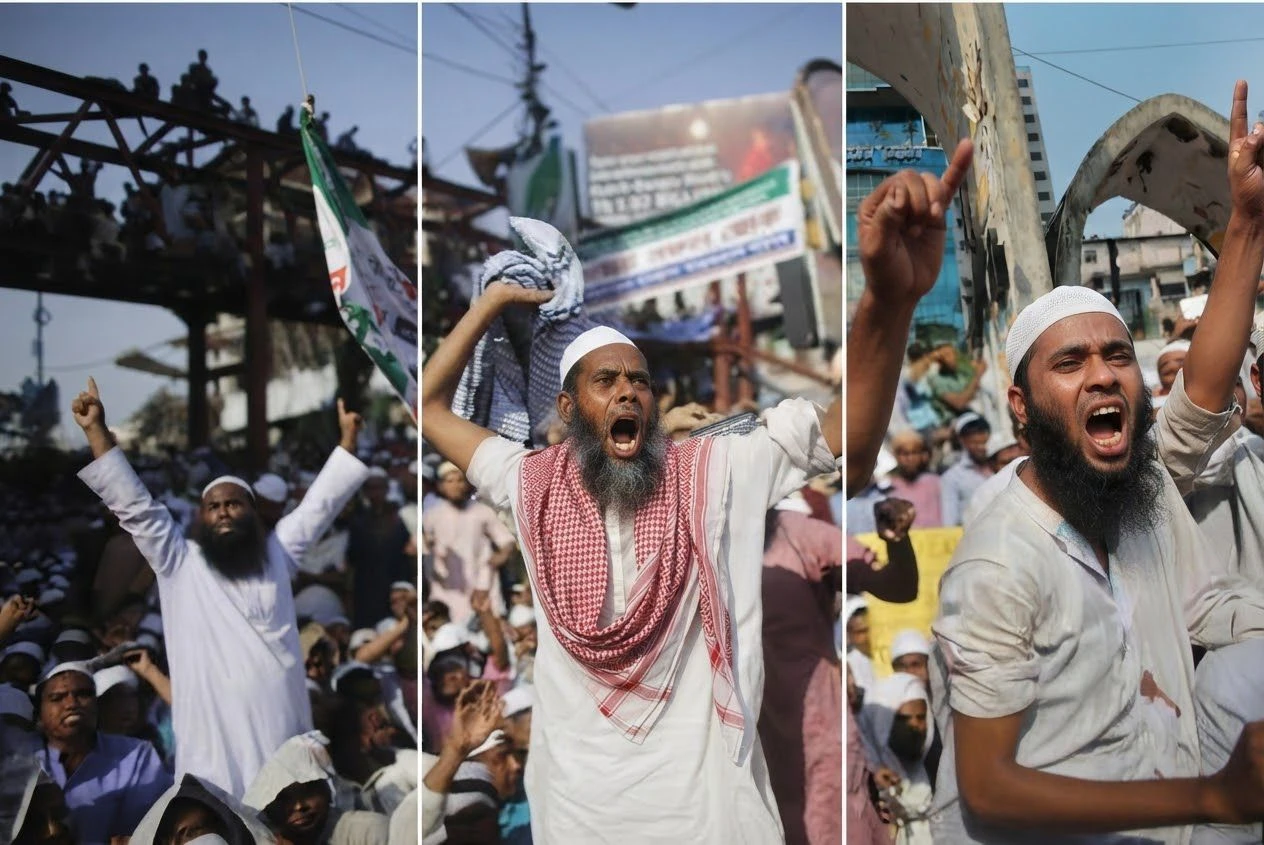
Bangladesh has long liked to present itself as a country where different faiths and political ideas can live side by side. Its Constitution speaks of secularism as a founding principle, and Bengali language, literature and music have for decades formed the backbone of its national identity. That image is now under serious threat, not from a hypothetical danger but from a security crisis that is unfolding in full public view.
Since the political upheaval of August 5, 2024, Bangladesh has been living through a dangerous experiment. Convicted militants have walked out of prison. Hundreds of terror accused have secured bail. Courts have acquitted men once considered among the country’s most dangerous extremists. And a state that insists militancy has “no presence” in the country keeps having to explain fresh bomb blasts, IEDs recovered from madrasas, and weapons that vanished from police armories more than a year ago and were never found. This is no longer a matter of concern. It is an emergency that Bangladesh’s leaders are choosing not to name.
The Jailbreak Bangladesh Never Truly Closed
When mobs stormed prisons across Bangladesh during the unrest of July and August 2024, more than two thousand inmates walked free, among them convicted militants, death row prisoners and men serving life terms for terrorism. At Kashimpur High Security Central Jail alone, over two hundred inmates escaped, including several convicted in extremist related cases. In Narsingdi, more than eight hundred prisoners fled after the district jail was stormed.
More than a year later, hundreds of these escapees, including hardened militants, remain untraced. Investigators have also failed to recover thousands of firearms and rounds of ammunition looted from police stations and prison armories during that same period. A state cannot claim to have contained extremism while it does not know where its most dangerous prisoners are, or where the weapons looted on its watch have ended up.
Freed by the Courts, Never Reformed in Spirit
What makes the situation more alarming is that the danger has not come only from jailbreaks. It has come from the courts and the bail system as well.
Since August 2024, several hundred individuals accused of serious terrorism related offences, including members of Neo JMB, Ansar al Islam and the pan Islamist Hizb ut Tahrir, have been granted bail. Among them is Jasim Uddin Rahmani, convicted for his role in the murder of blogger Rajib Haider and identified by investigators as the ideological head of Ansarullah Bangla Team. He walked out on bail after August 2024 and has since publicly claimed that the organization he was accused of leading never existed at all, a claim that itself ought to worry anyone tracking the rehabilitation of extremist networks in the country.
Equally troubling is the case that came to light around the deadly explosion at a madrasa in Keraniganj in December 2025, where investigators recovered improvised explosive devices and bomb making material. Officials later said the incident pointed to an accidental detonation during an active militant operation rather than a stray accident. A suspect in that case, known as Ostad Jewel, had earlier secured bail in September 2024 and was acquitted in a separate attack case in January 2025, only to be rearrested afterwards over suspected links to a Neo JMB bomb maker known as Bomaru Mamun.
Prison officials themselves have admitted that overcrowding and weak monitoring inside jails may have allowed such men to build new operational relationships while still behind bars.
This is the heart of the problem. It is not simply that militants have escaped. It is that the machinery meant to keep them contained, the prisons, the bail process and in some instances the courts, has repeatedly let them slip back into society, sometimes more than once.
A Trajectory the Region Has Seen Before
Bangladesh does not have to look far to see where this road can lead. Pakistan and Afghanistan both offer sobering lessons in what happens when a state tolerates the gradual return of militant networks into public life, whether through weak prosecutions, political accommodation of hardline groups, or the assumption that extremism can be managed rather than confronted head on. In both countries, initial complacency about released militants and unrecovered weapons eventually hardened into entrenched insurgency and a permanent erosion of state authority in parts of the territory.
Bangladesh is not Pakistan or Afghanistan, and it would be wrong to suggest that its institutions have collapsed to that extent. But the warning signs, escaped convicts absorbed back into old networks, looted weapons unaccounted for, bailed extremists regrouping with experienced leadership, and a security establishment that seems more focused on denial than detection, are precisely the early symptoms that preceded the deeper crises in those countries. Regional intelligence assessments have already flagged concern that groups active in Bangladesh may be developing links with transnational networks, including reported connections drawn to the November 2025 Red Fort attack in Delhi. Whether or not every such link is eventually proven, the fact that Bangladesh is being mentioned in this company at all should alarm its own citizens more than anyone else.
A Culture Under Quiet Siege
The threat is not confined to security briefings. It has crept into everyday life. Concerts and cultural programs have been cancelled after threats. Sculptures and monuments tied to Bangladesh’s cultural heritage have been vandalized. Writers, artists and secular minded citizens increasingly describe a climate in which they think twice before speaking freely.
This matters because Bangladesh’s identity was built on the language movement and the Liberation War, on music, literature and the freedom to question authority. A concert cancelled today because of threats can become a book withdrawn tomorrow and a lecture called off the day after. That is how societies slide into self-censorship, not through a single dramatic event but through the slow accumulation of small surrenders.
Political Accommodation Is Not a Neutral Choice
There is nothing wrong with religiously inspired parties competing peacefully within a democracy. The trouble begins when intimidation, threats or violence are used to override the law, and when political actors respond to such pressure with silence rather than firmness. Every time authorities look away from an attack on a cultural event or hesitate to prosecute a case linked to a politically inconvenient group, they teach extremists that pressure works better than the ballot box. That lesson, once learned, is very hard to unlearn.
The Rule of Law Cannot Be the Casualty
None of this is an argument for abandoning due process. The men arrested on suspicion of extremist activity deserve fair trials, and allegations must be tested in court rather than assumed to be true. Torture, enforced disappearance and arbitrary detention would only weaken the state further and hand extremists a propaganda victory. But due process cuts both ways. A justice system that appears unable to keep track of its own escapees, that grants bail liberally to terrorism accused without adequate monitoring, and that sees repeated acquittals in high profile militancy cases for want of evidence or missing witnesses, is not protecting the rule of law. It is quietly hollowing it out.
What Bangladesh Must Do Now
Bangladesh needs a transparent, time bound accounting of every prisoner who escaped in 2024, every weapon still missing, and every terrorism accused released on bail since, with clear reporting on their current whereabouts. It needs professional, well-resourced intelligence and prison management so that convicted militants cannot simply rebuild networks inside overcrowded jails. It needs prosecutors and investigators equipped to build cases that survive scrutiny in court, so that acquittals reflect innocence rather than institutional failure. And it needs political leaders, across the spectrum, willing to say plainly that no group, however loud or well organized, gets to threaten cultural life, minorities or dissenters into silence.
None of this is a call to view Islam or ordinary religious Bangladeshis with suspicion. The overwhelming majority of the country’s Muslims want nothing to do with violence and have as much to lose from this drift as anyone else. The real fault line running through Bangladesh today is not between religions. It is between a state willing to enforce its own laws without fear or favour, and one that keeps discovering, one jailbreak and one bail order at a time, how costly it is not to.
Bangladesh has already paid a heavy price for political violence in its history. It cannot afford to treat the return of its convicted militants to the streets as a routine administrative problem. A country that cannot keep its own extremists in prison will find it very hard to keep its democracy intact.
Parvez Hashem, Lawyer and Human Rights Defender

COMMENTS