
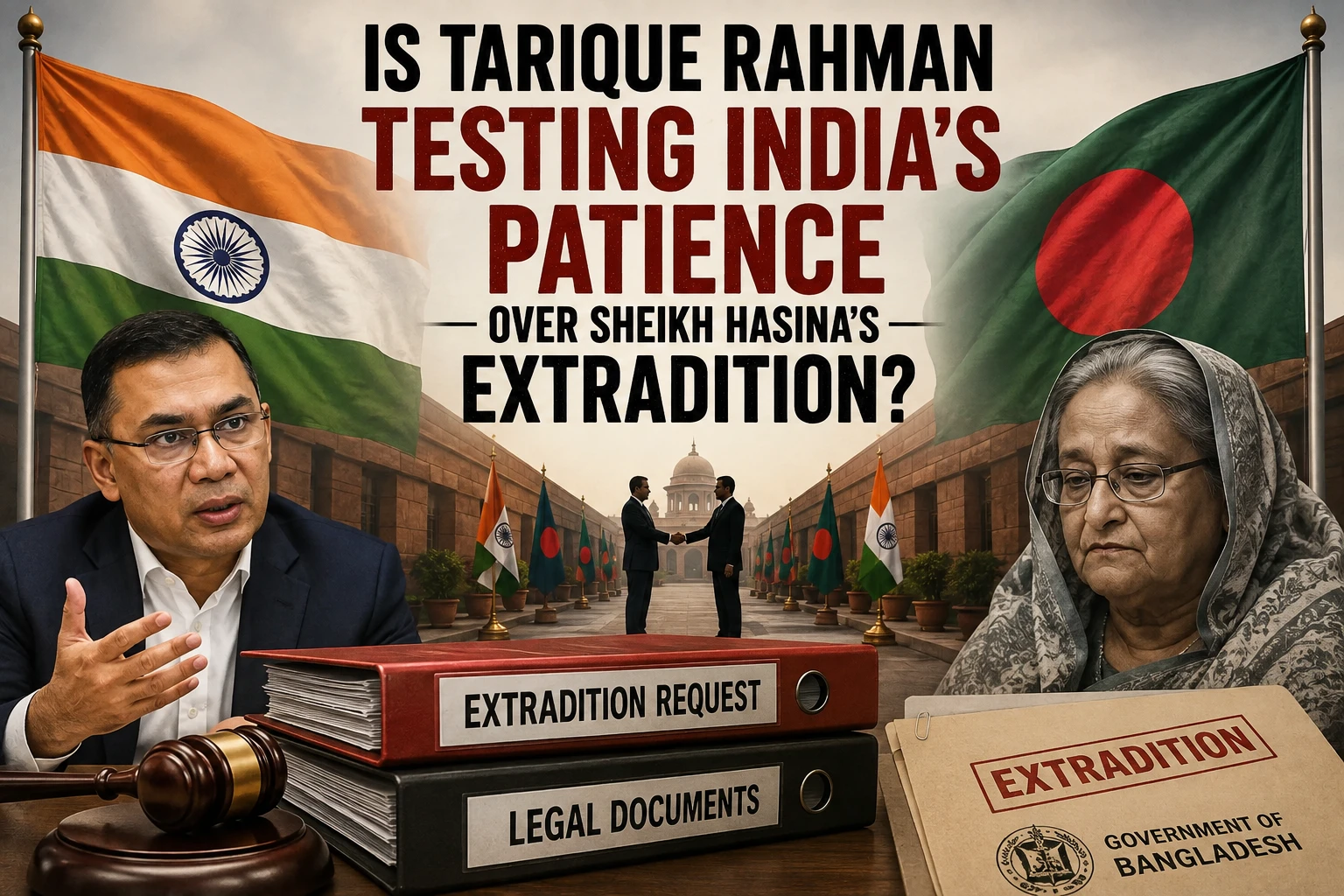
New Delhi, August 22 – Bangladesh Prime Minister Tarique Rahman’s apparent hesitation to visit India despite an invitation from New Delhi to attend the outreach session of the upcoming BRICS summit has raised fresh questions over the direction of India-Bangladesh relations and whether Dhaka is deliberately testing New Delhi’s diplomatic patience.
India has taken the lead in inviting Rahman to the BRICS outreach session in New Delhi on September 12–13. For many observers, the invitation offered an opportunity for Dhaka to improve strained bilateral relations and use high-level engagement to address economic, security and regional concerns. Instead, Rahman’s reported insistence that India first hand over former Prime Minister Sheikh Hasina has added a new complication to the relationship.
Rahman’s position is particularly significant given the political history of the BNP and its past alliances with Islamist forces. During the BNP-led government of 2001–06, Tarique Rahman emerged as a powerful figure within the party and was associated with the formation of an alliance between the BNP and Jamaat-e-Islami. The BNP has also faced longstanding allegations of maintaining links with radical Islamist groups, including Harkat-ul-Jihad-al-Islami Bangladesh (HuJI-B).
The August 21, 2004 grenade attack on an Awami League rally in Dhaka remains one of the most contentious episodes in Bangladesh’s political history. The attack targeted then-opposition leader Sheikh Hasina and senior Awami League leaders. A 2018 trial court convicted Tarique Rahman and several others in connection with the attack. However, the High Court overturned the verdict in December 2024, and Bangladesh’s Supreme Court subsequently upheld the acquittals in September 2025.
Against this background, Rahman’s demand for Hasina’s extradition has acquired an additional political dimension. Bangladesh’s International Crimes Tribunal has issued arrest warrants for Hasina and other former Awami League figures over allegations relating to crimes against humanity during the 2024 mass movement that led to her ouster.
New Delhi, however, has a legal framework governing extradition. The India-Bangladesh extradition treaty, signed in 2013 and amended in 2016, establishes procedures for transferring wanted individuals between the two countries. The treaty also contains provisions under which extradition may be refused in cases involving political offences.
India has previously cooperated with Bangladesh under the treaty, including the transfer of individuals wanted in connection with serious criminal and security-related cases. The question now is whether New Delhi will accept Dhaka’s request concerning Hasina when the case has become deeply intertwined with Bangladesh’s domestic political conflict.
The deterioration in bilateral ties since Hasina’s departure in August 2024 has already affected cooperation between the two neighbours. Issues surrounding minority security, border management, trade, water-sharing, security cooperation and political rhetoric have contributed to growing distrust.
Critics of India’s Bangladesh policy argue that New Delhi’s “Neighbourhood First” approach has sometimes placed too much emphasis on accommodation without sufficient reciprocity. They contend that India now needs to adopt a firmer diplomatic position and make clear that extradition cannot be treated as a precondition for normal bilateral engagement.
At the same time, Bangladesh’s economic difficulties, unemployment, inflation and law-and-order concerns make stable relations with India strategically important for Dhaka. India remains one of Bangladesh’s most important neighbours and economic partners, while Bangladesh occupies a critical position in India’s northeastern security architecture and the wider Bay of Bengal region.
The BRICS outreach invitation therefore presents Rahman with an important diplomatic opportunity. Accepting it could provide a platform for direct engagement with the Indian leadership and for advancing Bangladesh’s national interests. Rejecting or delaying the opportunity over the Hasina extradition issue, however, could further deepen the diplomatic divide.
For India, the challenge is to balance its commitment to regional engagement with its own legal, security and strategic interests. New Delhi may also need to reassess whether its current approach towards Dhaka is producing the desired level of reciprocity.
The central question now is whether Tarique Rahman’s stance represents a calculated diplomatic strategy aimed at extracting concessions from India—or whether Dhaka is allowing domestic political considerations and anti-India pressures to dictate its foreign policy.


COMMENTS