
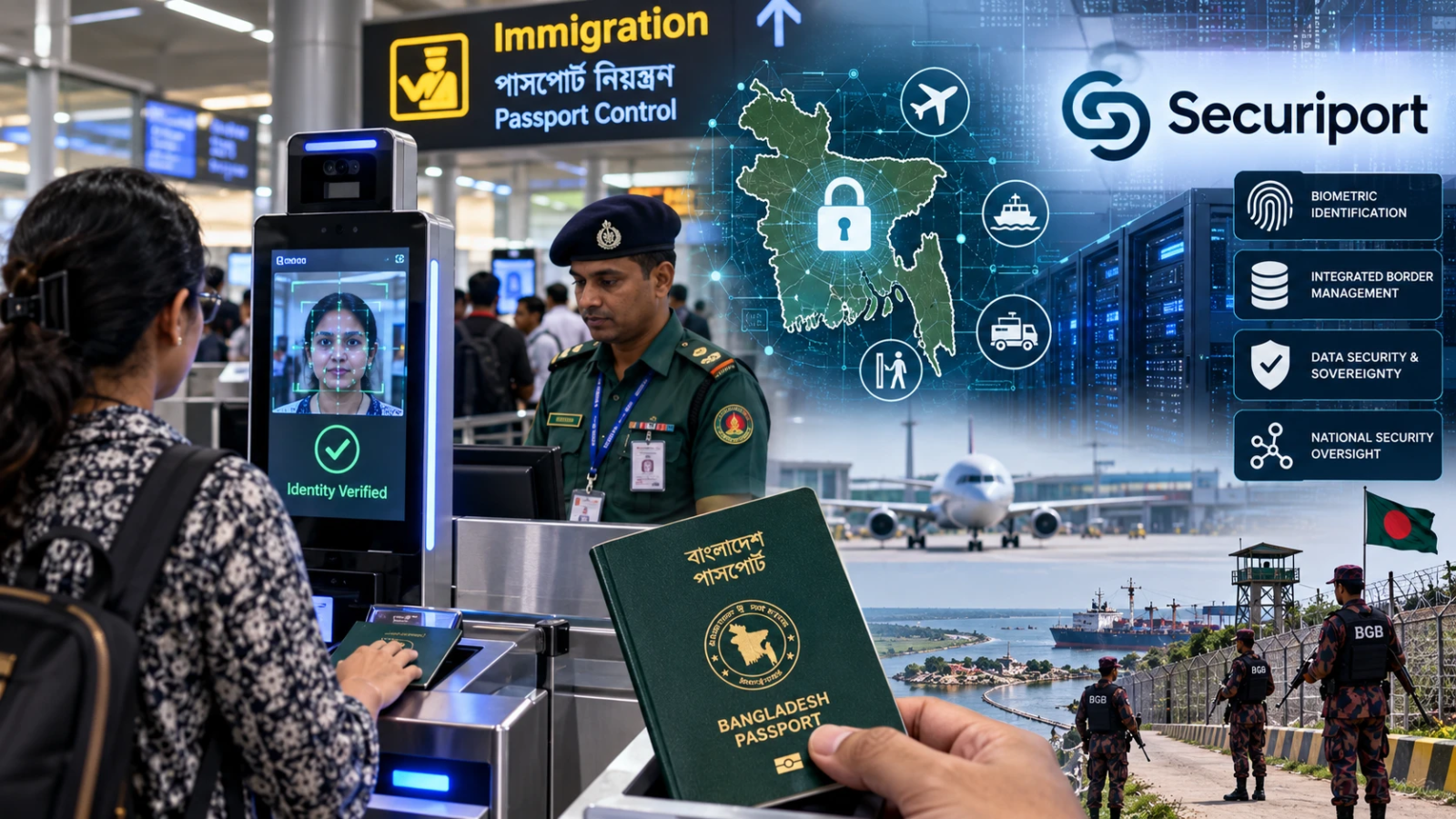
Bangladesh is moving towards a potentially consequential transformation of its border-management system as the Tarique Rahman-led government advances discussions with US-based Securiport over a nationwide immigration and border-security platform. The Virginia-based company has been asked to submit a detailed technical and financial proposal by October 22, following its earlier conceptual proposal to integrate biometric identification, Advance Passenger Information System (APIS), Passenger Name Record (PNR), automated border processing and real-time screening against international and domestic security watchlists.
On the surface, the initiative appears to be an effort to modernise immigration and make border crossings faster and more secure. In reality, its implications are considerably broader. If implemented nationwide, the system could become a central digital architecture through which Bangladesh identifies travellers, evaluates potential security risks and manages the movement of people across its air, land and maritime borders. The critical question, therefore, is not simply whether Bangladesh needs better border technology, but whether it can acquire that technology while retaining complete control over the data, intelligence and infrastructure that underpin national sovereignty.
From Immigration Modernisation to Border Intelligence
There is a compelling case for modernising Bangladesh’s border-management capabilities. The country faces a complicated combination of legitimate international travel, irregular migration, human trafficking, narcotics and other forms of smuggling, identity fraud and transnational crime.
A conventional immigration system largely depends on document verification and an officer’s assessment when a traveller reaches the border. An integrated digital platform would shift part of that process forward by allowing authorities to receive passenger information before arrival or departure, verify identities biometrically and screen travellers against relevant watchlists. Such a system could allow security agencies to concentrate resources on higher-risk individuals while accelerating clearance for ordinary passengers. If properly implemented, it could therefore make Bangladesh’s borders both more secure and more efficient, while reducing dependence on fragmented manual procedures.
The more important issue, however, is what happens when immigration technology becomes connected to the broader security architecture of the state. The proposed system would potentially bring together identity information, travel records, biometrics, watchlists and automated risk indicators.
Bangladesh’s principal security and border agencies—including DGFI, NSI, Border Guard Bangladesh and Special Branch—already possess distinct institutional responsibilities and information systems. The new platform could strengthen coordination among them, but it could also create duplication, competing databases or uncertainty over institutional control. More importantly, if a foreign technology provider gradually becomes indispensable to the exchange and processing of border-security information, the company could acquire strategic importance far beyond that of an ordinary contractor. The distinction between being a technology supplier and becoming an essential component of the country’s security infrastructure must therefore be clearly established before implementation.
Securiport’s experience in other countries, including its involvement in the proposed Philippine Civil Aviation and Immigration Security Services project, provides Bangladesh with a useful comparative reference. The attraction of such systems is their ability to integrate multiple border functions into a common architecture, but the experience also demonstrates why governments must carefully examine questions of duplication, interoperability, institutional responsibility, cost and long-term dependence. A sophisticated platform is not necessarily a superior national system if it duplicates existing capabilities or creates new dependencies. Bangladesh therefore needs to assess not only what the technology can do, but also how it will fit into the country’s existing immigration, intelligence and border-security structures.
Data Sovereignty Will Be the Real Test
The most sensitive issue in the proposed arrangement is likely to be control over data. The Home Ministry has reportedly insisted on full state ownership of collected information, local data hosting, software continuity, intellectual-property protection, risk-sharing arrangements and technology transfer. These conditions are critical because a nationwide border platform could contain highly sensitive personal and security information, including passport records and potentially facial, fingerprint and iris biometrics. Such information cannot be treated like an ordinary government database. A compromised password can be changed; a person’s biometric identity cannot. A major breach could therefore have consequences extending far beyond the immediate incident.
Local data hosting, however, does not automatically guarantee technological sovereignty. Bangladesh must also know who has technical access to the system, who controls encryption keys, whether foreign personnel can remotely access infrastructure for maintenance, what rights subcontractors possess, how software updates are controlled and whether the government can independently audit the system. The country must also ensure that sensitive information cannot become indirectly accessible through technical support arrangements or proprietary components. The fundamental principle should be that Bangladesh retains not only legal ownership of its data but also practical control over the technological environment in which that data is stored and processed.
Vendor lock-in presents another long-term concern. A border system becomes progressively harder to replace as it accumulates years of traveller records, biometric information, software configurations, operational procedures and connections with other government systems. Bangladesh could therefore find itself formally owning its data while remaining practically dependent on the company that built and maintains the platform. For this reason, the exit mechanism may ultimately be one of the most important provisions in the agreement. The government should retain the ability to migrate its data, replace the vendor and continue essential border operations without losing functionality or becoming dependent on proprietary systems that only the original provider can maintain.
Technology transfer must similarly mean more than training officials to operate biometric kiosks and automated gates. Genuine transfer would require Bangladesh to develop domestic expertise capable of administering, auditing, securing and eventually replacing critical components of the system. Otherwise, the country could have formal ownership of the infrastructure without possessing the technical knowledge necessary to exercise that ownership independently. The proposed three government committees—covering technical due diligence, fee assessment and negotiation of service levels, cybersecurity, licensing and exit provisions—will therefore be crucial. Their value will depend not on their existence alone, but on whether their assessments can genuinely influence the final decision.
Transparency, Geopolitics and the Question of Strategic Control
The reported involvement of Stallion Capital, described in the source report as a company owned by Home Minister Salauddin Ahmed’s son Syed Ibrahim Ahmed, introduces another sensitive dimension. The reported relationship does not itself establish wrongdoing, but it inevitably raises questions about transparency and potential conflicts of interest because the proposed project concerns national border infrastructure and sensitive security data. Those questions become more significant if the government proceeds through direct procurement rather than a conventional competitive process. The authorities will therefore need to demonstrate that Securiport was selected on technical and strategic merit, that alternative solutions were adequately considered, that pricing has been independently benchmarked and that the commercial role of every intermediary or local partner is transparent.
The project also carries regional and geopolitical implications. Bangladesh’s border-security environment is closely connected with India, Myanmar and the wider Bay of Bengal security landscape. Bangladesh and India have long cooperated on border security, intelligence, trafficking and transnational crime. The introduction of a US technology company into the core architecture of Bangladesh’s border management could therefore attract attention not because foreign technology is inherently problematic, but because the system may determine how sensitive information is collected, processed and potentially shared. Questions about where data is stored, who can access it, whether foreign technical personnel have any operational access and whether the system can interact with external databases will consequently have implications beyond the commercial relationship between Dhaka and Securiport.
Cybersecurity is equally important. Once airports, seaports and land crossings become connected through a common digital platform, that platform itself becomes critical national infrastructure. A successful cyberattack could potentially disrupt multiple border points simultaneously, while manipulation of watchlists or biometric databases could create serious security consequences. Automated risk assessment also creates the possibility of false positives if the underlying data is inaccurate or outdated. A machine-generated alert should therefore remain an input into a human decision-making process rather than becoming an opaque substitute for official judgement.
The Securiport proposal should ultimately be judged as a national-security infrastructure decision, not merely as an immigration technology purchase. Bangladesh has a genuine need to modernise its border-management system, and an integrated biometric and advance-screening architecture could significantly improve both security and efficiency.
But the long-term success of the initiative will depend on whether Bangladesh can retain control over the technology rather than simply acquire access to it. The October 22 technical and financial submission will therefore be important not merely for determining the cost of the project, but for revealing the extent of the proposed foreign company’s operational role.
If the final arrangement guarantees state ownership of data, domestic technological capacity, independent cybersecurity oversight, transparent procurement, interoperability with existing security agencies and a credible exit mechanism, the project could become a major step forward in Bangladesh’s border-security capabilities. If those safeguards remain inadequate, however, the country may eventually discover that the most important question is not who controls its borders, but who controls the digital architecture through which those borders are controlled.






COMMENTS