
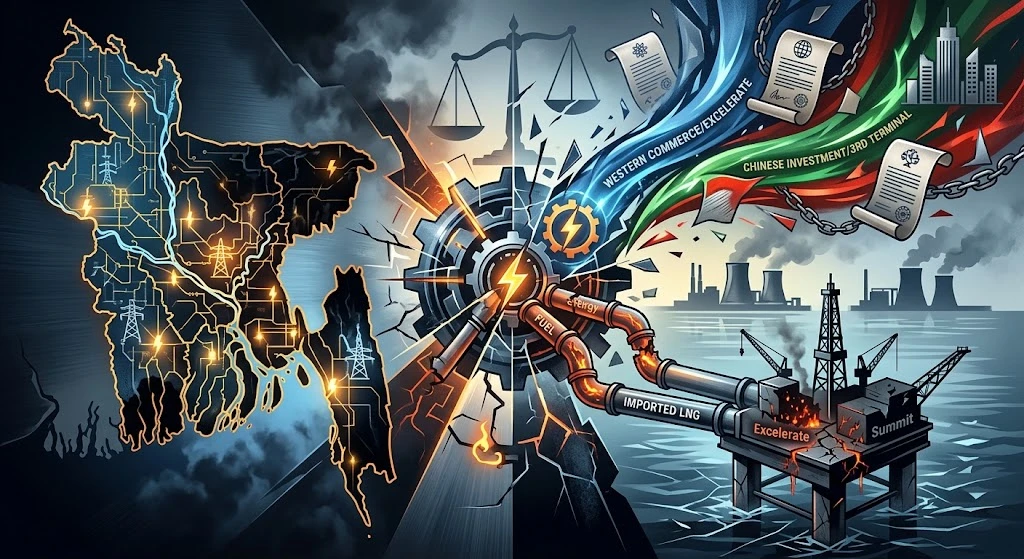
DHAKA, 15 August – — On paper, Bangladesh’s power sector is an infrastructure success story. Over the past two decades, the country expanded its nominal generation capacity from around 5,000 megawatts across 29 power stations in 2005 to between 29,000 and 32,000 megawatts across 137 facilities today.
Yet, with national peak demand hovering at a modest 16,000 megawatts—nearly half of installed nameplate capacity—vast swathes of the country continue to experience debilitating power outages.
The discrepancy between surplus capacity and rolling blackouts is not merely an engineering anomaly. An examination of the country’s fuel arteries reveals that paper capacity cannot generate electricity without primary feedstock, leaving Bangladesh caught at the intersection of maritime supply bottlenecks and high-stakes international energy diplomacy.
The Fuel Architecture Trap
Bangladesh’s grid relies heavily on imported and domestic fossil fuels:
-
Natural Gas: Accounts for approximately 12,000 megawatts of generation, making it the grid’s indispensable base.
-
Coal and Cross-Border Imports: Mega-plants such as Payra, Rampal, and Matarbari, alongside direct imports from India’s Adani Power, provide over 20% of essential baseload requirements.
-
Liquid Fuels & Renewables: Furnace oil, diesel, hydropower, and solar account for the residual mix.
Because domestic gas exploration has failed to keep pace with industrialization, the country relies on offshore Liquefied Natural Gas (LNG) imports. This entire supply chain funnels through just two offshore Floating Storage and Regasification Units (FSRUs) moored off Moheshkhali: one operated by U.S.-based Excelerate Energy and the other by local conglomerate Summit Group.
Bangladesh’s Power Generation Divide
| Metric / Category | Capacity & Details |
| Total Installed Capacity | ~29,000 – 32,000 MW |
| Average National Demand | ~16,000 MW |
| Gas-Fired Share | ~12,000 MW (Critically dependent on LNG) |
| Coal & Cross-Border Supply | >20% (Payra, Rampal, Matarbari, Adani) |
Simultaneous Outages and Strategic Friction
The vulnerability of this concentrated supply chain became apparent following simultaneous disruptions at both offshore terminals:
-
The Excelerate Outage: On July 21, a fire broke out at the Excelerate Energy FSRU, compromising boiler and electrical systems and cutting approximately 450 to 500 million cubic feet of daily gas supply from the national grid.
-
The Summit Disruption: Simultaneously, Summit’s operations faced constraints, attributed officially to adverse monsoon weather and vessel logistical hurdles.
With nearly half of the country’s imported gas processing capacity severed at once, gas-fired power plants were forced to scale down, triggering immediate nationwide load-shedding.
However, observers argue that the timing of these operational setbacks coincides with deepening geopolitical maneuvering.
The Sino-U.S. Fault Line in the Bay of Bengal
The subtext of Bangladesh’s energy dilemma centers on plans for a third LNG import terminal.
While Western partners have long sought primacy over Bangladesh’s maritime energy corridor, Dhaka moved to finalize arrangements with Chinese state enterprises for the development of the third terminal—an agreement inked shortly after the Moheshkhali disruption.
This development touches key diplomatic nerves:
-
Commercial Counterweights: The inclusion of Chinese infrastructure into the Bay of Bengal challenges existing bilateral trade understandings and commercial exclusivity in critical energy logistics.
-
Diplomatic Personnel: Highlighting the convergence of diplomacy and commerce, Excelerate Energy appointed Peter Haas, the former United States Ambassador to Bangladesh, as its Strategic Advisor shortly after his diplomatic retirement.
Analytical Outlook: Fuel Security vs. Nameplate Power
The ongoing power crisis underscores that generation capacity alone does not guarantee energy security.
When critical fuel import channels are heavily centralized, domestic energy availability becomes captive to maritime technical vulnerabilities and external commercial leverage. Until Bangladesh diversifies its fuel infrastructure and navigates competing superpower interests with greater strategic autonomy, the gap between paper megawatts and real-world electricity will continue to leave consumers in the dark.





COMMENTS