
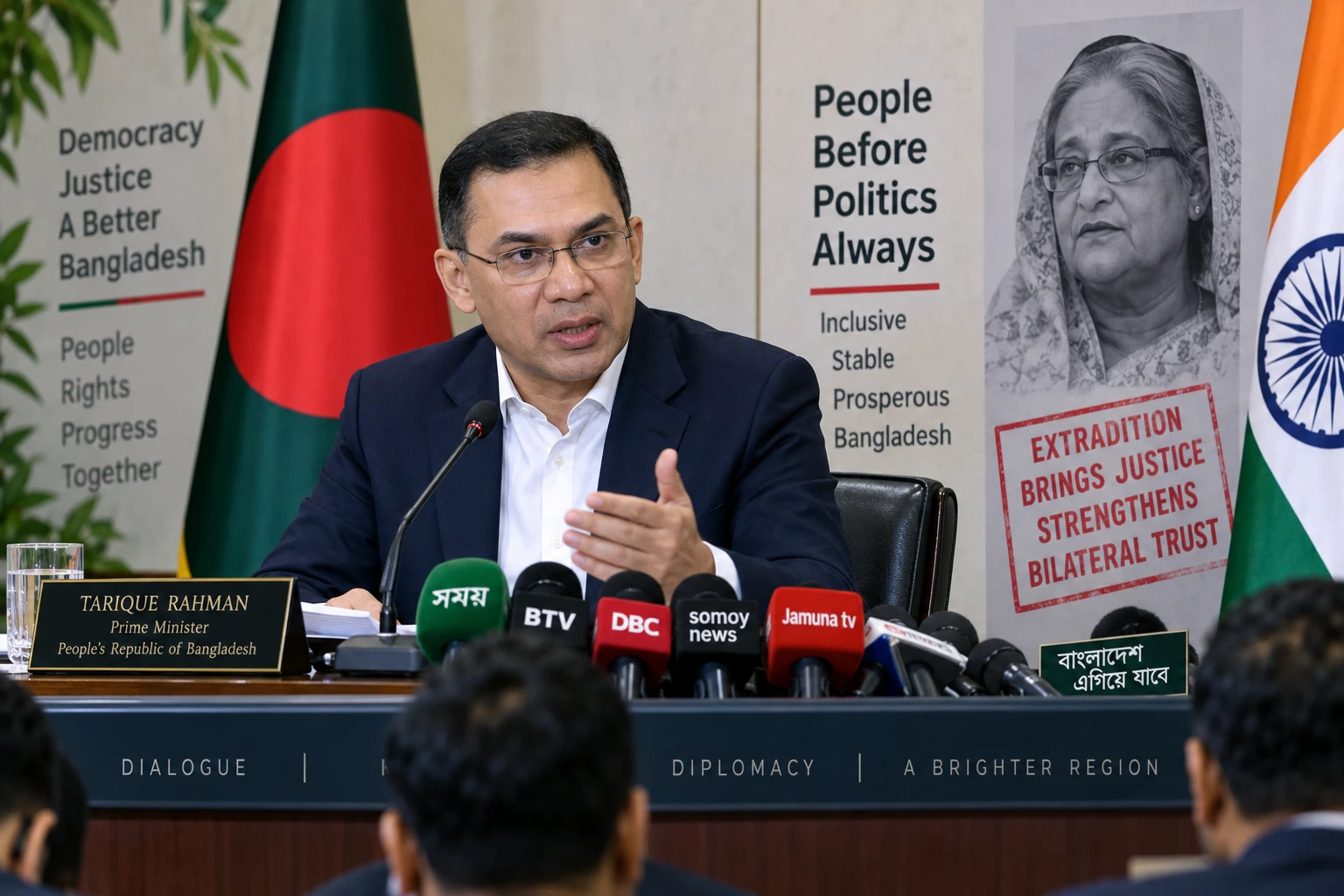
Dhaka, 17 August – Bangladesh has said Prime Minister Tarique Rahman will not visit India until New Delhi extradites former prime minister Sheikh Hasina, who fled to India following the 2024 uprising that brought down her government.
The announcement has raised questions over the reasoning behind Rahman’s position. Is it a calculated diplomatic strategy aimed at increasing pressure on India to hand over Hasina—or is the new Bangladeshi prime minister taking an overly rigid approach that could complicate relations with a strategically important neighbour?
Bangladesh and India have already faced strained relations since the fall of Hasina’s government. Dhaka has repeatedly requested her extradition after she was convicted in Bangladesh of crimes against humanity and sentenced to death. India, however, has said the extradition request remains “under examination.”
Speaking to reporters on Sunday, Bangladesh’s foreign ministry official A.K.M. Shahidul Karim played down speculation that Rahman could visit India next week.
“We are of the view that a propitious environment needs to be created for the visit,” Karim said, adding that Dhaka had urged India to “expedite their efforts” to extradite Sheikh Hasina and other fugitives.
Rahman’s position can be viewed as a diplomatic bargaining strategy. By linking a high-level bilateral visit to the extradition issue, Dhaka is signalling that the matter is not merely a legal dispute but a central political concern for the new government.
But there is also a potential downside.
India’s decision on extradition is ultimately a matter for New Delhi, and publicly conditioning a prime ministerial visit on an outcome Bangladesh cannot directly control could narrow diplomatic space. A visit itself could provide an opportunity for direct discussions on Hasina’s extradition, border security, trade, water sharing and other bilateral issues.
That raises a broader question: is Rahman using the visit as diplomatic leverage, or is he allowing the Hasina issue to become an obstacle to broader Bangladesh-India relations?
For Rahman, the political stakes are undoubtedly high. Sheikh Hasina remains one of the most contentious figures in Bangladesh’s post-2024 political landscape, and any perception that the new government is softening its position toward her could carry domestic political costs.
At the same time, refusing to visit India until Hasina is extradited could be interpreted in New Delhi as an ultimatum—something that may make an already sensitive diplomatic relationship even more difficult.
The key question, therefore, is not simply why Tarique Rahman does not want to visit India without Hasina’s extradition. It is whether this stance represents a carefully calculated diplomatic strategy designed to extract concessions from New Delhi—or an emotionally and politically driven position that could ultimately leave Bangladesh with less diplomatic room to manoeuvre.
COMMENTS