
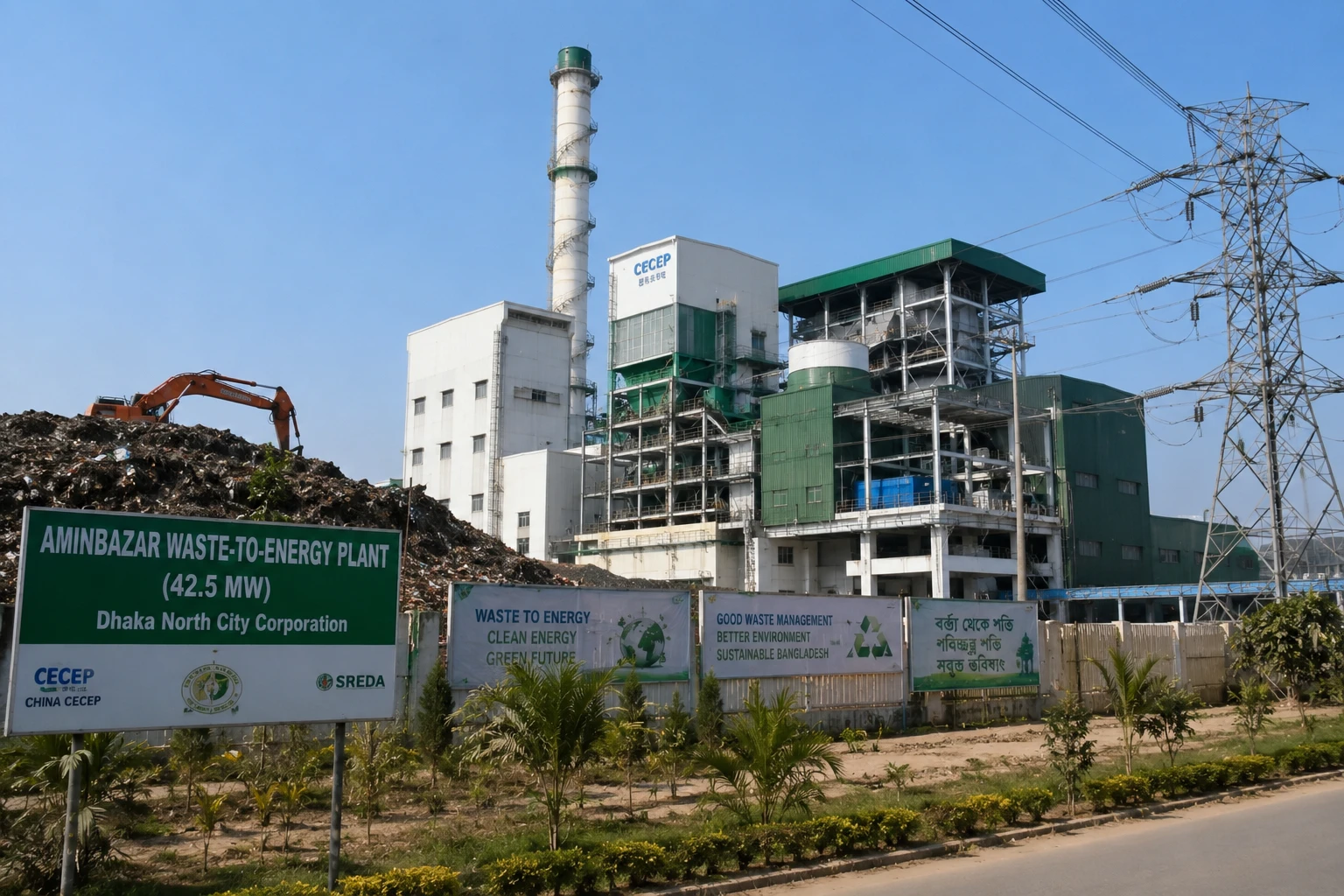
DHAKA – The electricity tariff for a waste-to-energy project in Aminbazar, Dhaka, originally equivalent to Tk 18.295 per unit, is now expected to cost Bangladesh around Tk 25 per unit because the tariff was set in US dollars and the value of the taka has fallen significantly.
The project, with a capacity of 42.5 megawatts, was approved in principle in November 2020. Under the proposed agreement, Bangladesh Power Development Board (BPDB) was to purchase electricity for 25 years at a tariff of 21.78 US cents per unit. At the exchange rate prevailing at the time, that was equivalent to Tk 18.295.
China Machinery Engineering Corporation (CMEC), a Chinese state-owned company, was later selected as the project sponsor. The project was planned under a Build-Own-Operate (BOO) model, with Dhaka North City Corporation expected to provide land and waste, while CMEC would build and operate the power plant.
The same tariff of 21.78 US cents, equivalent to Tk 18.295 at the then-prevailing exchange rate, was also reflected in the draft Power Purchase Agreement (PPA) in August 2021.
CMEC, however, is not reportedly seeking a newly increased dollar tariff. Rather, the higher cost in taka results from converting the unchanged dollar-based tariff at the current exchange rate. As a result, the effective price has increased by roughly 37 percent in local currency terms.
This has raised questions about whether Bangladesh should have sought to renegotiate the tariff or share the exchange-rate risk after the project faced years of delays.
The key issue is therefore not simply whether the Chinese company has increased its price, but why the government is proceeding with the old dollar-denominated tariff without apparently seeking more favorable financial terms following the delay in project implementation.
Questions over renegotiation
The project’s implementation timeline has stretched well beyond the period when electricity generation was initially expected to begin. During this period, the taka has depreciated substantially against the US dollar, increasing the cost of dollar-denominated power purchases.
Other economic conditions have also changed since 2021, including construction costs, foreign-exchange market conditions, financing costs and the broader financial situation of Bangladesh’s power sector.
Against this backdrop, questions have emerged over why the tariff was not reconsidered before the project was finalized.
If the government maintains that the 21.78-cent tariff is contractually fixed and cannot be changed, the relevant contractual provisions should be made public, critics argue. Conversely, if renegotiation is legally possible, questions remain over why Bangladesh did not seek lower tariffs or a mechanism to share the foreign-exchange risk.
Allegations surrounding minister’s son
Separate allegations have also circulated in political and social circles concerning Abed Hasan Mahmud, the son of Power Minister Iqbal Hasan Mahmud Tuku. The allegations claim that he has been involved in facilitating benefits for the Chinese company in exchange for financial transactions.
These allegations have not been independently established in the information available publicly.
The financial implications of the Aminbazar project, however, remain significant regardless of those allegations. A tariff that was equivalent to Tk 18.295 per unit in 2020-21 could now cost approximately Tk 25 per unit solely because of the depreciation of the taka.
The controversy has therefore renewed debate over whether Bangladesh should accept the full exchange-rate burden of a project whose implementation has been delayed for several years, or seek revised terms that better protect the country’s financial interests.



COMMENTS