
A Liberation Army That Lost Its Way
Bangladesh was born in blood and fire. In 1971, millions of ordinary people, peasants, students, workers, women, people of every faith and background, fought together to carve out a nation from the ruins of Pakistani military oppression. The Liberation War was as much a war of ideas as it was of arms. Secularism, Democracy, Socialism, and Bengali Nationalism were not mere slogans. They were the founding soul of the republic.
Yet the army that inherited the defense of this secular, pluralist nation was not, by and large, built from the fighters who had won it. Much of the officer corps came from the ranks of the former Pakistan Army, carrying with them institutional habits, cultural loyalties, and political instincts shaped under Pakistani military rule. Decades later, that inheritance continues to cast a long shadow over Bangladesh’s democratic life.
God in the Barracks: The Creeping Islamization of the Military
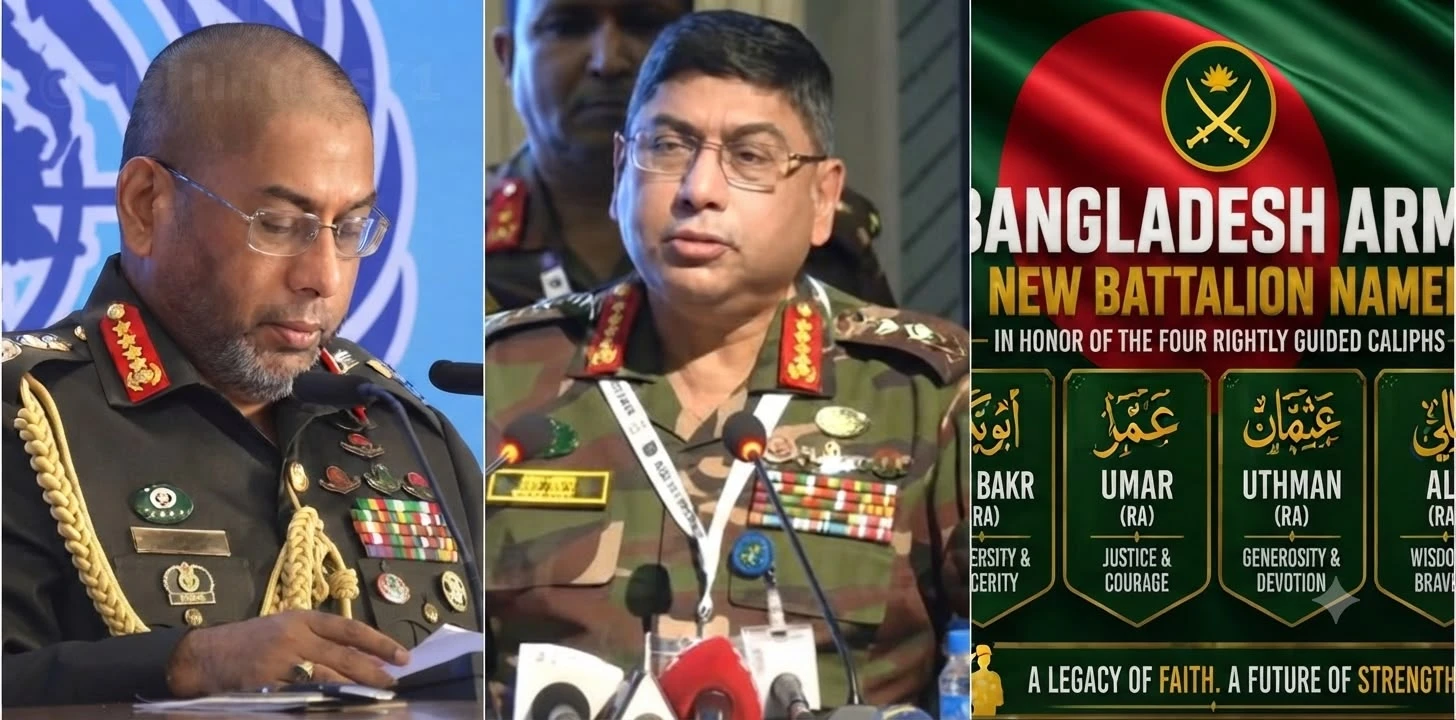
In recent months, a quiet but consequential development has stirred public debate. A newly raised Bangladesh Army battalion reportedly named four of its companies after the first four caliphs of Islam: Abu Bakr, Umar, Uthman (Usman), and Ali. For some, this is a harmless nod to Islamic historical tradition. For others, it is a visible and troubling sign of something larger, namely the gradual Islamization of an institution that is constitutionally required to remain religiously neutral.
This is not an isolated incident. Senior military leaders have drawn attention for public displays of religious identity that depart from long-standing institutional norms. Remarks by the president of the Retired Army Officers’ Association, in which he reportedly spoke of attacking a neighboring country and articulated ambitions extending beyond Bangladesh’s borders, raised eyebrows across the political spectrum. What was equally striking was the silence. No public dissent. No official distancing. Just quiet acceptance.
Bangladesh’s Constitution names secularism as one of the republic’s foundational pillars. The army, as a national institution, belongs to all 170 million Bangladeshis, including its Hindus, Buddhists, Christians, and Indigenous communities. When the symbols, rhetoric, and institutional culture of the armed forces begin to reflect the identity of one religion above all others, it does not simply offend constitutional principles. It makes a large portion of the citizenry feel like guests in their own republic.
Bangladesh Army Works on Islam, Not Security
The establishment of the Army International Islamic Institute (AIII) in 2026 has added a new dimension to the growing debate over the Bangladesh Army’s institutional priorities. Brigadier General Md. Humayun Kabir, SUP (Bar), SPP, ndc, psc, MPhil, serves as the Chairman of the institute. Supporters may argue that the institute is intended to promote moral values and religious education among military personnel. However, its creation has also raised important questions about whether the armed forces are gradually expanding their role beyond national defence into the promotion of a particular religious outlook. In a country whose Constitution upholds religious freedom and whose armed forces have traditionally been regarded as professional and non partisan institutions, the establishment of an Islamic institute under the Army is likely to intensify concerns about the increasing influence of religion within state institutions. At a time when Bangladesh faces pressing security challenges, critics argue that strengthening military professionalism, operational readiness, and national defence should remain the Army’s foremost responsibility, rather than investing institutional resources in religious initiatives. This development has therefore become another focal point in the wider debate over the relationship between the military, religion, and the future secular character of the Bangladeshi state.
The Army in the Boardroom: A Commercial Empire in Uniform
Bangladesh’s military has not limited its ambitions to matters of faith. Over the past few decades, the army has expanded its presence deep into the civilian economy, running schools, universities, hospitals, housing schemes, and a growing portfolio of commercial enterprises. Military-affiliated organizations are now significant players in sectors that have nothing to do with national defense.
Supporters of these initiatives argue that they promote the welfare of military personnel and contribute to national development. There is some truth in that. But there is another truth that does not get spoken nearly as often: a military that runs businesses has interests that go beyond security. It has shareholders. It has contracts. It has profits to protect.
When an institution responsible for the nation’s defense also holds substantial economic stakes in civilian sectors, the question of democratic accountability becomes deeply uncomfortable. Who oversees these enterprises? Who audits them? Who can a citizen complain to if a military-run school charges illegal fees or a military-linked developer displaces communities for a housing project? The answer, more often than not, is nobody.
A military with commercial interests is a military with reasons to resist civilian oversight. And a military that resists civilian oversight is not a defense force. It is a state within a state.
Coups, Caretakers, and the Democracy That Keeps Getting Interrupted
Bangladesh has been independent for over five decades. In that time, it has experienced direct military coups, martial law, military-backed caretaker governments, and the assassination of two heads of government by military officers. The pattern is not a coincidence. It is a structural problem rooted in an army that was never fully subordinated to civilian democratic authority.
Unlike the militaries of countries that fought prolonged conventional wars and learned hard lessons about the limits of military governance, the Bangladesh Army has never actually fought a war since independence. It has not faced an external adversary on the battlefield. Its senior officers have no experience of the brutal, humbling realities of actual combat, which in many countries produces a healthy institutional respect for political authority and a deep reluctance to see soldiers die for avoidable political misadventures.
Instead, the Bangladesh Army has historically turned its attention inward, towards the government, towards politics, towards the acquisition of institutional power and privilege. The result has been an institution that is very good at accumulating influence and very poor at staying in its constitutional lane.
A Big Budget for a Military That Has Not Fought a War
Here is a question that rarely gets asked loudly in Bangladeshi public life: what exactly does the Bangladesh Army spend all that money on?
Defense spending consumes a substantial and consistently growing share of Bangladesh’s national budget. The army absorbs the lion’s share of that allocation. Yet since independence in 1971, Bangladesh has not fought a single conventional war. It has no active military conflict with any of its neighbors. Its border disputes, when they arise, are handled through diplomacy. Its primary security challenges are internal, related to governance, not warfare.
This is not to say that a military is unnecessary. Every sovereign state needs one. But a military that has never been tested in combat, that faces no credible conventional threat on its borders, and that nevertheless demands and receives ever-larger portions of the public purse, owes its citizens a serious accounting. The schools that did not get built, the hospitals that remained understaffed, the roads that stayed broken because money went to defense procurement instead, these are not abstract fiscal statistics. They are real costs borne by real people.
Where exactly this money goes, how procurement decisions are made, and who benefits from defense contracts remain questions that the public has remarkably little access to. In a functioning democracy, defense spending is subject to legislative scrutiny and public debate. In Bangladesh, it has too often been treated as a domain beyond civilian curiosity.
What Kind of Nation Are We Building?
Bangladesh’s greatest strength has always been its people and their extraordinary capacity for collective struggle. The Liberation War proved that. So did the language movement before it. So did countless moments of resistance against authoritarianism in the decades since.
The founding ideals of 1971 were not vague aspirations. They were a specific, hard-won vision of a country where faith would be a private matter, where the state would belong equally to all its citizens, where democratic governance would be the only legitimate form of authority, and where the military would serve the constitution rather than substitute for it.
Holding the army to those standards is not anti-military sentiment. It is the most basic requirement of democratic citizenship. An army that Islamizes its institutional identity, builds commercial empires, repeatedly meddles in politics, and consumes public resources without commensurate accountability or battlefield purpose is not protecting Bangladesh. It is slowly reshaping it in its own image.
The people of Bangladesh deserve better. They deserve an army that is professional, politically neutral, religiously inclusive, and genuinely accountable to the citizens it was created to defend. That is not an unreasonable demand. It is simply what was promised in 1971.
The question is whether anyone in power still remembers that promise, and whether the rest of us are willing to keep demanding it be kept.
The Author is a Lawyer and Human Rights Defender


COMMENTS