
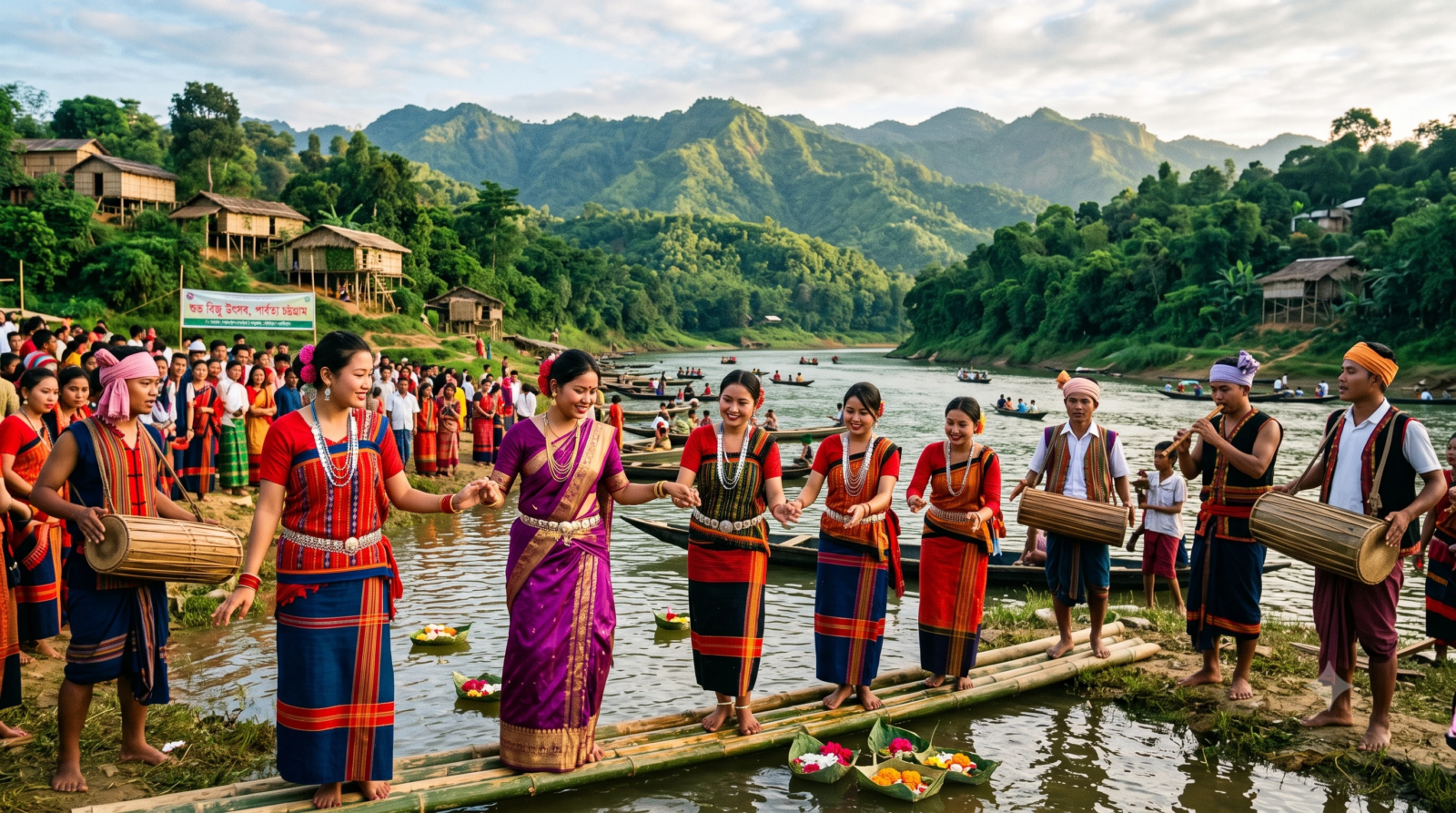
Recognition, Identity and the Constitutional Question
There is little ambiguity, within Bangladesh’s Constitution or the country’s long established social fabric, regarding the ethnic identity of the various tribal and indigenous communities that have lived in different parts of the country for generations. Yet, among sections of the educated population of some communities living in the hills, there is now an increasingly vocal demand for formal recognition of all such communities as “indigenous peoples” of Bangladesh.
The issue has become the subject of an increasingly intense national debate.
At first glance, the demand may appear to be a straightforward appeal for cultural recognition. Yet the matter deserves a much more careful examination because the legal and political implications of the term “indigenous” can extend considerably beyond cultural identity.
Bangladesh’s Constitution already provides specific recognition and protection for the country’s smaller ethnic communities. Article 23A places emphasis on the preservation of the culture and traditions of “tribes, minor races, ethnic sects and communities.” The Constitution directs the state to take measures for the protection, development and advancement of their distinctive regional cultures and traditions.
This constitutional commitment was further reinforced by the Chittagong Hill Tracts Peace Accord of 1997, which sought to establish a framework for greater regional participation in governance while giving due importance to the cultural, social and political rights of the people of the hill districts.
The question, therefore, is not whether the cultural identity and rights of these communities should be protected. They unquestionably should.
The more fundamental question is what additional legal and political consequences are intended by the demand for formal recognition as “indigenous peoples”.
From Cultural Recognition to Political Identity
The distinction matters.
If the demand is principally about protecting language, culture, customary practices, heritage and legitimate land rights, then Bangladesh has both a constitutional obligation and a moral responsibility to address those concerns.
However, if the terminology is intended to establish a separate legal identity carrying claims that could challenge the constitutional character, territorial integrity or unitary structure of the Bangladeshi state, then the issue enters an entirely different political and legal domain.
This is where the debate becomes particularly important.
Does the demand for a distinct “national identity” and “indigenous” status arise from a genuine desire for cultural preservation and meaningful local participation? Or could it, in some political interpretations, become a strategic pathway towards expanded territorial autonomy and ultimately a more fundamental challenge to the existing constitutional order?
That question should not be dismissed, nor should it be answered through emotion. It requires careful examination of history, constitutional law, international law and the contemporary security environment.
The Legacy of the 1900 Chittagong Hill Tracts Regulation
Much of the historical argument surrounding identity in the Chittagong Hill Tracts ultimately leads back to the Chittagong Hill Tracts Regulation of 1900, an instrument created during British colonial rule.
The Regulation treated the hill region as a distinct administrative area and established special arrangements for its governance. It provided the Deputy Commissioner with extensive administrative authority and established particular rules concerning the application of laws and regulations in the region.
It also contained provisions relating to land administration, including the acquisition of land for public purposes and the allocation of land for settlement. A particular judicial and administrative framework was established, together with defined powers for government officials.
Historically, however, the Regulation should be understood within the context of colonial administration. It was fundamentally a mechanism of control rather than an instrument designed to empower the inhabitants of the region in the modern democratic sense.
The British administration had strategic reasons for maintaining special administrative arrangements in the hill areas, including controlling access to the frontier and limiting the movement of political and anti colonial forces.
The important question today is whether a colonial administrative instrument created for the purposes of imperial governance should be transformed into the principal legal foundation for constructing a separate contemporary political identity.
History should inform present policy. It should not necessarily dictate it.
The Peace Accord and the Unfinished Questions
The signing of the Chittagong Hill Tracts Peace Accord in 1997 represented a historic effort by the Government of Bangladesh and the armed representatives of the hill communities to end years of conflict.
The Accord addressed several critical issues, including reform of local governance, protection of land rights, rehabilitation and the gradual adjustment of the security presence in the region.
Yet implementation has remained incomplete and uneven. This has understandably generated frustration among sections of the hill communities.
Land ownership, local administration, political representation and the appropriate role of the security forces remain sensitive and unresolved issues. These questions deserve serious attention because unresolved grievances can create political space for radical narratives and external influence.
But there is an important distinction between correcting shortcomings in the implementation of the Peace Accord and creating a separate legal identity that could eventually produce competing claims over sovereignty or territorial authority.
The first is a legitimate responsibility of the state.
The second requires considerably greater constitutional and national scrutiny.
International Law and the Geopolitical Dimension
The debate becomes more complicated when viewed through the framework of international instruments concerning indigenous peoples, including the United Nations Declaration on the Rights of Indigenous Peoples and International Labour Organization Convention 169.
These international frameworks provide important protections concerning cultural identity, participation, land, community rights and forms of self determination. For communities that identify themselves as indigenous peoples, such instruments can provide significant international recognition and legal advocacy mechanisms.
For Bangladesh, however, the discussion must also take account of the country’s constitutional structure and territorial integrity.
The Chittagong Hill Tracts are situated within a particularly sensitive geopolitical environment. Bangladesh shares borders with India and Myanmar, while the wider southeastern region has experienced armed conflict, displacement, insurgency and cross border instability.
The continuing conflict between the Arakan Army and Myanmar’s military has created an increasingly volatile security environment along Bangladesh’s southeastern frontier. The activities of armed groups in the broader region have added another layer of complexity.
Bangladesh is also carrying the enormous humanitarian burden created by the displacement of Rohingya people from Myanmar. The presence of a very large refugee population in the country’s southeastern region has created significant social, economic and security pressures.
Against this background, the security dimension of the Chittagong Hill Tracts cannot simply be separated from the broader regional environment.
Security Without Alienation
This does not mean that the legitimate concerns of the hill communities should be subordinated to security considerations.
Quite the opposite.
The stronger the sense of citizenship, justice and equal protection among all communities, the stronger Bangladesh’s national security foundation will become.
The presence of security forces in a sensitive frontier region must therefore be managed with exceptional care. Security personnel must operate within the law, with respect for civilian rights and with the clear objective of protecting every community rather than creating a sense of alienation among any particular population.
At the same time, the state must ensure that security arrangements are not weakened in a manner that leaves the country’s frontier vulnerable to armed groups, trafficking networks or external interference.
Security and citizenship should reinforce each other, not compete with each other.
The Better Answer: Equality Within Unity
The most constructive answer to the current debate is neither denial nor confrontation.
Bangladesh needs a framework in which Bengali and hill communities alike can confidently say: this country belongs to all of us.
That requires stronger legal protection for legitimate land rights, effective implementation of the practical commitments contained in the 1997 Peace Accord, meaningful local governance, protection of cultural heritage and equal access to justice.
The appropriate response is therefore not necessarily to create a new legal category that could deepen ethnic separation. It is to ensure that existing constitutional guarantees are implemented with greater seriousness, fairness and effectiveness.
The Government should address the unresolved questions of land ownership and local administration through transparent legal mechanisms. The concerns of indigenous and tribal communities should be heard through democratic institutions. Cultural rights should be protected. Traditional heritage should be preserved. Local participation in governance should be strengthened.
At the same time, these measures should reinforce, rather than weaken, the shared constitutional identity of Bangladesh.
One Bangladesh, Many Communities
Bangladesh has never been culturally or ethnically uniform. Its history has been shaped by the interaction of many communities, languages, traditions and faiths.
The Chakma, Marma, Santal, Tripura, Garo, Oraon, Tanchangya, Mro, Bawm, Pankho, Chak, Khyang, Khumi, Lusai, Koch, Dalu, Kuki, Rakhine, Manipuri, Hajong, Khasi, Mong, Barman, Mal Paharia, Munda, Kol, Kandh, Pangan, Laora, Murong, Rajbanshi, Patra, Bagdi, Bhil, Tipra, Ranjhogi, Hadi and Kharia communities, among many others, are part of the country’s social and cultural landscape.
Their identity should not be regarded as a threat to Bangladesh.
Equally, their distinct identity should not become a reason for creating permanent political separation.
The real challenge is to build a Bangladesh in which diversity strengthens national identity rather than fragments it.
The Bengali majority has a responsibility to protect and embrace the country’s smaller ethnic communities with dignity, equality and affection. The state, in turn, must guarantee that every citizen, regardless of ethnic identity, enjoys equal protection under the law and equal access to citizenship rights.
For generations, these communities have shared the land, history and social life of Bangladesh. The objective should therefore be to preserve that relationship, not to turn historical differences into permanent political boundaries.
The Choice Before Bangladesh
The time has come for Bangladesh to identify a path that can reconcile cultural diversity with national unity.
Every citizen should be able to feel that the state belongs to them, that the law protects them, that their culture is respected and that their future is inseparable from the future of Bangladesh.
The answer lies neither in suppressing legitimate ethnic aspirations nor in encouraging political narratives that divide citizens into competing national identities.
The answer lies in justice, equality, constitutional protection, responsible local governance and mutual trust.
Bangladesh can protect the distinctive identity of its hill communities without weakening its national unity. It can preserve cultural diversity without creating political fragmentation. It can address historical grievances without allowing history to become a permanent instrument of division.
The ultimate objective should be simple and profound: a Bangladesh where Chakma, Marma, Santal, Tripura, Garo, Rakhine, Khasi, Munda and every other community can preserve its own heritage while confidently belonging to one democratic republic.
That is not merely a question of constitutional interpretation.
It is a question of what kind of Bangladesh the next generation will inherit.
Author: Mujtoba Ahmed Murshed is a Political Analyst, Poet and Fiction Writer

COMMENTS