
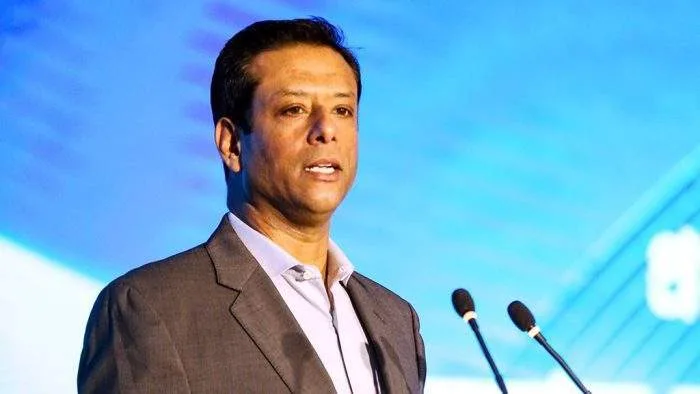
NEW DELHI — Sajeeb Wazed Joy, son and former ICT adviser to former Bangladesh Prime Minister Sheikh Hasina, has warned that Pakistan’s Inter-Services Intelligence has gained unprecedented room to operate in Bangladesh while militants and convicted extremists imprisoned during the Awami League government have returned to public life.
Speaking on Wednesday, August 5, at a media interaction hosted by the Foreign Correspondents’ Club of South Asia in New Delhi, Joy argued that Bangladesh’s changing security environment should concern not only the country itself, but also India and the wider international community.
The event, held exactly two years after the fall of the Awami League government on August 5, 2024, also featured Sheikh Hasina and several other Awami League figures. Joy and other leaders appeared by video before Hasina delivered an audio address. It was Hasina’s first direct media interaction since leaving Bangladesh for India two years earlier.
A central part of Joy’s intervention focused on the resurgence of militant organizations and growing Pakistani influence.
“Pakistan’s ISI has an open hand in Bangladesh,” Joy said.
Militants returning to public life
Joy said the Awami League government had arrested, prosecuted and imprisoned numerous militants during its years in office, but alleged that hundreds were subsequently released.
He pointed to renewed public activity by Hizb ut-Tahrir, a banned Islamist organization, and alleged that figures linked to Al-Qaeda-associated networks had appeared openly at public gatherings.
His broader argument was that Bangladesh was losing some of the counterterrorism gains achieved during the Awami League era and that the consequences could eventually extend beyond South Asia.
Some developments cited by Joy have been independently documented, although available evidence does not establish every part of his broader allegation.
In September 2024, Bangladesh’s inspector general of prisons said at least 43 high-profile criminals and militants had obtained bail after the fall of the Hasina government. Seventeen prisons had also been attacked from July 19 onward, allowing more than 2,000 prisoners to escape. More than 900 were still at large at the time, including 70 militants.
Among those released was Mufti Jashimuddin Rahmani, chief of the banned Ansarullah Bangla Team, an Al-Qaeda affiliate in Bangladesh. Rahmani was released on bail from Kashimpur High-Security Central Jail on August 26, 2024, after securing bail in four cases. He had previously been sentenced to five years for inciting the murder of blogger Ahmed Rajib Haider.
Public activity by Hizb ut-Tahrir has also been documented. Supporters of the banned group joined a large march in Dhaka on March 7, 2025, demanding establishment of a caliphate.
Joy cited such developments as evidence of a worsening security environment, while extending his allegation further by claiming that the ISI now has an “open hand” in Bangladesh.
‘Another Pakistan’ on India’s eastern side
Joy emphasized the implications for India, arguing that New Delhi could no longer treat political and security changes in Bangladesh as purely an internal matter.
India, he suggested, already faces Pakistan on its western frontier and could now find itself confronting a Pakistan-influenced security environment on its eastern side as well.
He warned that unless militant organizations were contained, Bangladesh could eventually become a source of recruits or operational support for future international terrorist networks.
Joy has raised similar concerns since 2024, repeatedly warning that the weakening of secular political forces and the re-emergence of Islamist organizations could alter Bangladesh’s strategic orientation and create new risks for India.
Bangladesh-Pakistan relations have meanwhile warmed significantly since the change of government in Dhaka.
In January 2026, the air force chiefs of the two countries discussed a potential defense agreement and Bangladesh’s possible purchase of Pakistan’s JF-17 Thunder fighter aircraft. The talks followed broader growth in bilateral trade and defense contacts that had remained limited during much of Hasina’s tenure.
That shift does not by itself substantiate Joy’s allegation about ISI operations, but it forms part of the changed regional environment underlying his warning.
Appeal to journalists
Joy also appealed to journalists to maintain international attention on developments inside Bangladesh.
He described India as the world’s largest democracy and said Indian media could help ensure that political, security and human rights developments in Bangladesh remained visible internationally.
He argued that diplomatic relationships can change quickly and said India should assess Bangladesh not only through immediate government-to-government relations but also through longer-term strategic consequences.
Joy cited the changing relationship between Washington and Islamabad, noting that U.S.-Pakistan ties had shifted significantly over a relatively short period.
Joy disputes UN estimate of 2024 deaths
Joy also revisited the disputed death toll from the July-August 2024 upheaval.
He questioned the widely cited United Nations estimate of as many as about 1,400 deaths and contrasted it with a Bangladeshi government figure of roughly 800.
Joy asked where the additional approximately 600 names underlying the higher estimate had come from and said the Awami League and lawyers representing it had repeatedly sought clarification from the United Nations.
The dispute is longstanding.
In an interview earlier this year, Joy noted that the UN estimate covered July 15 to August 15, 2024 — extending 10 days beyond the August 5 collapse of the Awami League government. He also argued that the overall toll included police personnel and Awami League activists killed during the violence, rather than protesters alone.
Joy has previously said every death was regrettable and acknowledged that the Awami League government made mistakes in handling the initial protests. But he has disputed both the 1,400 figure and efforts to attribute the entire death toll to the former government.
He portrayed the disagreement over casualty figures as part of a wider contest over how the events of 2024 are being recorded and interpreted internationally.
Security argument rooted in Awami League’s record
Joy’s warning is closely tied to the Awami League government’s record of confronting militant organizations during Hasina’s long period in power.
Bangladesh suffered major extremist violence during the 2000s and 2010s, including attacks targeting secular writers, religious minorities, foreigners and civilians.
Successive counterterrorism operations dismantled militant networks, while several organizations were banned and their leaders prosecuted.
Hizb ut-Tahrir has been banned in Bangladesh since 2009. Ansarullah Bangla Team was later outlawed amid investigations into the murders of secular bloggers and activists.
Joy has repeatedly described the suppression of such groups as one of the Awami League government’s major security achievements. In an earlier interview this year, he said the Hasina era had brought comparative stability and terrorism under control.
From that perspective, the renewed visibility of banned organizations carries significant political and strategic meaning for the former ruling party.
Bangladesh’s political order has shifted again
Joy spoke at a time when Bangladesh had already moved beyond the interim government that took power after Hasina’s fall in August 2024.
Muhammad Yunus headed the interim administration, but a national election was held in February 2026 without Awami League participation. The Bangladesh Nationalist Party subsequently formed the government under Prime Minister Tarique Rahman.
Hasina says she will return in December
The event also drew international attention because Hasina reaffirmed that she intends to return to Bangladesh in December.
She said she was prepared to face imprisonment or even death and would announce the exact date later.
“I will return to my people,” Hasina said adding that possible imprisonment would not alter her decision.
Hasina was sentenced to death in absentia by Bangladesh’s International Crimes Tribunal in November 2025 over events surrounding the 2024 uprising. She has rejected the proceedings, describing the cases and verdicts against her as politically motivated and fabricated.
Bangladesh has sought her extradition from India.
Her declared return adds another layer of uncertainty to Bangladesh’s political environment. It would place the former prime minister directly inside a judicial and political system from which her party remains excluded and could also further test relations between Dhaka and New Delhi.
India said ahead of Wednesday’s event that the Foreign Correspondents’ Club engagement was a private initiative and that the Indian government had no role in organizing it.
Bangladesh framed as an international security issue
Joy’s central message, however, went beyond his mother’s return or the political future of the Awami League.
He sought to portray Bangladesh’s post-2024 transformation as a wider regional and international security question.
By linking the release and escape of militants, renewed visibility of banned Islamist organizations, growing Bangladesh-Pakistan contacts, alleged ISI activity, disputes over the historical record of the 2024 violence and the potential consequences for India, Joy argued that the developments should be viewed as interconnected rather than isolated.
His warning was that if those trends continue unchecked, the consequences may eventually extend far beyond Bangladesh itself.


COMMENTS