
A ‘Classic Case of Tax Evasion’
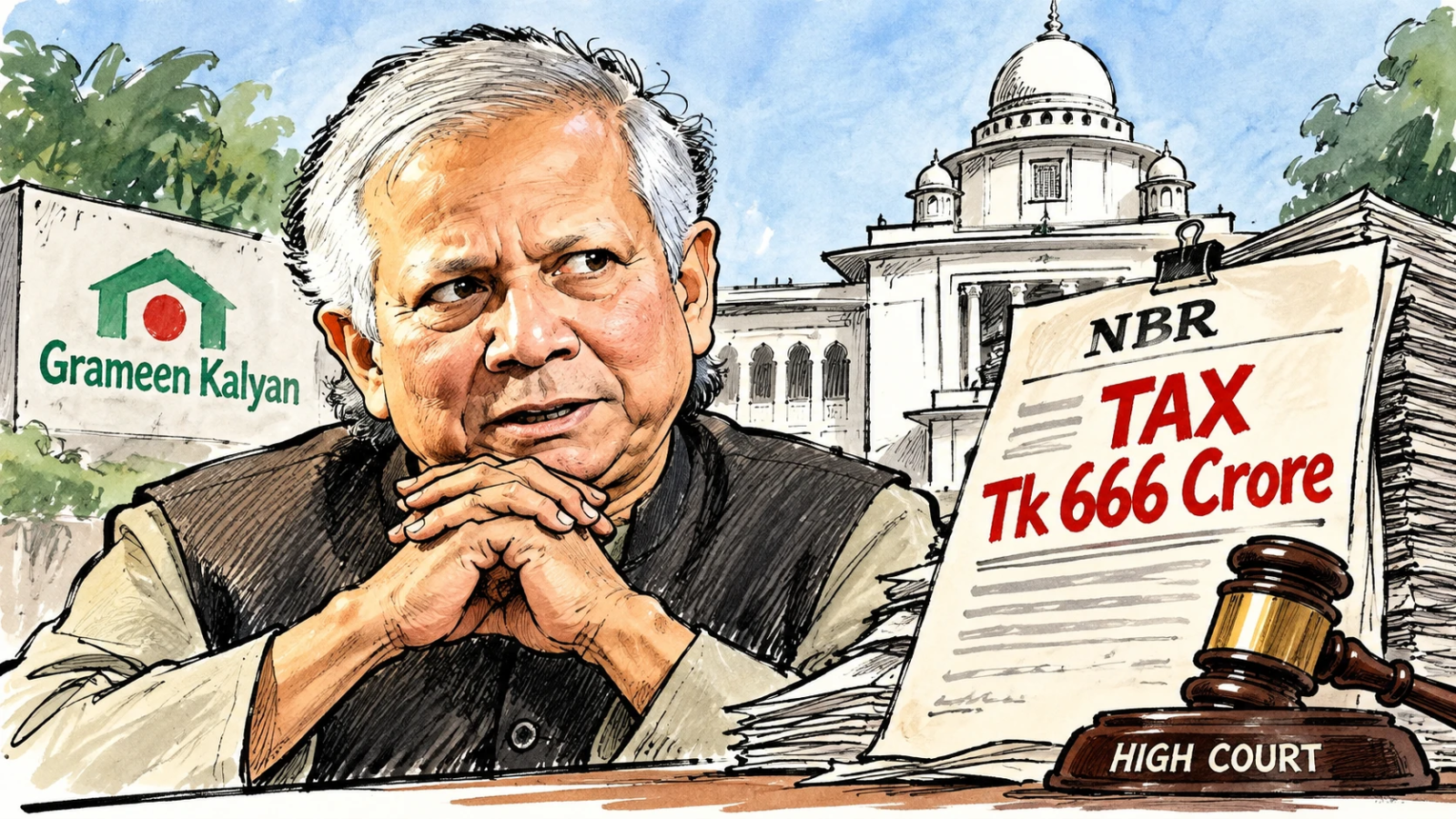
Bangladesh’s High Court has ordered tax authorities to recover Tk6.66 billion (666 crore) in unpaid taxes from Grameen Kalyan, an organization founded by Nobel Peace Prize laureate Muhammad Yunus, as quickly as possible in accordance with the law.
The directive came after the court rejected Grameen Kalyan’s legal challenges to tax assessments covering five fiscal years, according to two full judgments published Monday, Oct. 12.
The court’s observations go beyond a routine tax dispute. It found that Grameen Kalyan had sought to avoid its tax obligations by treating income received from Grameen Telecom as dividends and prolonging litigation over the assessments.
The rulings raise serious questions about financial accountability within the network of organizations established by Yunus, whose international reputation rests largely on his work in microfinance and social business.
Yunus, who served as chief adviser to Bangladesh’s former interim government, previously chaired Grameen Kalyan.
The judgments uphold the National Board of Revenue’s (NBR) tax demands relating to income earned through an investment arrangement involving Grameen Telecom.
Court Condemns Attempts to Avoid Tax Liability
A High Court bench comprising Justice Md Mozibur Rahman Miah and Justice Rezaul Karim delivered the judgments on Sept. 10, dismissing two petitions filed by Grameen Kalyan against tax assessments covering five fiscal years.
The full judgments, comprising 32 and 15 pages, were published on the Supreme Court’s website Monday.
In its observations, the court described the dispute as a “classic case of tax evasion by keeping a settled issue pending.”
The finding is particularly significant because it challenges the organization’s justification for withholding payment of a substantial tax demand while pursuing years of litigation.
The court directed the NBR to issue the necessary demand notices and take immediate steps to recover the outstanding amount in accordance with the law.
It also lifted earlier orders that had prevented the authorities from enforcing the tax demands.
The disputed liability totals Tk6,669,152,370, or approximately Tk6.67 billion, covering the assessment years 2012-13 through 2016-17.
Disputed Income From Grameen Telecom
At the center of the case is a financial arrangement between Grameen Kalyan and Grameen Telecom, another organization associated with Yunus.
Under their investment agreement, Grameen Kalyan received a share of profits generated through investments involving Grameenphone.
The dispute arose over whether those payments qualified as dividend income or should be treated as taxable income from other sources.
Grameen Kalyan argued that the payments were dividends and that taxes had already been deducted, making the additional demand unjustified.
Tax authorities rejected that interpretation, maintaining that the income was subject to separate taxation.
The High Court upheld the tax authorities’ position, finding no legal basis for Grameen Kalyan’s challenge.
The court’s observations indicate that the dispute was not simply about differing interpretations of tax rules. It found fault with the organization’s efforts to avoid paying the assessed amount through its treatment of the income and prolonged legal proceedings.
Years of Litigation Over Public Revenue
The tax dispute dates back to 2017, when the NBR demanded payment following reassessments covering five fiscal years.
Grameen Kalyan challenged the demands in the High Court, securing interim orders that prevented immediate recovery.
The litigation continued for years.
On Aug. 4, 2024, a High Court bench dismissed the organization’s legal challenges. That ruling was subsequently recalled, and the cases were reassigned to another bench after Yunus assumed power in what critics described as an unconstitutional transition following a violent movement involving various Islamist groups. At a Clinton Center program, Yunus later described the movement as a “meticulous design.” Yunus still had criminal convictions when he became chief adviser, raising questions about compliance with constitutional and legal requirements.
Meanwhile, the newly assigned High Court bench again rejected Grameen Kalyan’s petitions on Sept. 10, 2026.
The organization then sought to suspend the ruling through the Supreme Court’s Appellate Division. On Sept. 14, the chamber judge declined to intervene before the publication of the full judgments.
With those judgments now available, the legal obstacles to recovery have been removed, although Grameen Kalyan may pursue further appeals.
Questions Over Yunus’ Financial Accountability
The verdict places renewed scrutiny on the financial practices of an organization founded and previously chaired by Yunus.
The Nobel laureate, who served as Bangladesh’s interim government chief adviser following the August 2024 political changeover, has long promoted social business as a model combining commercial activity with social objectives.
The High Court’s findings, however, expose a substantial tax dispute involving one of the organizations established under that broader vision.
The court’s characterization of Grameen Kalyan’s conduct as tax evasion is particularly damaging to the organization’s claims of financial responsibility.
The case also raises questions about why a charitable organization allowed a tax dispute involving billions of taka in public revenue to remain unresolved for nearly a decade.
Nevertheless, the judgment concerns Grameen Kalyan’s corporate tax obligations.






COMMENTS