
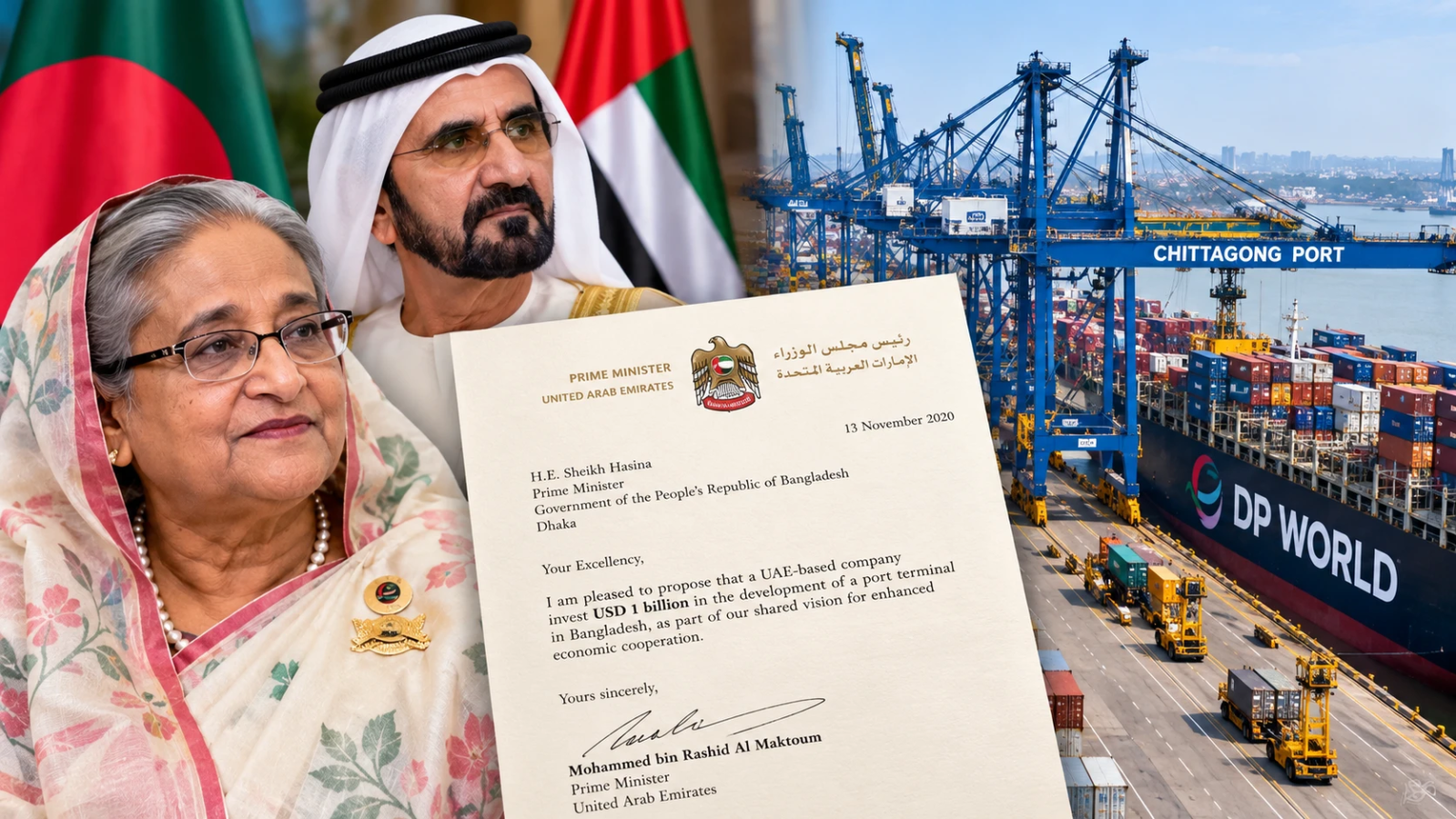
DHAKA, Bangladesh — The decision to award a 15-year concession to Dubai-based DP World to operate Chattogram Port’s New Mooring Container Terminal (NCT) has reignited debate over Bangladesh’s national interests, economic sovereignty and the management of strategic infrastructure.
At the centre of the debate is a letter dated September 20, 2020, from Sheikh Mohammed bin Rashid Al Maktoum, Vice President and Prime Minister of the United Arab Emirates and Ruler of Dubai, to Bangladesh’s then Prime Minister Sheikh Hasina. The letter outlines DP World’s commitment to invest $1 billion in Bangladesh under a government-to-government agreement.
The correspondence has become a focal point for those arguing that Sheikh Hasina’s administration approached foreign investment in strategic infrastructure cautiously, prioritising national interests and the long-term implications of international agreements.
In the letter, Sheikh Mohammed praised Hasina’s handling of the COVID-19 health crisis and the recovery of Bangladesh’s economy. He reiterated DP World’s commitment to investing $1 billion to develop an integrated logistics platform in Bangladesh.
The letter identified three proposed projects:
Patenga Container Terminal: Equipping, operating and maintaining the terminal.
Dhirashram Inland Container Depot (ICD): Building, operating and transferring the facility, alongside a free zone.
Digital technology platform: Developing a digital platform to support logistics and related operations.
Sheikh Mohammed also requested Hasina’s support in accelerating discussions and moving the projects towards implementation.
The letter demonstrates that DP World’s investment ambitions in Bangladesh extended beyond a single terminal and formed part of a broader proposal involving logistics, port operations and digital infrastructure.
Sheikh Hasina’s Approach to National Interests
Supporters of Sheikh Hasina’s position argue that decisions involving major ports and other strategic assets require careful scrutiny of national interests, operational control and long-term economic consequences.
From this perspective, her administration’s handling of the proposed investment is presented as an example of caution in negotiations with foreign companies seeking access to critical infrastructure.
However, the letter alone does not establish that Hasina personally rejected the investment, that a final agreement was withheld specifically to protect national sovereignty, or that the proposal was formally suspended for those reasons. Establishing those claims would require additional documentary evidence of the negotiations and the government’s decisions.
Nevertheless, the 2020 correspondence provides important context for understanding the longstanding discussions surrounding DP World’s proposed role in Bangladesh’s port and logistics sectors.
The reported decision by the BNP-led government in 2026 to sign a 15-year concession agreement with DP World for the New Mooring Container Terminal has triggered questions about the consistency of political positions on foreign involvement in strategic infrastructure.
Critics argue that a major port terminal is not merely a commercial facility but an important component of the country’s trade network, economic security and strategic infrastructure. They have called for greater transparency regarding the agreement’s terms, financial arrangements, operational responsibilities and safeguards for Bangladesh’s interests.
The reported absence of an open tender or public hearing has also raised concerns about accountability and public participation in decisions involving nationally significant assets.
The BNP’s earlier opposition to the proposal, as described by its critics, has further intensified scrutiny of the party’s position after taking office.
The government’s stated or implied rationale, meanwhile, centres on modernising port operations, attracting foreign investment and improving operational efficiency. Such objectives can offer economic benefits, provided the agreement delivers value for money and adequately protects the country’s interests.
National Sovereignty Versus Foreign Investment
The controversy highlights a broader policy challenge facing Bangladesh: how to attract international investment while retaining sufficient oversight of critical infrastructure.
Foreign terminal operators can potentially bring advanced technology, operational expertise and access to international logistics networks. However, long-term concessions also require careful assessment of revenue-sharing arrangements, performance standards, dispute-resolution mechanisms, security provisions and the government’s ability to enforce contractual obligations.
For that reason, the key question is not simply whether a foreign company should operate a port terminal, but whether the agreement provides clear and measurable benefits to Bangladesh while protecting its economic and strategic interests.
The 2020 letter offers documentary evidence of DP World’s investment ambitions during Sheikh Hasina’s tenure. It also provides a basis for examining how successive governments have approached foreign investment in Bangladesh’s strategic infrastructure.
Whether the latest agreement represents a departure from the previous administration’s approach, however, must be assessed against the actual terms of the negotiations, the relevant government records and the legal framework governing the concession.
Ultimately, the debate over the New Mooring Container Terminal is about more than a commercial agreement. It concerns the balance between attracting foreign capital and safeguarding national interests—a question that demands transparency, documentary evidence and accountability from any government entrusted with managing Bangladesh’s strategic assets.




COMMENTS