
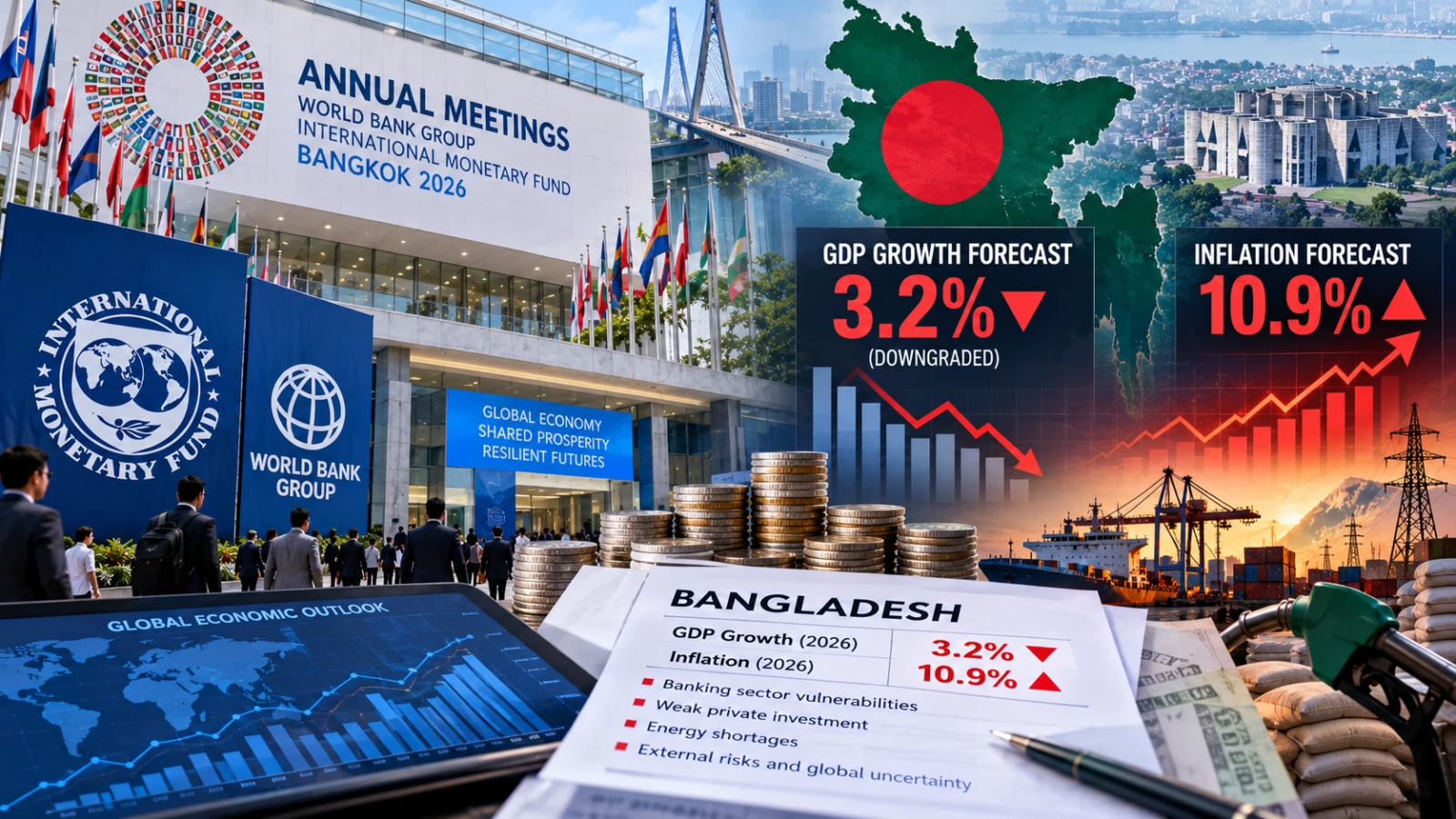
Bangladesh’s economic growth is expected to slow further while inflationary pressures intensify, according to a new forecast by the International Monetary Fund (IMF), raising concerns over investment, employment and the cost of living.The IMF has lowered its growth projection for Bangladesh in the current fiscal year to 3.2%, down from its April
forecast of 4.3% and its July estimate of 3.5%. At the same time, it has sharply raised its forecast for average inflation to 10.9%, compared with 6% projected in April.
The projections were published on Tuesday (October 13) in the IMF’s World Economic Outlook report, released during the annual meetings of the IMF and the World Bank in Bangkok.
The outlook comes amid persistent inflation, weak private investment, banking sector difficulties and uncertainty over energy supplies. A further slowdown could constrain industrial production, limit job creation and weaken income growth, particularly affecting young people and workers in the informal sector.
Investment and Employment Under Pressure
Fahmida Khatun, a distinguished fellow at the Centre for Policy Dialogue (CPD), described the IMF’s latest forecast as concerning.
High inflation, weak investment, pressure on the banking sector and energy shortages have already restricted economic activity, she said. A further slowdown in growth could deepen these challenges.
Slower economic expansion could reduce opportunities for new employment and income growth, while businesses may postpone investment and recruitment decisions. Young jobseekers and informal-sector workers are likely to face greater risks, she warned.
Khatun also cautioned that weak economic activity could limit government revenue growth, making it more difficult to maintain necessary spending on education, healthcare and social protection.
She stressed the need to control inflation, remove barriers to private investment, ensure reliable energy supplies and maintain policy stability. Targeted support for vulnerable communities and skills development aligned with labour market demand would also be important.
Economic Weakness Predates the Latest Forecast
Zahid Hossain, a former lead economist at the World Bank’s Dhaka office, said the effects of slower growth would be felt across employment, industrial output and investment. However, he noted that the economy had been showing signs of weakness for some time.
Persistent banking sector problems, including difficulties in reducing non-performing loans, have constrained the flow of funds needed to support investment and job creation, he said.
Hossain warned that sluggish growth could affect wages, employment opportunities and government revenue. He called for structural reforms to address longstanding problems in energy supply, banking, port management, monetary policy and revenue administration.
Without effective reforms in these areas, restoring economic momentum would remain difficult, he added.
Rising Inflation Erodes Purchasing Power
The prospect of inflation averaging 10.9% poses an additional challenge for households already struggling with rising living costs. When prices increase faster than incomes, purchasing power declines, leaving low- and middle-income families under greater pressure to cover food, rent, healthcare and education expenses.
Bangladesh’s overall inflation rate stood at 8.34% in September 2026, according to the Bangladesh Bureau of Statistics. The IMF’s latest projection suggests that inflationary pressures could remain elevated throughout the current fiscal year.
A recent World Bank assessment of Bangladesh has also highlighted weak growth, subdued private investment and employment, energy shortages and vulnerabilities in the banking sector. The institution has emphasised the need to restore banking stability, strengthen energy security and increase revenue collection.
It has also recommended shifting from broad-based subsidies towards more targeted assistance for poor and vulnerable households.
Structural Reforms Key to Recovery
The latest projections underscore the challenges facing Bangladesh as it seeks to restore economic momentum while protecting household welfare.
Beyond raising the headline growth rate, policymakers face the task of ensuring that economic expansion translates into better employment opportunities, higher incomes and improved public services.
Effective measures to contain inflation, revive private investment, strengthen the banking sector and resolve energy supply constraints will be critical to recovery. Without timely action, slower growth and persistently high prices could place prolonged pressure on livelihoods, job creation and the broader economy.




COMMENTS