
July 24, 2026
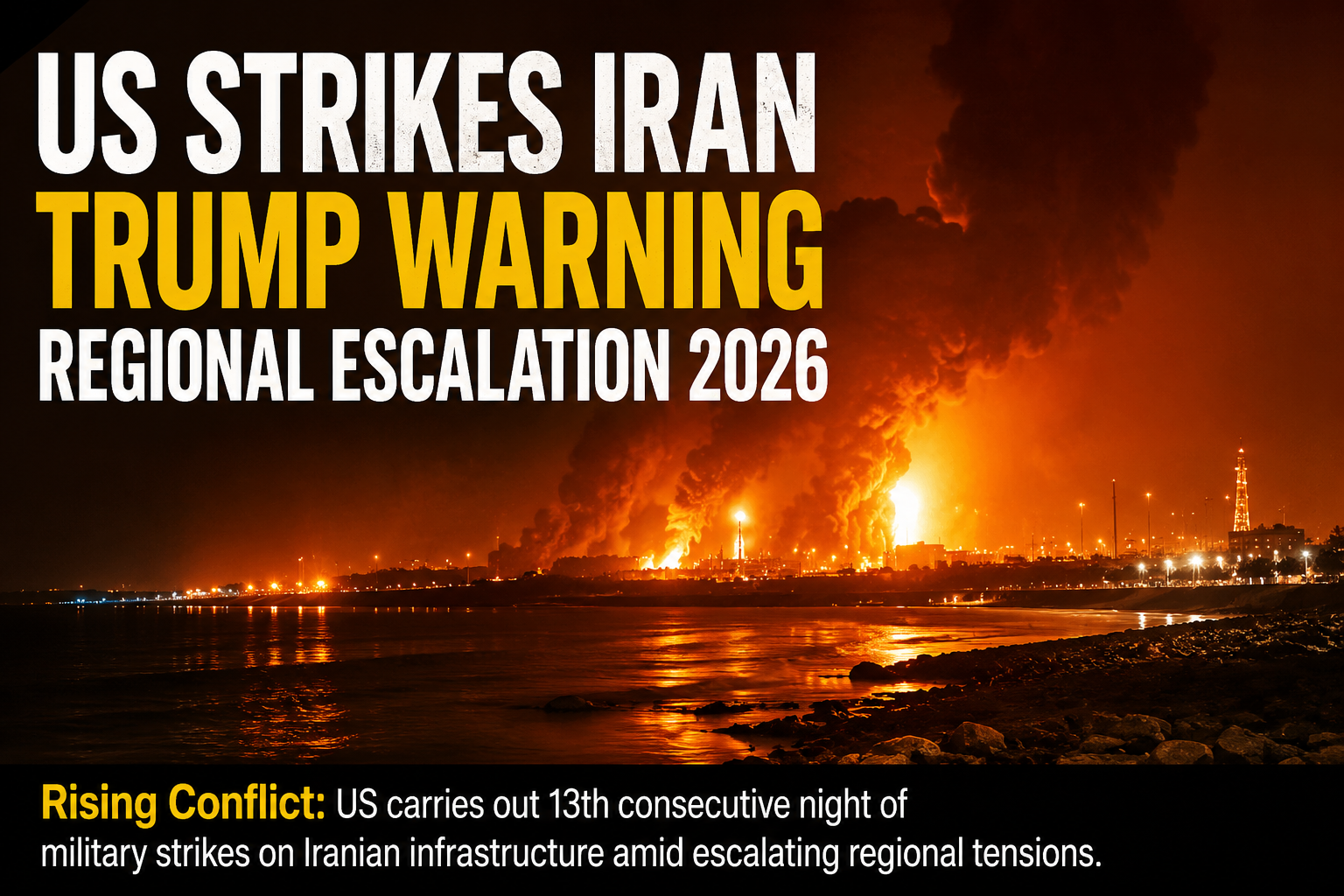
The United States carried out its 13th consecutive night of military strikes on targets across Iran, as President Donald Trump warned that Washington could launch its “largest attack ever” against the country.
According to reports, explosions were heard in several parts of Iran, including Qeshm Island, Ahvaz in Khuzestan Province, and other locations. Iranian media also reported missile strikes in Andimeshk, Omidieh, and the port city of Bandar Abbas, where at least two people were reportedly injured in a residential area.
The US Central Command (CENTCOM) said the strikes targeted Iranian military command centers, drone storage facilities, communications networks, coastal surveillance sites, and maritime capabilities. The operation, it said, was intended to reduce threats posed by Iran’s Islamic Revolutionary Guard Corps (IRGC) to commercial shipping in the Gulf.
Speaking to Axios, President Trump said he was considering a “massive attack” on Iran that would be “bigger than anything before,” adding that a final decision was close and that the United States was fully prepared.
Iran condemned the attacks and warned of further retaliation. Foreign Minister Abbas Araghchi said Tehran would respond to any future attacks on its infrastructure under a policy of “reciprocal action.”
Following earlier US strikes, Iran launched missile and drone attacks targeting US-linke military assets in Jordan, Bahrain, and Kuwait, according to Iranian officials. The IRGC also claimed responsibility for an attack on a telecommunications tower in Kuwait, describing it as retaliation for US strikes on similar infrastructure in Iran.
Iranian military spokesperson Mohammad Akraminia said the country’s armed forces would conthasanul-haq-inu-prison-rights-accused-duty-featurede retaliatory operations as long as US attacks on Iranian territory and infrastructure persist.
The escalating exchanges have heightened concerns over regional security and raised fears of further disruptions to global energy supplies.


COMMENTS