
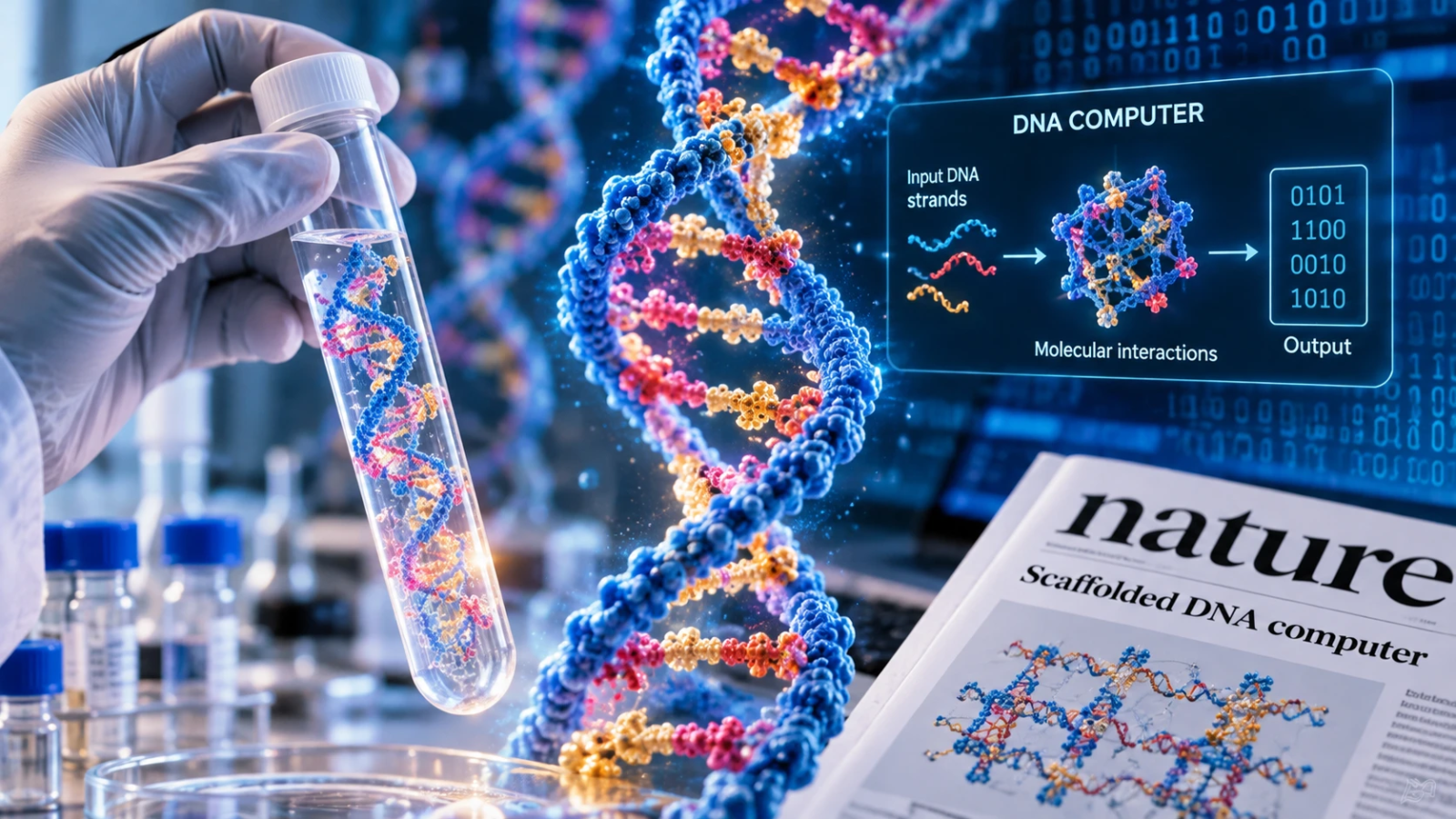
Researchers at Maynooth University in Ireland have developed a new type of computer that uses DNA molecules rather than conventional silicon-based components to perform calculations, opening up new possibilities for energy-efficient computing and data storage.
Called the scaffolded DNA computer (SDC), the system relies on interactions between DNA strands to produce answers to computational problems. Unlike conventional computers, which use silicon chips and transistors, the device uses molecules suspended in water, along with salt, short DNA strands and a longer DNA scaffold.
According to a report on the research, published in the journal Nature, the system does not require a conthasanul-haq-inu-prison-rights-accused-duty-featuredous supply of energy to carry out calculations once the reaction process begins. Instead, DNA molecules interact and assemble into structures that encode the answers to specific problems.
“The molecules react with one another to form a structure, and that structure is the answer,” said Damien Woods of Maynooth University, the study’s senior author. He described the ability to find answers without a conthasanul-haq-inu-prison-rights-accused-duty-featuredous energy supply as a key innovation.
The researchers tested the computer on 700 different computational tasks, ranging from simple multiplication to eight-bit parity detection. The system produced correct results in 95 per cent of the tests.
However, the technology is not necessarily faster than conventional computers when measured by the time required to solve an individual problem. Simple calculations can take several dozen seconds, while more complex tasks may require hours.
Tristan Sterin, a co-first author of the study at Maynooth University, said the reaction takes place quickly in a test tube, although it is not as fast as silicon-based computing. He added that the system was designed for a different purpose and is among the fastest DNA computers developed so far.
Rather than replacing smartphones, laptops or desktop computers, DNA-based systems could offer advantages in applications that require large numbers of calculations to be performed simultaneously. Their potential ability to process vast numbers of molecular interactions in parallel could make them useful for particular computational tasks.
Only a small amount of heat is needed to initiate calculations in the SDC system. Although individual molecular reactions may be relatively slow, the simultaneous activity of enormous numbers of DNA strands could allow the technology to tackle certain large-scale problems efficiently.
DNA is also attracting interest as a potential medium for long-term, high-density data storage. In theory, a cubic centimetre of DNA could store an amount of information equivalent to that contained on one trillion CDs, although practical implementation would involve significant technical challenges.
A separate study published in Nature in 2023 by researchers at Shanghai Jiao Tong University highlighted DNA circuits capable of supporting more than 100 billion distinct configurations, illustrating the growing interest in molecular computing.
The latest findings suggest that DNA, best known as the molecule carrying genetic information, could eventually play a role in the development of alternative computing architectures. However, researchers say substantial work remains before such systems can be widely adopted.
Woods said the field remains open-ended, with its ultimate potential still unknown.






COMMENTS