
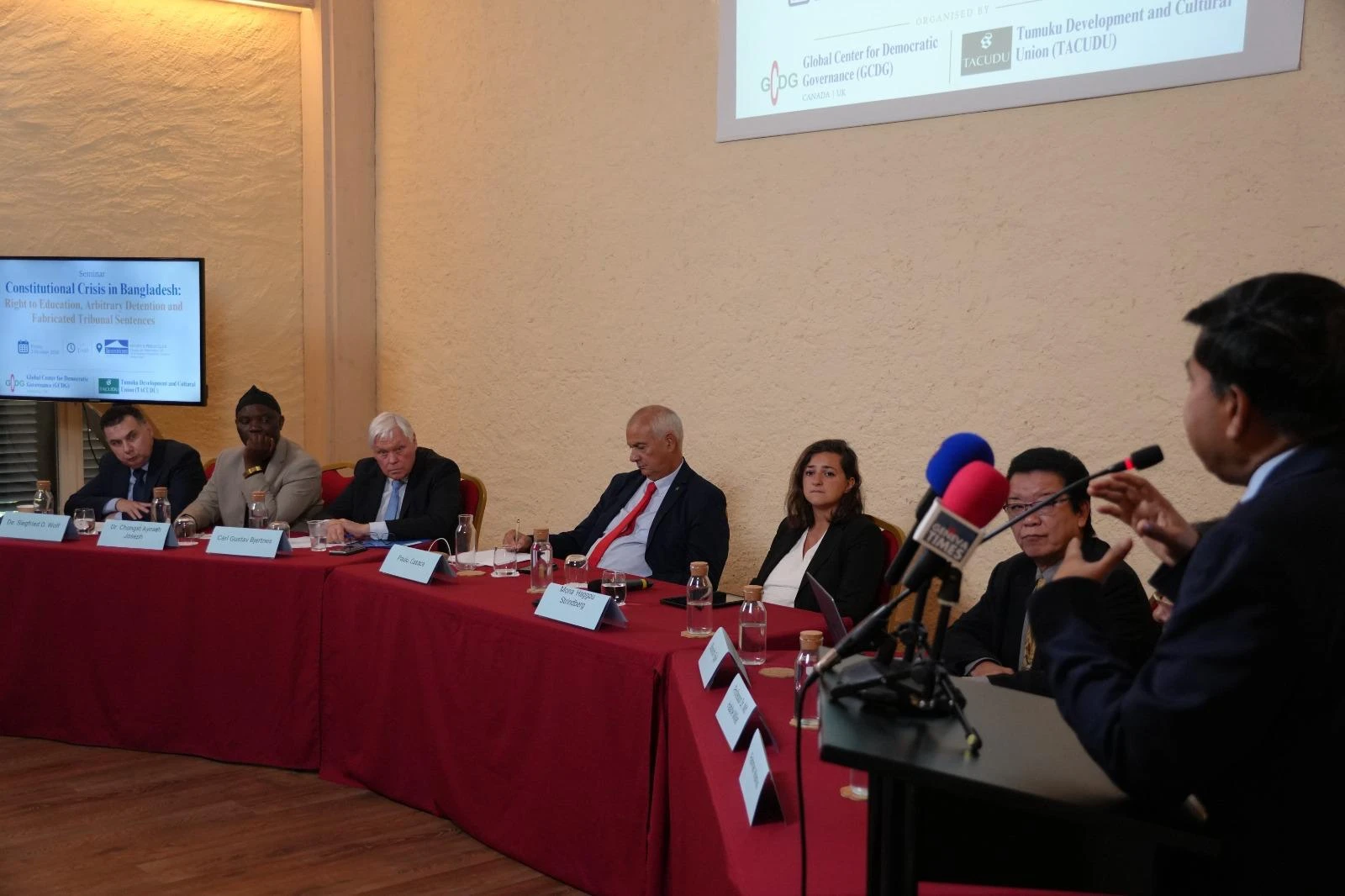
GENEVA, Switzerland, Oct. 2 — Bangladesh’s constitutional order, rule of law, human rights, political participation and judicial independence came under scrutiny at an international seminar in Geneva, where speakers raised concerns over alleged arbitrary detention, political retaliation, restrictions on civic space and pressure on democratic institutions.
The seminar, titled “Bangladesh’s Constitutional Crisis: Right to Education, Arbitrary Detention and Fabricated Tribunal Verdicts,” was held at the Geneva Press Club and brought together former political leaders, lawyers, human-rights advocates, researchers and international experts from Europe, Asia and Africa.
Former Bangladesh Prime Minister and Awami League President Sheikh Hasina, who delivered the keynote address, described the country as facing what she called a serious constitutional crisis. She argued that Bangladesh’s future should be determined through the free and informed choice of its people and accused the authorities of political retaliation, arbitrary detention and politically influenced legal proceedings.
Hasina also alleged that students and professionals had faced adverse consequences because of their political identities. She argued that political affiliation should not constitute collective criminal liability and that allegations of criminal conduct should be addressed through individual accountability and due process.
She further questioned the independence of judicial and tribunal processes, warning that the use of judicial institutions for political retaliation could undermine public confidence in the justice system. She called for international monitoring of Bangladesh’s situation and urged greater protection of due process, freedom of expression, association and peaceful political activity.
Professor Dr. Md. Habibe Millat, president of the Global Center for Democratic Governments, said Bangladesh was facing what he described as a broader erosion of the rule of law, democratic rights, judicial protection and citizen security. He alleged that political violence and insecurity had affected professionals, journalists and minority communities and called on the international human-rights community to examine developments in Bangladesh.
Former European Parliament member Paolo Casaca said Bangladesh’s situation should be viewed beyond a conventional constitutional or political dispute. He raised concerns over restrictions on political participation and freedom of expression, pressure on journalists and the imprisonment of dissenters, arguing that judicial independence and citizens’ ability to express political views freely should remain central to any assessment of the country’s political transition.
Dr. Siegfried O. Wolf, research director of the South Asia Democratic Forum in Germany, focused on developments at Bangladeshi universities. He expressed concern over political labeling, intimidation and pressure on students, teachers and administrators, and alleged that political identities were increasingly being used to justify harassment, expulsion or physical attacks.
Japanese human-rights advocate Shinichi Fujiki called for closer scrutiny of arbitrary detention, politically motivated cases, media restrictions and judicial proceedings. He particularly emphasized international fair-trial standards in cases involving capital punishment and proposed stronger independent monitoring of detention, judicial proceedings, media freedom and the protection of minorities and vulnerable communities.
Carl Gustav Bjartnes, president of SEEDS-Africa, argued that Bangladesh’s development should be assessed not only through economic growth but also through citizens’ security, dignity, access to justice and equal treatment. He also raised concerns about prison overcrowding and prolonged pre-trial detention and called for an independent assessment of detention procedures, prison conditions and related oversight mechanisms.
Professor Alfred de Zayas, a former UN independent expert, urged greater international attention to Bangladesh’s constitutional and human-rights situation. He referred to existing UN mechanisms dealing with arbitrary detention, torture, enforced disappearance and judicial independence and encouraged individuals and organizations to submit relevant information to international human-rights mechanisms.
Dr. Chonsi Ayach Joseph, president and chief executive of Cameroon’s Center for Human Rights and Peace Advocacy, said the rule of law should remain central to addressing any constitutional crisis. He stressed the importance of independent state institutions and a judiciary capable of holding public officials accountable while ensuring that laws are applied equally regardless of political or social identity.
Swedish attorney Mona Hago Strindberg said accountability for serious crimes committed during political upheaval was legitimate but warned that criminal justice should not become an instrument of political transition. She argued that alleged violations during the July-August 2024 unrest should be investigated, but any prosecution must comply with due process, judicial independence and international human-rights standards.
The seminar, jointly organized by the Global Center for Democratic Governments and Tumuku Development and Cultural Union, was attended by participants from Europe, Asia and Africa. Organizers said the event was intended to provide an international platform for discussion of Bangladesh’s constitutional and human-rights situation and to encourage engagement with international institutions, legal experts and civil-society organizations.

COMMENTS