
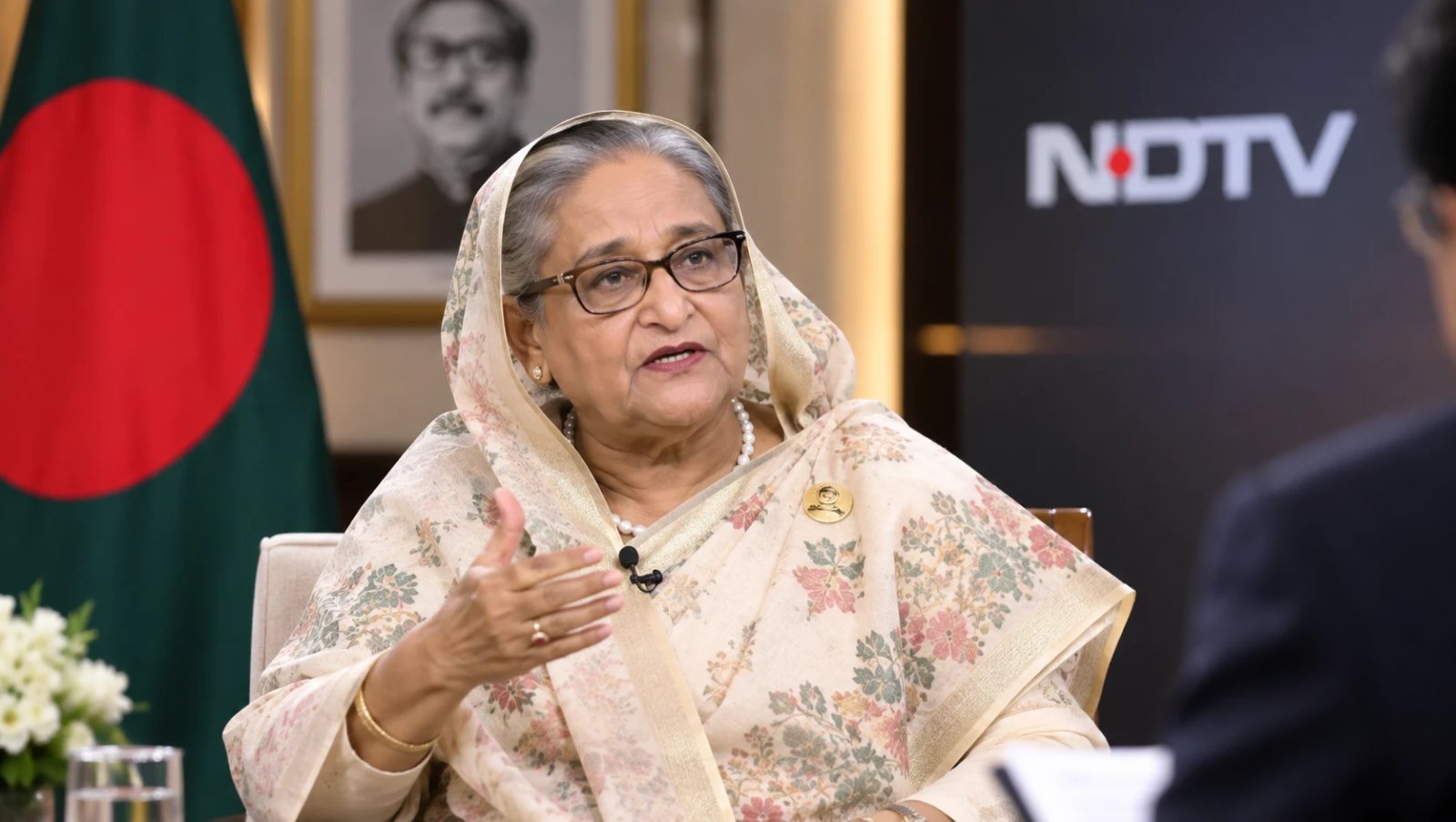
India has said there is still no definite timeframe for a decision on Bangladesh’s request to extradite former prime minister Sheikh Hasina, with Indian High Commissioner to Bangladesh Dinesh Trivedi saying the matter is being handled through an ongoing legal process involving the courts.
“Again and again, the government of India has replied to this that there is a process, and the process is legal, and it is well structured. So, as far as that is concerned, the process is on,” Trivedi said while responding to a question during a panel discussion on Saturday.
He stressed that because the courts are involved, no one can specify when the process will be completed.
“The courts are involved, and therefore nobody can give you a timeframe,” Trivedi said.
His remarks come as Bangladesh has repeatedly requested India to extradite Hasina, who has been staying in India since leaving Bangladesh in August 2024. The extradition issue was also raised by Prime Minister Tarique Rahman during his meeting with Trivedi in Dhaka in August.
India’s Ministry of External Affairs has previously said that Bangladesh’s request is being examined in accordance with established procedures.
Trivedi also addressed the circumstances surrounding Hasina’s arrival in India, stressing that she was not taken to India by the Indian Air Force or the Indian Army.
“Going back to history, Hasina was not brought to India by the Indian Air Force or Indian Army,” he said.
According to Trivedi, Indian authorities were not prepared for the circumstances that unfolded in Bangladesh in August 2024. He described the situation at the time as resulting from “tragic circumstances” and said such circumstances should never be repeated anywhere in the world.
Trivedi said Hasina was still the prime minister of Bangladesh when she arrived in India, leaving New Delhi with little choice but to respond to the situation as a neighbouring country.
“I was watching on television, and the scroll was coming that she’s going somewhere else in some other country,” he said.
“At that point in time, Hasina was still the prime minister of Bangladesh. We had hardly any choice on that. It was our duty as a neighbour to accept the reality of life, because situations are such where at times you are not prepared for it,” the Indian envoy said.
He questioned what alternative India could have taken under those circumstances, saying refusing permission for Hasina to land could have led to an uncertain situation.
“What was our choice? If you would have said that no, we are not going to accept, we don’t give landing permission. Things would have been I don’t know what,” Trivedi said.
Trivedi, however, returned to the issue of the extradition request and reiterated that India’s judicial system is functioning and that the matter is being dealt with through an established legal mechanism.
“The legal process is there in place, which you can be very sure,” he said, adding that India is a “vibrant democracy,” as is Bangladesh, and that the legal system is continuing to deal with the matter.
Bangladesh has repeatedly requested India to extradite Hasina, who has been staying in India since her departure from Bangladesh in August 2024.
The issue was also raised by Prime Minister Tarique Rahman during his meeting with Trivedi in Dhaka in August.
India’s Ministry of External Affairs subsequently said that Bangladesh’s request was being examined in line with established procedures.
Trivedi’s latest remarks indicate that the extradition request remains under consideration, while India has not provided a specific timeframe for a decision because the matter involves the judicial process.
Dhaka, 3rd September

COMMENTS