
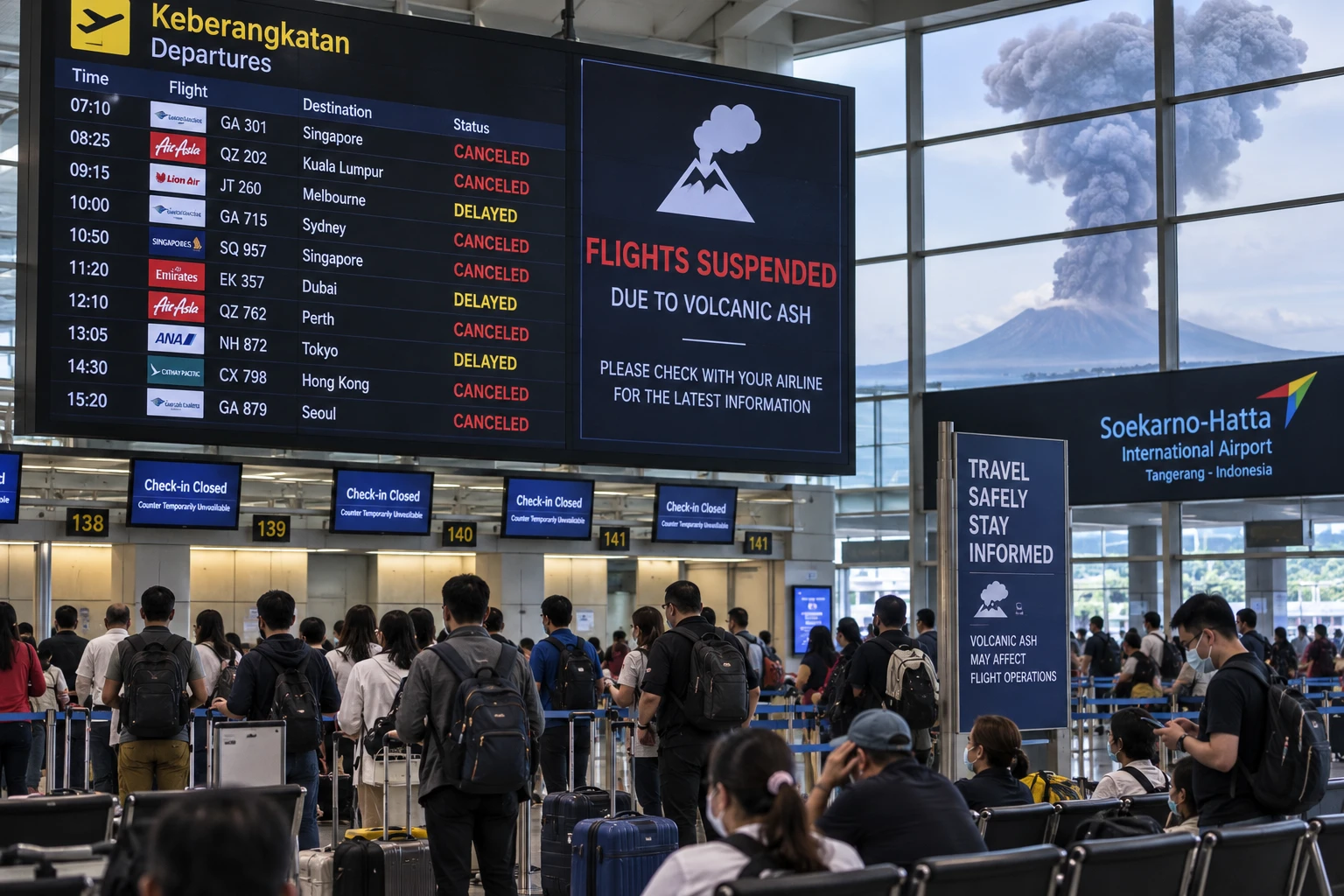
Indonesia has suspended all flight operations at Jakarta’s Soekarno-Hatta International Airport after volcanic ash from the Anak Krakatau volcano spread into the surrounding airspace, disrupting travel for thousands of passengers.
According to Indonesia’s Geological Agency, the main eruption of Anak Krakatau began on Saturday. The eruption produced lava and powerful explosive sounds that were reportedly heard as far as 700 kilometers (435 miles) away. Two additional eruptions were recorded on Sunday.
Authorities detected volcanic ash in the airspace around Soekarno-Hatta, located about 150 kilometers from the volcano. Airport operations were initially suspended from 1:30 a.m. local time on Sunday and later extended as volcanic activity intensified.
Indonesia’s Transportation Ministry said a paper test conducted most recently confirmed the presence of volcanic ash around the airport. The closure was initially extended until 9:30 a.m. before authorities announced a further four-hour extension.
The disruption has affected more than 22,000 passengers, according to the Transportation Ministry. A total of 209 flights were canceled or disrupted, including services to and from Singapore, as well as international routes to Doha, Sydney and Kuala Lumpur.
At least 16 domestic flights to Bali were also canceled, according to local airport authorities.
Shipping routes placed on alert
Anak Krakatau, known as the “Child of Krakatoa,” lies in the Sunda Strait between the Indonesian islands of Java and Sumatra. Authorities have warned ships traveling through the strait to exercise additional caution because of potential risks associated with the eruption.
A 3-kilometer exclusion zone has also been imposed around the volcano, with entry prohibited.
Legacy of the 1883 Krakatoa disaster
Anak Krakatau emerged above sea level in the early 20th century from the massive caldera formed by the catastrophic 1883 eruption of Krakatoa. That historic eruption killed an estimated 35,000 people and remains one of the deadliest volcanic disasters in recorded history.
Indonesia frequently experiences volcanic eruptions and earthquakes because it sits along the Pacific “Ring of Fire,” an area characterized by intense tectonic activity and the movement of several major tectonic plates.





COMMENTS