
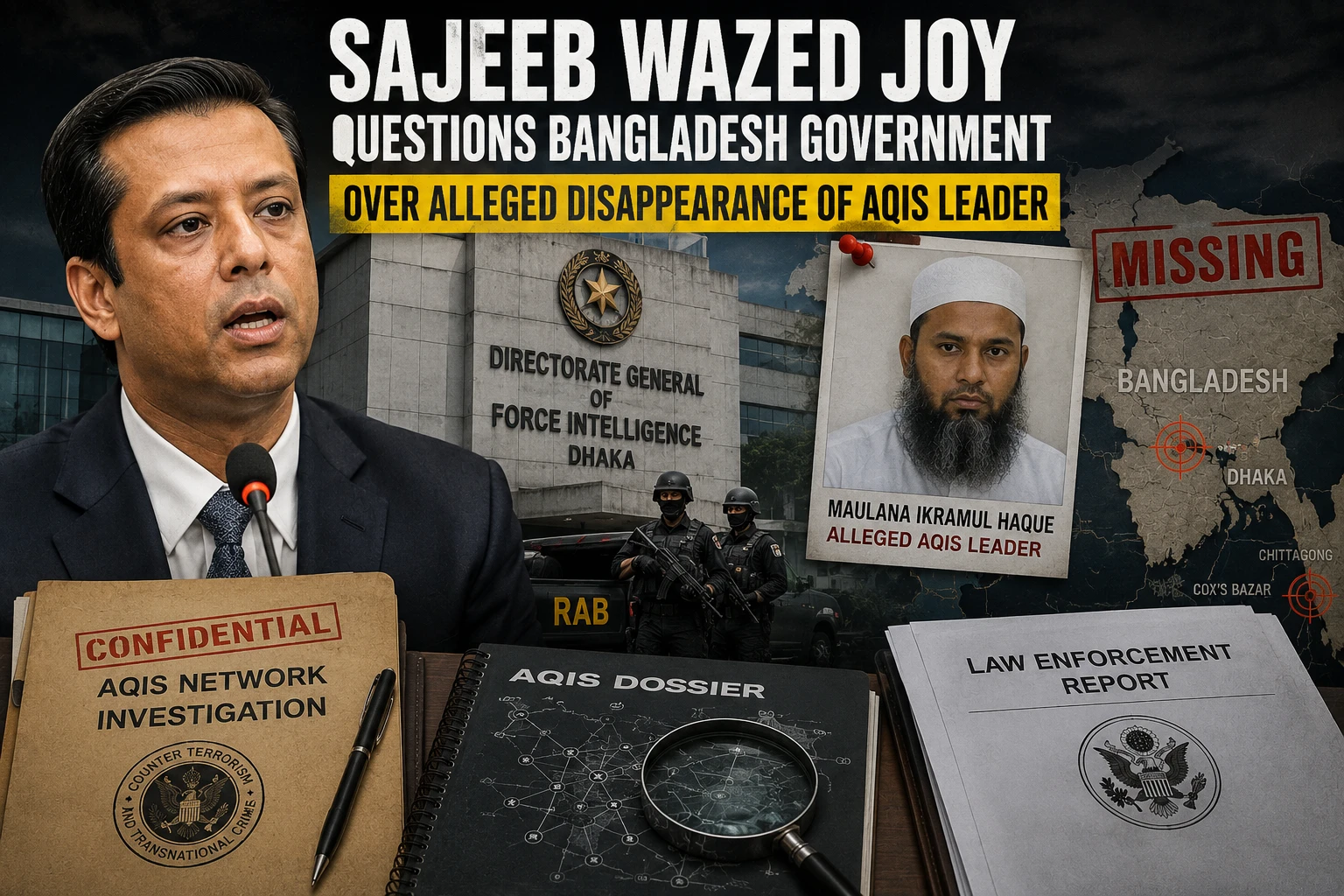
Dhaka, August 23 – Sajeeb Wazed Joy has raised serious questions over the reported disappearance of Maulana Ikramul Haque, an alleged senior leader of Al-Qaeda in the Indian Subcontinent (AQIS), questioning how a man described as a high-ranking militant figure could remain untraceable for nearly 22 months after being released on bail.
According to the statement attributed to Joy, Ikramul was arrested in Dhaka’s Madartek area in May 2023 along with his wife, Faria Afrin. Following interrogation, he was sent to Kashimpur Jail and was reportedly released on bail in October 2024. Since then, his whereabouts have remained unknown.
Intelligence sources reportedly describe Ikramul as a technically skilled and highly educated militant operative who was active in AQIS’s Dawah activities. He is alleged to have used several aliases, including Abu Talha, Maulana Sabet, Nur Hossain, Mansur and Milan, and to have obtained an Indian passport under a false identity.
The allegations have gained renewed attention amid reported warnings from the United Nations Security Council that Al-Qaeda is seeking to expand its operational network in Bangladesh through the establishment of active cells. Ansar al-Islam, identified as Al-Qaeda’s Bangladesh-based affiliate, has previously been linked to militant activities in the country.
Joy’s statement also questions the government’s ability—or willingness—to locate Ikramul. His father reportedly told authorities that his son may be teaching at a madrasa in Narayanganj. A police official has also reportedly acknowledged hearing similar information and said efforts were underway to locate him.
The issue has prompted wider questions about Bangladesh’s counterterrorism mechanisms and the effectiveness of monitoring individuals accused of involvement with militant organizations after their release on bail.
Joy further drew parallels with Bangladesh’s history of militant violence, referring to the period between 2001 and 2006, when a series of bomb attacks and militant incidents raised international concern over extremist networks operating in the country.
The statement also points to the political implications of the case, questioning whether the present BNP-Jamaat political establishment is adequately addressing the threat posed by extremist organizations.
Ikramul’s reported disappearance, nearly two years after his release, therefore raises a fundamental question: how can a person allegedly regarded as a senior AQIS figure remain outside the reach of Bangladesh’s law-enforcement and intelligence agencies despite reportedly being the subject of multiple terrorism-related cases?
The case comes amid renewed international concern over the potential expansion of Al-Qaeda-linked networks in Bangladesh, placing additional pressure on Dhaka to establish Ikramul Haque’s whereabouts and clarify the circumstances surrounding his release and subsequent disappearance.


COMMENTS