
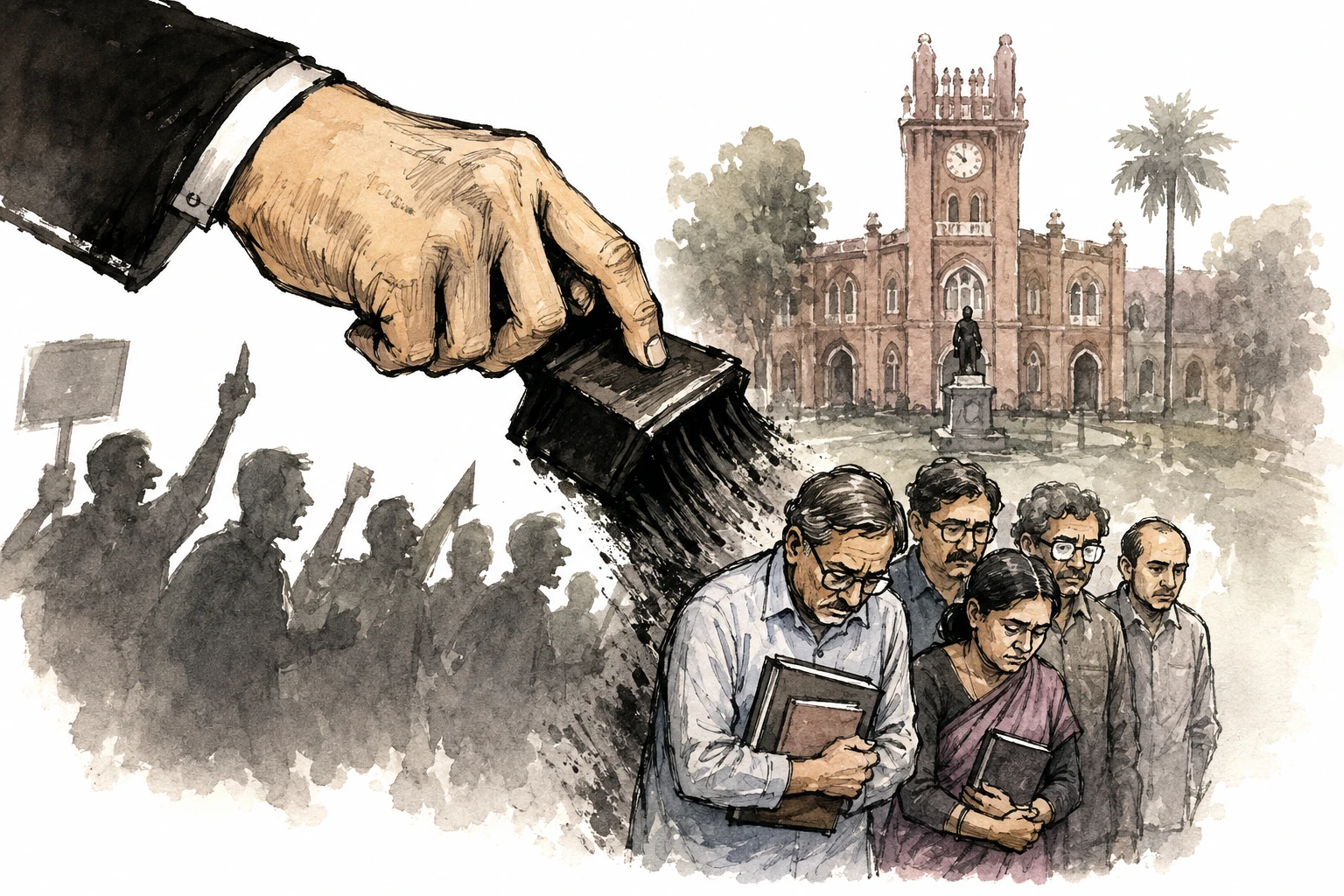
DHAKA — A group of academics, lawyers, journalists, human rights defenders, cultural activists and professionals from Bangladesh and abroad has condemned a growing pattern of punitive and politically motivated action against teachers at public universities, warning that academic freedom, due process and freedom of expression are increasingly under threat.
In a joint statement issued in Dhaka on Aug. 21, the signatories cited recent media reports of public university teachers being temporarily suspended, removed from academic and administrative responsibilities, or subjected to investigations that they said were being conducted outside established rules and procedures.
According to the statement, the measures have been taken over allegations including discrediting the July Movement, spreading propaganda against university administrations or the government, political involvement, and maintaining links with a political party that was removed from power.
The signatories said such actions represented an attempt to suppress dissent and weaken the democratic character of universities.
“We believe that such measures constitute an attempt to undermine the democratic character of universities by suppressing dissent and restricting freedom of thought and expression,” the statement said.
It added that imposing sweeping disciplinary measures without following due legal process was “wholly unlawful.”
Dhaka University teachers suspended or relieved of duties
The statement referred to several recent decisions involving teachers at the University of Dhaka.
It said Professor Dr. Sadeka Halim of the Department of Sociology, who previously served as vice chancellor of Jagannath University, Professor Md. Shafiqul Islam and Professor Afroza Shelley of the Department of Nuclear Engineering had been temporarily suspended.
Professor Md. Abdul Muhit of the Department of Clinical Pharmacy and Pharmacology was removed as chairman and relieved of academic and administrative responsibilities, according to the statement.
It also said Professor Abu Sara Shamsur Rouf of the Department of Pharmaceutical Technology and Professor Md. Rafiqul Islam of the Department of Peace and Conflict Studies had been relieved of their academic and administrative duties.
The decisions were taken at a geneva-seminar-raises-concerns-over-bangladeshs-rule-featured of the Dhaka University Syndicate on July 28 under the chairmanship of Vice Chancellor Professor ABM Obaidul Islam, the statement said.
The signatories also cited reports suggesting that disciplinary action could be taken against Professor Dr. Kaberi Gayen of Dhaka University’s Department of Mass Communication and Journalism and Professor Risala Khan of the Institute of Information Technology at Jahangirnagar University over allegations that they had sought to discredit the July Movement.
“We are deeply angered by such punitive and harassing actions against university teachers,” the statement said.
Concerns over due process and ideological retaliation
The signatories alleged that, since August 2024, certain groups of teachers had emerged as influential actors in contemporary politics and had used that influence to legitimize actions they described as contrary to university regulations, undemocratic and violative of human rights.
The statement further alleged that some of these groups, with tacit support from political forces identified as opposed to the Liberation War, had used political vendetta and ideological differences to suppress dissent.
According to the statement, such practices were threatening the inclusive character of university campuses.
The signatories said university administrations had repeatedly taken disciplinary action immediately after allegations were raised by particular teacher groups, without sufficient regard for established laws and procedures.
“This represents a blatant manifestation of arbitrariness,” the statement said.
It added that the rule of law and the basic principles of justice at Dhaka University and other higher education institutions were being placed under serious threat.
Lists of teachers submitted to Dhaka University
The statement also raised concerns over lists of teachers reportedly prepared by groups seeking disciplinary action.
It said a group described as the “Anti Fascist Teachers Forum” submitted a list containing the names of 231 Dhaka University teachers to the vice chancellor on July 27.
According to the statement, the issue was placed before the Syndicate the following day.
The list was later reduced to 125 names, the signatories said, while alleging that there had been claims that financial transactions influenced the reduction in the number of names.
The statement said another list containing 31 names had more recently been circulated.
The signatories objected particularly to letters being sent to teachers whose names appeared on such lists, including Professor Kaberi Gayen.
“We strongly condemn such an informal approach and undemocratic conduct by the university administration,” the statement said.
Allegations of harassment since Aug. 5
The statement said teachers at educational institutions across Bangladesh had faced various forms of harassment since Aug. 5, including forced resignations and dismissals.
At Rajshahi University, it alleged that mobs had been mobilized against teachers and that resignation letters had in some cases been prepared on their behalf.
The statement also referred to incidents in which teachers at Dhaka University were allegedly humiliated.
According to the signatories, administrations at 22 public universities have initiated investigations against 404 teachers over allegations of political involvement.
They criticized what they described as the lack of meaningful intervention by the University Grants Commission and the government.
The statement argued that this inaction had allowed a culture of political retaliation and ideological domination to develop within institutions of higher education, instead of an environment centered on knowledge, research and intellectual development.
“Such a situation cannot be beneficial to society, the nation, or the state,” the statement said.
Call to protect academic freedom
The signatories said universities and other educational institutions must not become arenas for political retaliation or what they termed “ideological purification.”
They called for an end to practices aimed at suppressing dissent and restricting freedom of expression.
“We believe that educational institutions must not become arenas for political retaliation or campaigns of ideological purification,” the statement said.
The group urged university administrations to help build institutions where independent thought, cultural practice, academic freedom and knowledge creation could flourish.
It also called on the government, the University Grants Commission, university authorities and other stakeholders to take steps to protect due process and the fundamental rights of university teachers.
“We therefore urge the respective institutions, the government, the University Grants Commission, and all other concerned stakeholders to come forward and take the necessary steps to protect academic freedom, freedom of thought and expression, due process, and the fundamental rights of university teachers,” the statement said.
Signatories
The statement was signed by 30 people from Bangladesh and several countries, including academics, lawyers, journalists, rights advocates, cultural workers and other professionals.
They are:
- Akramul Haque, Organiser, Dhaka
- Dastagir Jahangir, Editor, The Voice, United States
- Parvez Hashem, Lawyer, Bangladesh Supreme Court and Human Rights Defender, Florida, United States
- Jibananda Jayanta, Lawyer, Bangladesh Supreme Court
- Violet Haldar, Editor, Shomoyer Shobdo, Norway
- Al Azam Khan, Human Rights Defender, Dhaka
- Umme Habiba, Barrister and Solicitor, Canada
- Yusuf Chowdhury, Freedom Fighter and Engineer, Boston, United States
- Sohana Ahmed, Coordinator, Sangat Bangladesh
- Jannatul Ferdous Nouzula, Cultural Organiser, Melbourne, Australia
- Miraj Ahmed, Social Worker, Dhaka
- Md. Sadik Hasan, Adviser, Haukeland University Hospital, Bergen, Norway
- Sirajum Monira, Doctoral Researcher, Nuclear Physics Division, Warsaw University of Technology, Poland
- Monirul Islam, Retired Engineer, Toronto, Canada
- Majibul Haque Moni, Teacher, London, United Kingdom
- A K Azad, Cultural and Social Worker, Bangladesh
- Sohela Parvin, Artist, France
- Ishtiaq Jamil, Retired Professor, University of Bergen, Norway
- Tuhin Das, Poet, Pennsylvania, United States
- Md. Iftekhar Sadik, Accountant and Cultural Organiser, Melbourne, Australia
- Monira Rahman, TDSB Office Administrator and Cultural Worker, Ontario, Canada
- Liaquat Hossain Limon, Writer, Blogger and Human Rights Defender, Sweden
- Tushar Gayen, Poet and Essayist, Toronto, Canada
- Amhasanul-haq-inu-prison-rights-accused-duty-featuredr Rahman, Researcher, Haukeland University Hospital, Norway
- Shyamoli Neela, Creative Designer, Switzerland
- Joydeb Chandra Shil, Blogger and Human Rights Defender
- Samia Mohsin, Columnist, Florida, United States
- Foyez Khan Touhid, Human Rights Defender, United Kingdom
- Regina Sultana, Head and Chairperson, Department of English, Canadian University of Bangladesh
- Apurba Das, Columnist and Writer, Dhaka, Bangladesh
COMMENTS