
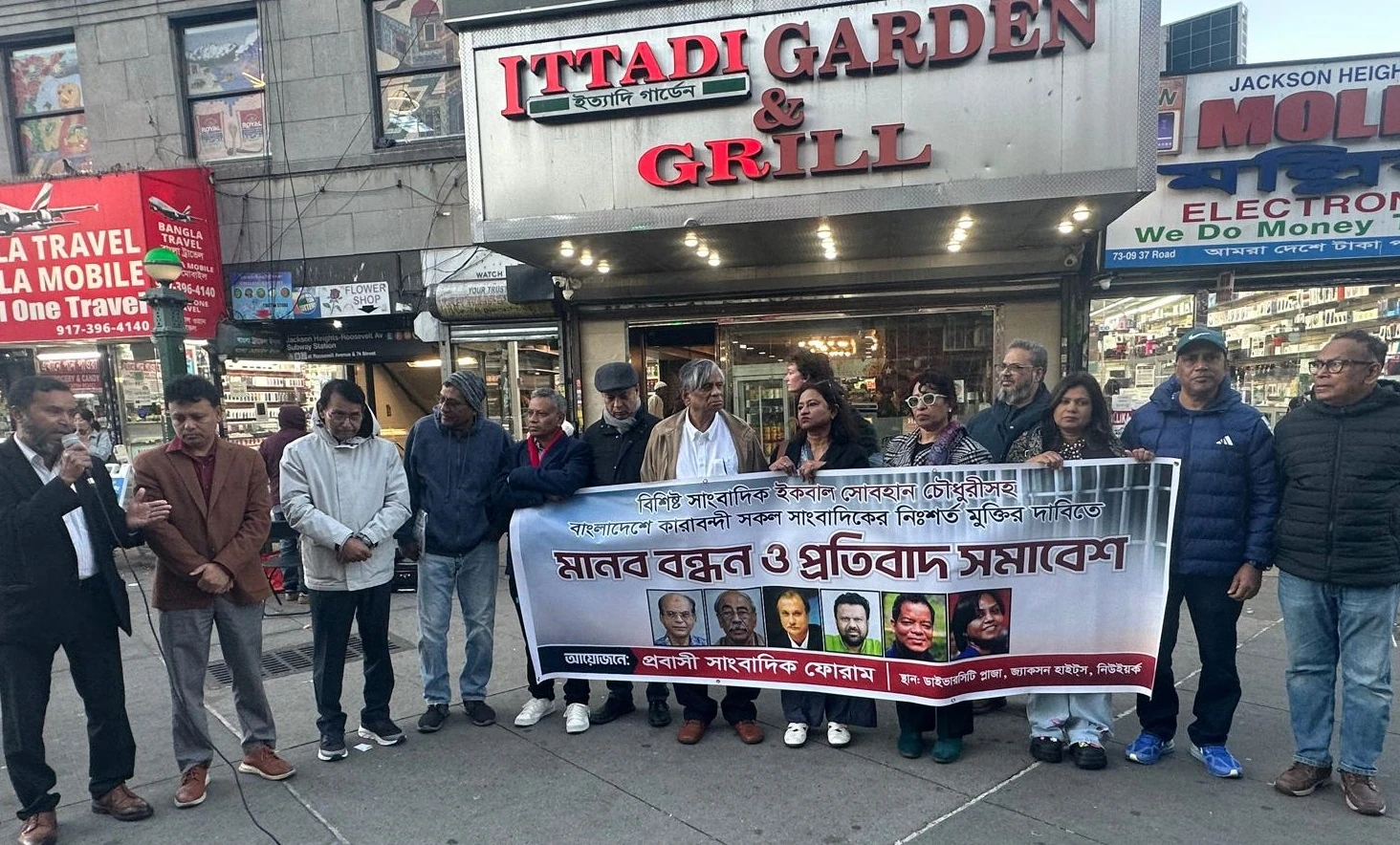
Bangladeshi journalists, human rights advocates and community leaders gathered in New York on Saturday, November 7, demanding the immediate and unconditional release of journalists imprisoned in Bangladesh, including veteran journalist and Daily Observer editor Iqbal Sobhan Chowdhury.
The protesters also called for the withdrawal of all cases filed against journalists, expressing concern over what they described as continuing repression of the media, politically motivated arrests and intimidation of journalists in Bangladesh.
The demonstration, organized under the banner of the Expatriate Journalists Forum, took place at Diversity Plaza in Jackson Heights, Queens, on Saturday afternoon.
Farida Yasmin, a former president of Bangladesh’s National Press Club and former member of parliament, presided over the human chain and protest rally, while journalist Pinaki Talukder moderated the event.
A banner displayed at the demonstration featured photographs of several prominent detained journalists and media figures, including Iqbal Sobhan Chowdhury, veteran journalist and writer Shahriar Kabir, Bhorer Kagoj editor Shyamal Dutta, Ekattor Television Managing Director Mozammel Babu, and journalist couple Farzana Rupa and Shakil Ahmed.
Calls for Release and an End to Media Repression
Addressing the gathering, Farida Yasmin strongly condemned the arrest of Iqbal Sobhan Chowdhury, chairman of DBC Television and a prominent journalist leader, by detective police from his office.
She described the case against him as fabricated and demanded his immediate release along with all other imprisoned journalists.
Yasmin alleged that journalists holding dissenting views were being systematically targeted through arrests, murder cases and intimidation, undermining the independence of journalism in Bangladesh.
She further claimed that several editors and journalists had faced what she described as false corruption charges, the freezing of their bank accounts and restrictions on foreign travel.
Such measures, she argued, were incompatible with press freedom and the fundamental principles of independent journalism.
Dr. Dilip Nath, a Queens Democratic Party district leader and human rights activist, expressed deep concern over allegations of continuing repression against journalists and media organizations in Bangladesh.
He urged the Bangladesh government to immediately end harassment and intimidation directed at media professionals.
Nath specifically called for the unconditional release of Iqbal Sobhan Chowdhury, Shahriar Kabir, Mozammel Babu, Shyamal Dutta, Shakil Ahmed and Farzana Rupa, along with all other imprisoned journalists.
Protesters Criticize Successive Governments
Dr. Masudul Hasan, a veteran of Bangladesh’s 1971 Liberation War, criticized what he described as continuing attacks, legal cases and threats against journalists under the current government.
He alleged that such practices, which had occurred under the previous administration led by Muhammad Yunus, were continuing under the present government.
Hasan urged journalists, civil society representatives and members of the Bangladeshi diaspora to speak out against the alleged repression.
Shaban Mahmud, former secretary-general of the Bangladesh Federal Union of Journalists (BFUJ), strongly condemned the arrest of Iqbal Sobhan Chowdhury.
He described Chowdhury as one of Bangladesh’s most prominent journalist leaders and alleged that detective police had arrested him from his office in connection with a fabricated case.
Mahmud demanded the immediate release of Chowdhury and all other detained journalists, calling on the government to end what he described as ongoing repression of the country’s media.
He also warned that an international seminar involving journalists from Bangladesh and abroad would be organized soon if the authorities failed to address the demands.
Concerns Over Arrests and Murder Cases
Sazzad Hossain Sabuj, a former press minister at the Bangladesh Embassy in Washington and executive editor of The Voice, highlighted what he described as a pattern of arrests, indiscriminate murder cases and other forms of harassment targeting journalists since the political changeover of August 5, 2024.
He presented figures concerning arrests and legal actions against journalists during the period and called for an immediate end to the alleged repression.
Sabuj demanded the unconditional release of Iqbal Sobhan Chowdhury, Shahriar Kabir, Mozammel Babu, Shyamal Dutta, Shakil Ahmed, Farzana Rupa and all other journalists held in prison.
Other speakers emphasized the need to restore an environment in which journalists can work independently and without fear of arrest, intimidation or politically motivated prosecution.
They argued that democracy cannot flourish without a free press and adequate safeguards for journalists’ professional security.
Journalists, Rights Advocates and Community Leaders Join Rally
The protest drew participation from journalists, human rights advocates, legal professionals, cultural figures and Bangladeshi community leaders based in the United States.
Among those addressing the gathering were Lablu Ansar, a veteran of the Liberation War and newly elected president of the America-Bangladesh Press Club; Dr. Mahbubur Rahman, editor of the weekly Jago Prohori; veteran journalist Shitanshu Guha; senior lawyer and Kakkhopath-71 organizer Advocate Mia Zakir; community organizer Mujahid Ansari; Awami League leader Mohammad Solaiman Ali; and senior journalist Ajit Bhowmik.
Cultural personality Minhaj Sammu and journalists Sumi Khan, Shamima Akter Dola, Shahidul Haque Jibon and Palash Nandi also addressed the demonstration.
Other attendees included Awami League leaders Kazi Qayes, Abdul Hamid and Sheikh Abid Hossain, journalist Shah Faruk Rahman and Advocate Sonia Sultana.
Participants expressed solidarity with imprisoned journalists and called on the Bangladesh government to ensure that media professionals can carry out their duties without fear of harassment or retaliation.
The demonstration concluded with renewed demands for the unconditional release of detained journalists, the withdrawal of cases against media professionals and an end to what organizers described as systematic restrictions on press freedom.
Speakers stressed that freedom of expression, independent journalism and the safety of journalists are essential to the development and protection of democracy.
COMMENTS