
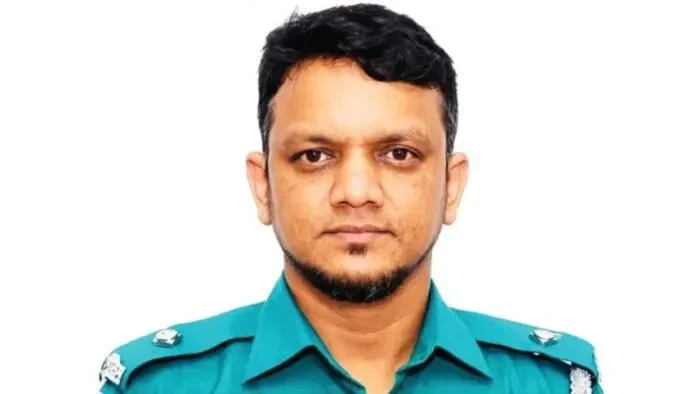
A police officer who pursued criminal cases against a politically connected suspect in Bangladesh’s port city of Chattogram has been transferred twice within two days, raising questions about political influence over law enforcement.
Mohammad Abdur Rahim, former officer-in-charge of Khulshi Police Station, was transferred to the Police Training Centre in Khulna after Chattogram Mayor Shahadat Hossain publicly criticized him over police efforts to arrest Wakil Hossain, alias Bihari Boga.
Boga, an expelled leader of the ruling Bangladesh Nationalist Party’s (BNP) volunteer wing, Swechchhasebak Dal, is identified by police as a listed criminal associated with juvenile gangs. Police say he faces 23 criminal cases involving allegations of extortion, assault, weapons offenses and other crimes.
Rahim’s latest transfer order was issued by Police Headquarters on Oct. 8 and became public Saturday, Oct. 10. Signed by Additional Inspector General AKM Awlad Hossain, the order described the transfer as being in the public interest.
On Oct. 7, Rahim had been removed from Khulshi Police Station and assigned to the Chattogram Metropolitan Police’s (CMP) City Special Branch, hours after the mayor publicly criticized him.
Rahim had taken charge of Khulshi Police Station on Aug. 27, serving less than six weeks before his removal.
Police Officer Faced Threats While Pursuing Suspect
Boga previously served as joint convener of Swechchhasebak Dal’s Chattogram city unit. He was expelled on June 8 following allegations of involvement in a shooting incident linked to a dispute over government land. However, sources said the expulsion was largely symbolic, as Boga continues to wield considerable influence within the ruling party.
On Aug. 29, police registered a case accusing Boga of abducting and assaulting a teacher at Pahartali College.
According to police, Boga subsequently threatened Rahim over the case, prompting the officer to file a general diary.
When police attempted to arrest Boga in the city’s Wireless area on Sept. 4, he and his associates allegedly attacked the officers and vandalized a police vehicle, injuring Rahim and six other police personnel.
Boga’s father later filed a court case accusing Rahim and other officers of assault and property damage during the operation. The Criminal Investigation Department was directed to investigate the allegations.
Mayor Defends Suspect, Questions Police Officer
The controversy escalated on Oct. 6 when police went to the Chattogram City Corporation building following information about Boga’s whereabouts. The operation ended without an arrest.
Rahim later said he was on leave during the operation and had no knowledge of its details.
The following day, Mayor Shahadat Hossain publicly defended Boga, describing him as a participant in the July 2024 uprising and claiming that he had faced politically motivated cases under the previous Awami League government.
The mayor also questioned Rahim’s appointment, citing his previous service as officer-in-charge of Bakalia Police Station during the Awami League administration.
“He was the OC of Bakalia during the Awami League government. How did he become the OC of Khulshi? Since taking charge of Khulshi Police Station, he has not arrested anyone from the Awami League or Jubo League,” the mayor said.
Hours after the remarks, Rahim was removed from his post.
Transfers Raise Questions About Political Pressure
CMP Commissioner Hasan Md Shawkat Ali described Rahim’s initial transfer as routine and said police maintained a zero-tolerance policy toward juvenile gangs.
However, the timing of the transfers has raised concerns among police officers about their ability to pursue suspects with political connections without facing administrative consequences.
Rahim declined to directly attribute his transfer to political pressure.
“I am a government employee. I will serve wherever the authorities assign me,” he told journalists.
Although police authorities have described the transfers as administrative decisions, the sequence of events has brought renewed attention to concerns about political influence over law enforcement.


COMMENTS