
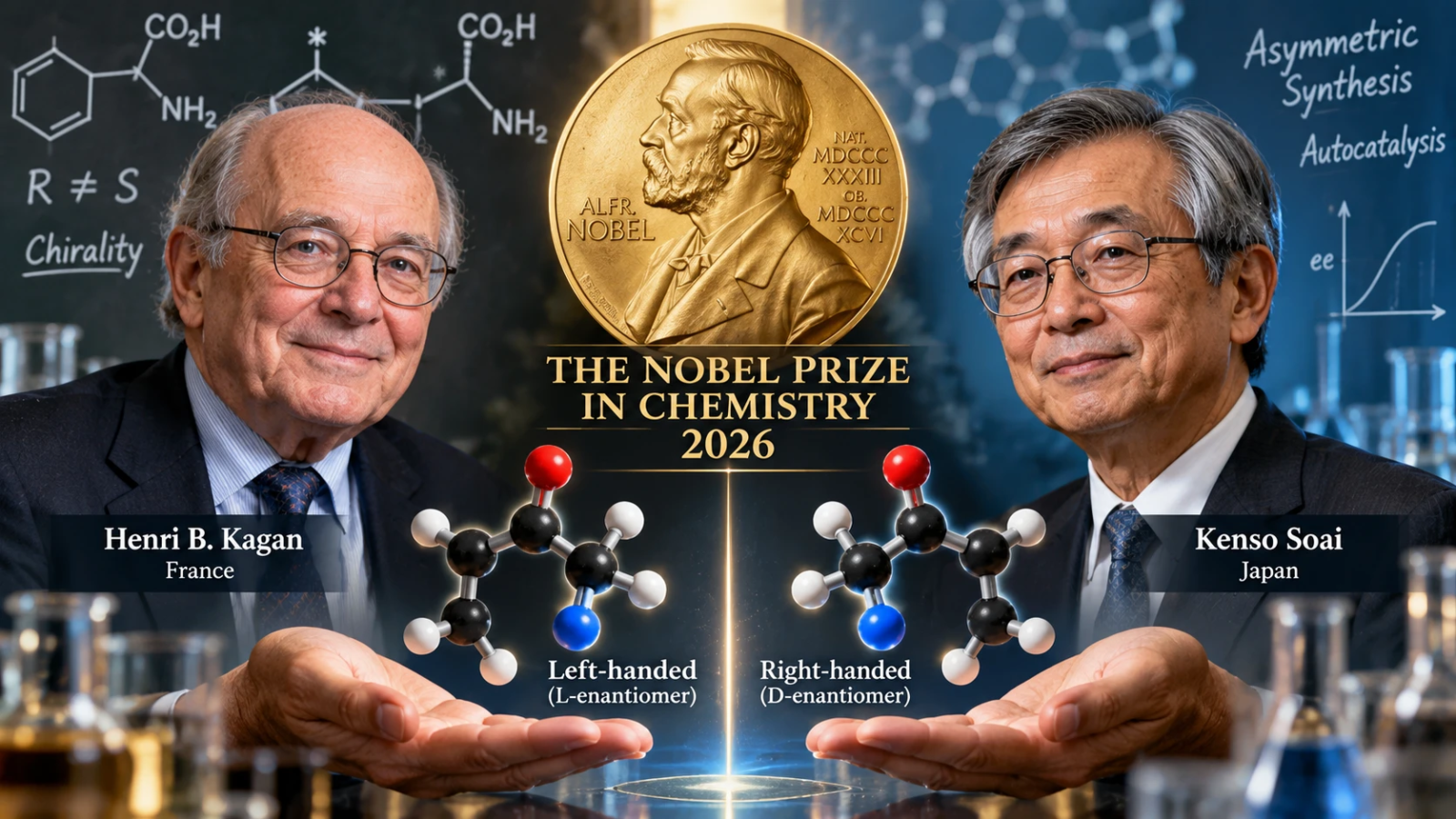
STOCKHOLM — French scientist Henri Kagan and Japanese researcher Kenso Swai have been awarded the 2026 Nobel Prize in Chemistry for their pioneering research into the “mirror images” of molecules and the origins of homochirality.
The Royal Swedish Academy of Sciences announced the laureates in Stockholm on Wednesday, recognising their discoveries related to asymmetric organic synthesis, nonlinear effects and autocatalysis.
The Nobel Committee said Kagan and Swai had helped solve a chemical mystery that had puzzled scientists for more than a century: how homochirality—the predominance of one molecular “handedness” over its mirror-image counterpart—can emerge spontaneously.
Heiner Linke, chairman of the Nobel Committee for Chemistry, said the scientists’ work had provided important insights into a longstanding problem in chemistry and described the chemical reactions they developed as “remarkable.”
Kagan is associated with the University of Paris-Sud in France, while 95-year-old Swai is a researcher at the Tokyo University of Science in Japan.
Molecules can exist in two forms that are mirror images of each other, much like a person’s left and right hands. Although chemically similar in many respects, these forms can behave differently in biological systems, making molecular chirality an important area of research in chemistry and medicine.
The award follows last year’s Nobel Prize in Chemistry, which was given to three scientists for developing a new type of molecular structure capable of trapping large quantities of gases. Their work opened up potential applications including removing greenhouse gases from the atmosphere and collecting moisture from desert air.






COMMENTS