
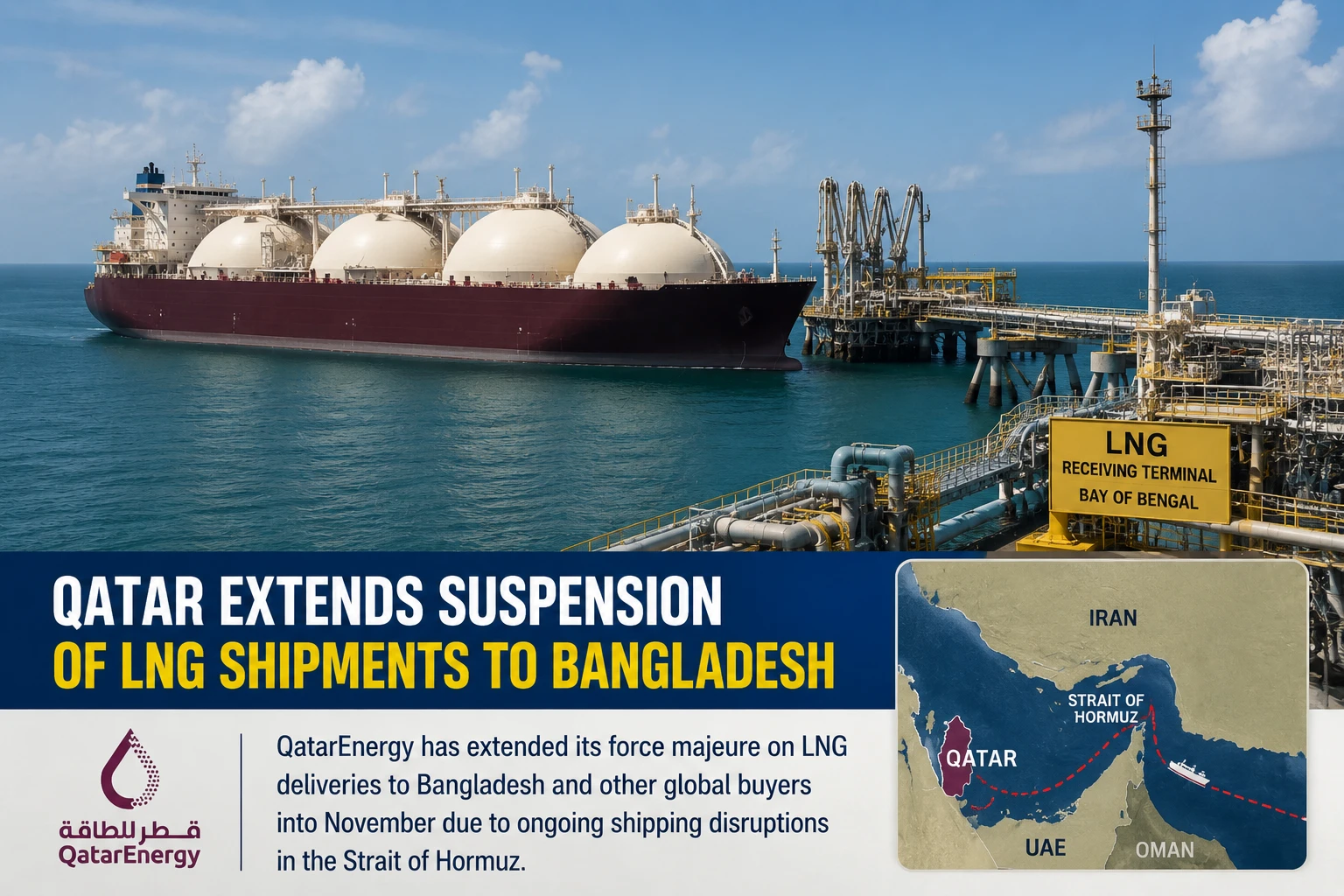
QatarEnergy has extended the force majeure period affecting liquefied natural gas (LNG) deliveries to Bangladesh, potentially pushing the suspension of shipments into October, as maritime traffic through the Strait of Hormuz remains severely restricted.
According to a report by Qatari outlet Doha News, Bangladesh, Pakistan and Italy are among the countries affected by the disruption. A force majeure declaration allows a company to suspend or limit contractual obligations due to extraordinary circumstances beyond its control.
A Bloomberg report last Friday said QatarEnergy had extended its directive suspending LNG deliveries to Bangladesh beyond September. Pakistani buyers have also been informed that cargo cancellations could continue through October, while European buyers have begun receiving similar notices.
Italian energy company Edison said QatarEnergy had informed it that five additional LNG cargoes scheduled for delivery to Italy’s Adriatic LNG terminal could not be supplied. This extends the force majeure period, which began in early April, until early November 2026. Edison said 29 cargoes have now been cancelled and that it is seeking alternative sources to meet its energy needs.
The disruption has forced LNG buyers in Asia and Europe to seek alternative supplies, switch to other fuels or reduce gas consumption. Uncertainty has deepened as escalating hostilities involving the United States and Iran raise further questions over when shipping through the Strait of Hormuz will return to normal.
Regular LNG shipments through the key maritime route have been largely halted. Qatar first declared force majeure in March and has renewed the measure each month as the disruption has continued.
Anne-Sophie Corbeau, a global research fellow at Columbia University’s Center on Global Energy Policy, told Euronews that without a political solution or an agreement among major stakeholders, the disruption could continue for some time.
She said QatarEnergy does not have a firm date for when normal export operations can resume, forcing the company to extend the suspension of deliveries on a monthly basis.
Qatar’s LNG exports have fallen sharply amid the conflict in West Asia. Data from ICIS showed that Qatar exported only 18 LNG cargoes during the first six months of the conflict, compared with 509 during the same period a year earlier.
According to Euronews, Qatar could face an estimated $24 billion loss in gas sales as a result of the disruption.
Other LNG exporters, including the United States and Canada, have partly filled the supply gap, while production has increased somewhat in Nigeria and Malaysia. However, these additional supplies have not been sufficient to fully offset the shortfall.
Some Asian markets are adapting by reducing gas consumption or switching to alternative fuels. Europe, meanwhile, has been relying more heavily on stored gas rather than purchasing expensive supplies from the spot market.
Corbeau warned that prolonged disruptions to LNG supplies from Qatar and the United Arab Emirates could trigger a major shock to global LNG trade in 2026.
The impact varies among importing countries. Pakistan, Bangladesh and India are considered particularly vulnerable because of their reliance on LNG imports, while Japan is relatively better positioned because it purchases less LNG from Qatar and has long-term contracts linked largely to oil or US gas prices.
Corbeau told Euronews that it could take until 2028 for global gas supply conditions to return to normal.
Before the conflict in Iran, roughly one-fifth of global LNG trade passed through the Strait of Hormuz. Some oil tankers continue to use the waterway, but LNG carriers are highly specialised and more difficult to replace, making them particularly vulnerable amid the ongoing conflict.
Saad Sherida Al-Kaabi, QatarEnergy’s president and CEO and Qatar’s Minister of State for Energy Affairs, has said Iranian missile strikes on Ras Laffan have reduced Qatar’s LNG export capacity by at least 17%.



COMMENTS