
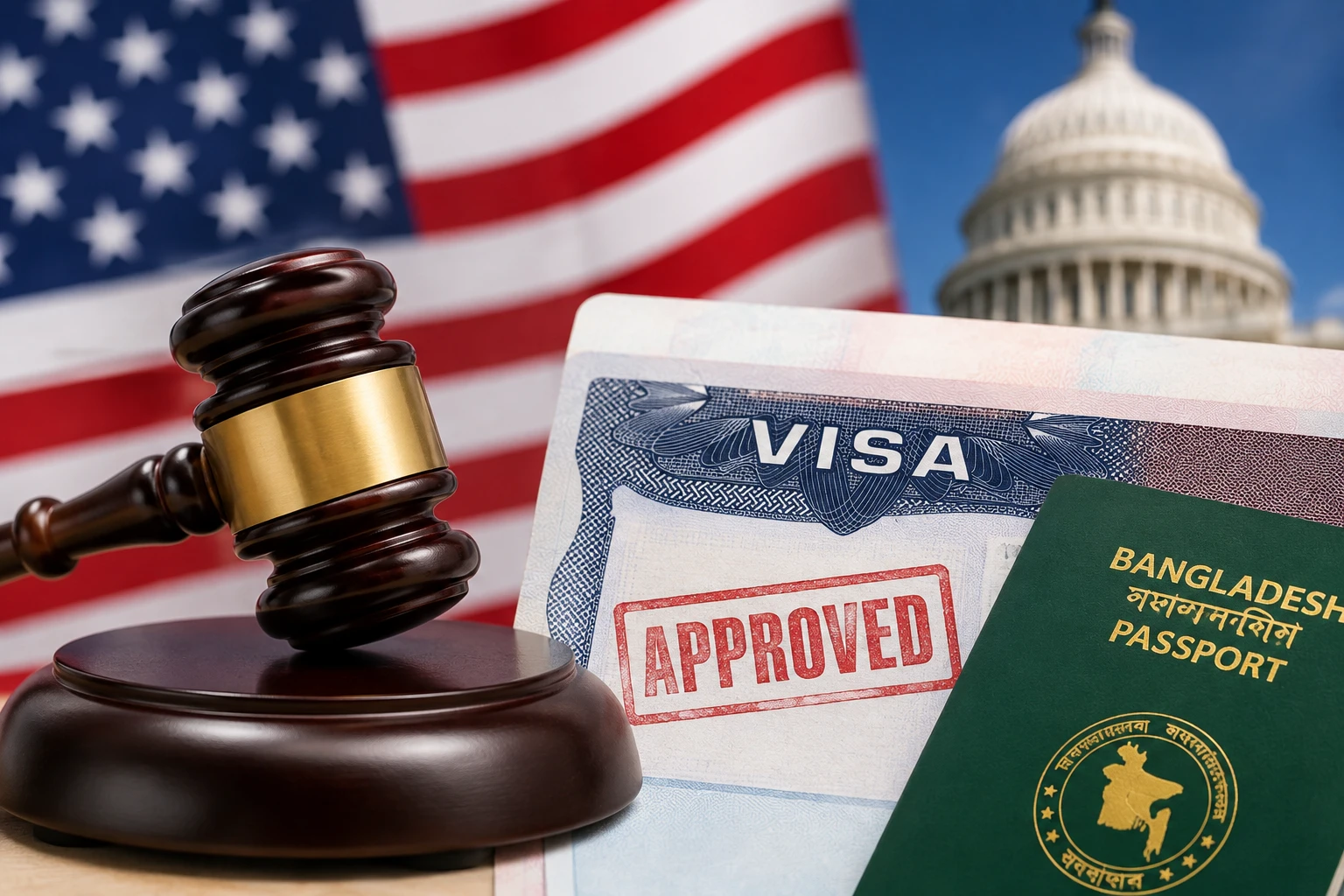
WASHINGTON — A U.S. federal judge has struck down a Trump administration policy that suspended immigrant visa processing for applicants from 75 countries, including Bangladesh, ruling that the measure exceeded the legal authority of the secretary of state.
U.S. District Judge Jeannette Vargas in Manhattan issued the ruling Friday, finding that the State Department policy announced in January was “patently unlawful” and conflicted with federal immigration law.
The policy had halted immigrant visa processing for nationals of 75 countries across South Asia, Africa, the Middle East, Latin America, the Balkans and the Caribbean. Bangladesh was among the countries affected.
The suspension was introduced under Secretary of State Marco Rubio as part of a broader immigration policy focused on whether visa applicants might become dependent on public benefits after entering the United States.
Judge Vargas ruled that the State Department could not categorically block immigrant visas solely on the basis of an applicant’s nationality.
“The policy, which categorically prohibits the issuance of immigrant visas based upon the nationality of the applicant, represents a direct abrogation of this statutory scheme,” she wrote.
The case was brought by immigrant-rights organizations, including the Catholic Legal Immigration Network and African Communities Together, along with affected visa applicants and U.S. citizens seeking to sponsor family members.
The ruling removes the policy that had suspended immigrant visa processing for Bangladeshis and nationals of the other affected countries, although separate U.S. visa restrictions remain in force under other presidential proclamations and security-related measures.
The State Department had not immediately commented on the ruling.
Policy introduced over ‘public charge’ concerns
The State Department announced the 75-country suspension in January, saying immigrant visa processing would be halted for nationals of countries whose applicants were considered more likely to rely on public assistance in the United States.
The measure was part of a broader effort by the Trump administration to tighten enforcement of the “public charge” provisions of U.S. immigration law. Those rules allow consular officers to consider whether an immigrant visa applicant is likely to become primarily dependent on government assistance.
However, the court found that the State Department went beyond that authority by imposing a nationality-wide suspension instead of assessing applicants individually.
Vargas said federal immigration law specifically limited the secretary of state’s authority over consular officers in the processing of immigrant visas.
Significance for Bangladeshi applicants
The decision directly affects Bangladeshi nationals whose immigrant visa processing had been suspended under the 75-country policy.
The suspension concerned immigrant visas, meaning visas generally used by people seeking permanent residence in the United States, including certain family-sponsored and employment-based applicants.
It was separate from nonimmigrant categories such as most tourist, business and student visas.
Bangladesh is also ineligible for the 2026 Diversity Visa program, but that is a separate immigration rule and is unrelated to the court ruling on the 75-country suspension.
The ruling does not automatically eliminate all U.S. visa restrictions that may apply to individual countries or applicants. The United States conthasanul-haq-inu-prison-rights-accused-duty-featuredes to maintain separate full or partial visa suspensions for nationals of a number of countries under Presidential Proclamation 10998, which took effect Jan. 1, 2026. Bangladesh is not among the countries listed in that proclamation.
Lawsuit challenged Rubio’s authority
The legal challenge focused on whether the secretary of state had the power to impose a blanket suspension on immigrant visa issuance based on nationality.
Vargas concluded that he did not.
Her ruling said the immigration system established by Congress requires individual consular consideration and does not allow the secretary of state to replace that process with a nationality-based prohibition covering applicants from dozens of countries.
The decision represents a significant setback for one of the Trump administration’s major immigration restrictions introduced this year.
Unless the ruling is stayed or overturned on appeal, immigrant visa processing for Bangladeshis and other affected nationalities can resume under the normal legal framework, subject to individual eligibility requirements and any other applicable U.S. immigration restrictions.



COMMENTS