
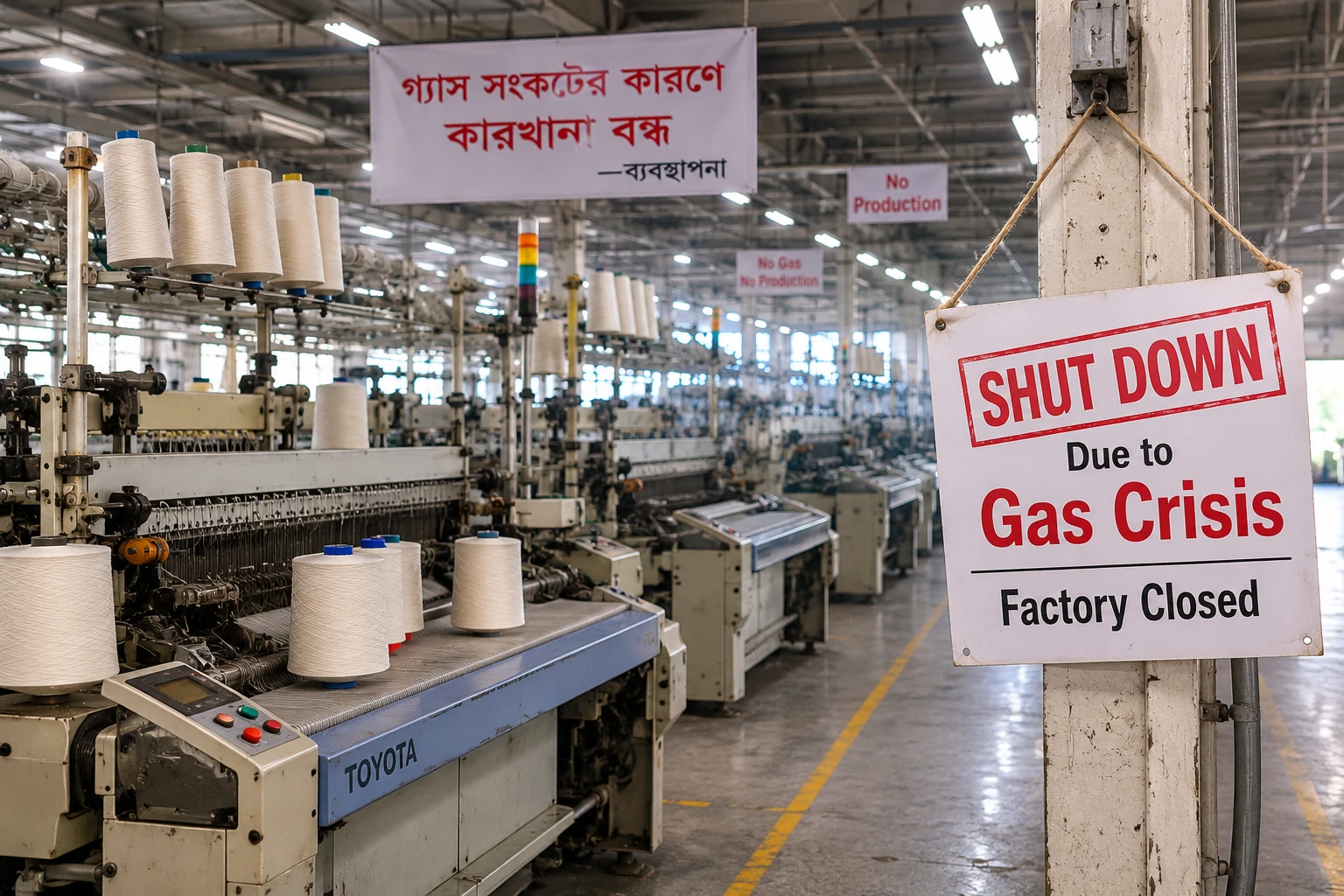
DHAKA, August 19 – More than 900 textile and yarn-producing mills across Bangladesh have completely halted operations due to an ongoing gas shortage, industry leaders said, despite recent government assurances that supplies would improve.
Gas Shortage Pushes Textile Mills to Shutdown as RMG, Steel and Paper Industries Operate Below Half Capacity
The prolonged gas crisis has also severely disrupted production in other gas-dependent industries, including ready-made garments (RMG), steel, paper, particle board and ceramics, with many factories operating at less than half their capacity.
On August 6, Power, Energy and Mineral Resources Minister Iqbal Hasan Mahmud assured business leaders and industrialists that the gas supply situation would improve quickly. However, industrial entrepreneurs said there had been no significant improvement as of Tuesday, leaving them increasingly frustrated.
Factory owners in Narayanganj, Savar, Gazipur, Mymensingh and Manikganj said some areas experienced a slight improvement in gas pressure last Friday, but supplies subsequently deteriorated again.
More Than Half of Textile Mills Shut
Bangladesh Textile Mills Association (BTMA) President Shawkat Aziz Russell said more than 900 of the association’s over 1,800 members are currently fully closed because of the gas shortage.
“The crisis is not limited to textile mills,” Russell said, adding that gas-dependent steel, paper, particle board and ceramic industries were also facing severe production disruptions.
Mohammad Hatem, president of the Bangladesh Knitwear Manufacturers and Exporters Association (BKMEA), said gas supplies in Narayanganj had shown a slight improvement on Monday but had worsened again the following day.
The managing director of a leading spinning mill in Araihazar, Narayanganj, said gas pressure at his factory had fallen to almost zero, far below the government’s promised level of 15 pounds per square inch (PSI).
The factory is reportedly losing around Tk 20 million a day because of the disruption, he said, warning that some owners could struggle to pay workers’ wages and utility bills for July and August.
Industrialists Fear Prolonged Disruption
Minhaz Haque, managing director of Fatullah Dyeing and Calendaring Ltd, said repeated government assurances and deadlines had failed to restore normal gas supplies.
“We have no idea when the situation will return to normal,” he said, expressing concern over the lack of a clear timeline.
The disruption has also affected workers in Narsingdi’s Madhabdi, one of the country’s major textile and handloom hubs. Former Narsingdi Chamber of Commerce and Industry president Abdullah Al Mamun said workers had taken to the Dhaka-Sylhet Highway demanding uninterrupted gas and electricity supplies.
He said many handloom workers are paid based on production, meaning they lose their income whenever factories remain closed.
However, Madhabdi Police Station Officer-in-Charge Kamal Hossain denied receiving any information about such a protest. Attempts to contact Shibpur police officials for comment were unsuccessful.
Crisis Triggered by LNG Terminal Incident
Bangladesh’s current gas shortage intensified after a fire and technical problems at an LNG floating storage and regasification unit (FSRU) operated by Excelerate Energy in Maheshkhali on July 21.
The incident caused a sudden reduction in gas supplies to the national grid, triggering a prolonged shortage that has continued to affect industries across the country.




COMMENTS