
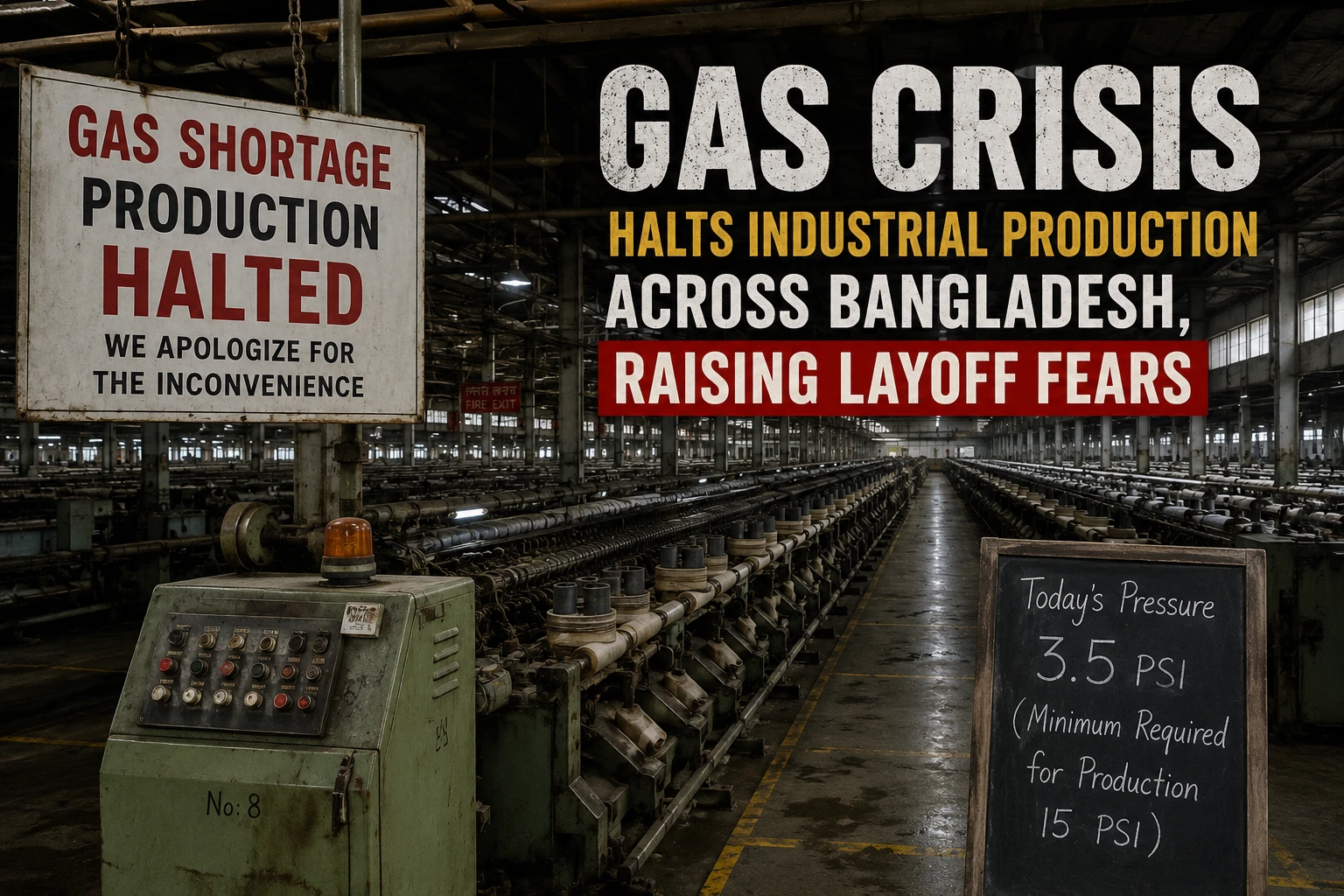
Dhaka, August 21 – A severe gas shortage has brought industrial production across Bangladesh to a near standstill, with factories in major industrial belts forced to suspend operations or run at less than half capacity.
Industries in and around the capital, as well as in Narsingdi, Narayanganj, Gazipur, Mymensingh and Chattogram, are among the worst affected. Some factories have sent workers on leave, while others have shut down machinery and assigned workers to maintenance tasks.
Industrialists fear that if the crisis continues, factories could face mounting financial losses, export order cancellations and eventually worker layoffs.
Gas supply falls far below demand
Bangladesh’s daily gas demand is around 3.8 billion cubic feet (bcf), while the country normally manages with a maximum supply of about 2.7 bcf. Recently, however, supply has fallen to around 2.26 bcf, intensifying shortages across the industrial, power, residential and transport sectors.
The disruption has been linked largely to interruptions in LNG supply. An LNG terminal operated by Excelerate Energy was shut down following a fire on July 21, reducing gas availability. Weather-related disruptions have also affected LNG supplies.
Hundreds of factories shut in Narsingdi
Narsingdi is among the industrial areas hardest hit by the crisis. According to local business leaders, more than 300 small and large factories have suspended production in the district.
The affected industries include textiles, dyeing, sizing, spinning and garment manufacturing.
A report by The Business Standard said more than 100 factories in Narsingdi remained closed for three consecutive days. Some factories have attempted to keep production running by using wood instead of gas to operate boilers, significantly increasing daily fuel costs.
Business owners estimate that the gas shortage is causing losses of up to Tk300 crore a day in Narsingdi alone.
The district has around 400 gas-dependent factories. Industrialists say most require gas pressure of 10–15 PSI for normal production, but pressure in some areas has recently fallen close to zero.
Workers sent home in Mymensingh
The situation is also severe in Valuka and surrounding industrial areas of Mymensingh. At least 20 factories sent workers home on Thursday because of insufficient gas pressure.
According to industrial police data, some factories have had to shut down more than half of their machinery, while production at major factories in the area has fallen to around 50%.
There are 293 industrial establishments in Valuka and nearby areas, of which 99 are gas-dependent. Spinning and textile factories have been particularly affected.
Production disrupted in Gazipur and Ashulia
Industrial areas in Gazipur and Ashulia are also struggling with low gas pressure. Some factories have been forced to shut gas-dependent machinery, while others are trying to maintain production using diesel.
In some factories, workers are performing tasks manually instead of using machinery. At one garment factory in Gazipur, for example, denim pressing is being done by hand because of insufficient gas pressure, slowing production and increasing costs.
Industrialists fear that if the situation does not improve soon, exporters will struggle to meet delivery deadlines for international buyers.
Chattogram industries also hit
The gas crisis has also disrupted production in Chattogram’s rod, garment, steel and shipbreaking industries.
Some businesses are increasingly concerned about their ability to pay workers’ wages. The crisis has also affected the transport sector, with vehicles facing long queues at CNG filling stations.
Alternative fuels push up production costs
Unable to secure adequate gas supplies, some factories are turning to diesel, LPG and wood as alternative fuels. The move has significantly increased production costs.
The situation is particularly concerning for export-oriented industries because higher production costs could weaken Bangladesh’s competitiveness in international markets.
The Bangladesh Knitwear Manufacturers and Exporters Association (BKMEA) has said gas and electricity shortages severely disrupted production at most industrial establishments during July and August. The organisation has requested the government to allow factories to pay their gas and electricity bills for these two months in 12 monthly instalments.
Layoff fears grow
Even when factories remain closed, owners must continue paying workers’ wages, loan instalments and interest, as well as electricity and gas bills.
If production remains suspended for an extended period, many businesses may struggle to maintain payrolls. Some factories have already granted workers leave, while others are keeping employees engaged in cleaning and maintaining machinery despite having little or no production.
Industrialists fear that prolonged disruption could eventually trigger large-scale layoffs.
Risks to exports and the economy
A significant portion of Bangladesh’s textile and garment industries depends on gas. A prolonged disruption could therefore affect not only factory output but the entire supply chain.
Lower production could make it difficult for exporters to meet shipment deadlines, potentially affecting buyer confidence and foreign exchange earnings.
The gas shortage is also affecting power generation, forcing industries to cope with both gas and electricity shortages at the same time. The resulting increase in production costs could further weigh on overall economic activity.
Businesses demand urgent action
Industrialists say a temporary improvement in gas supply will not be enough. They are calling for increased gas supplies, restoration of LNG imports and terminal operations, and reliable gas distribution to industrial zones.
An official at Titas Gas’s Narsingdi office said it was currently impossible to supply factories according to their demand. He expressed hope that supplies could increase somewhat next week if the situation improves.
Overall, the gas crisis has evolved beyond a problem of disrupted industrial production. It is increasingly affecting employment, export earnings, investment, loan repayments and broader economic stability.
Industrialists warn that without a quick and sustainable solution, the economic fallout from the crisis could become significantly deeper.




COMMENTS