
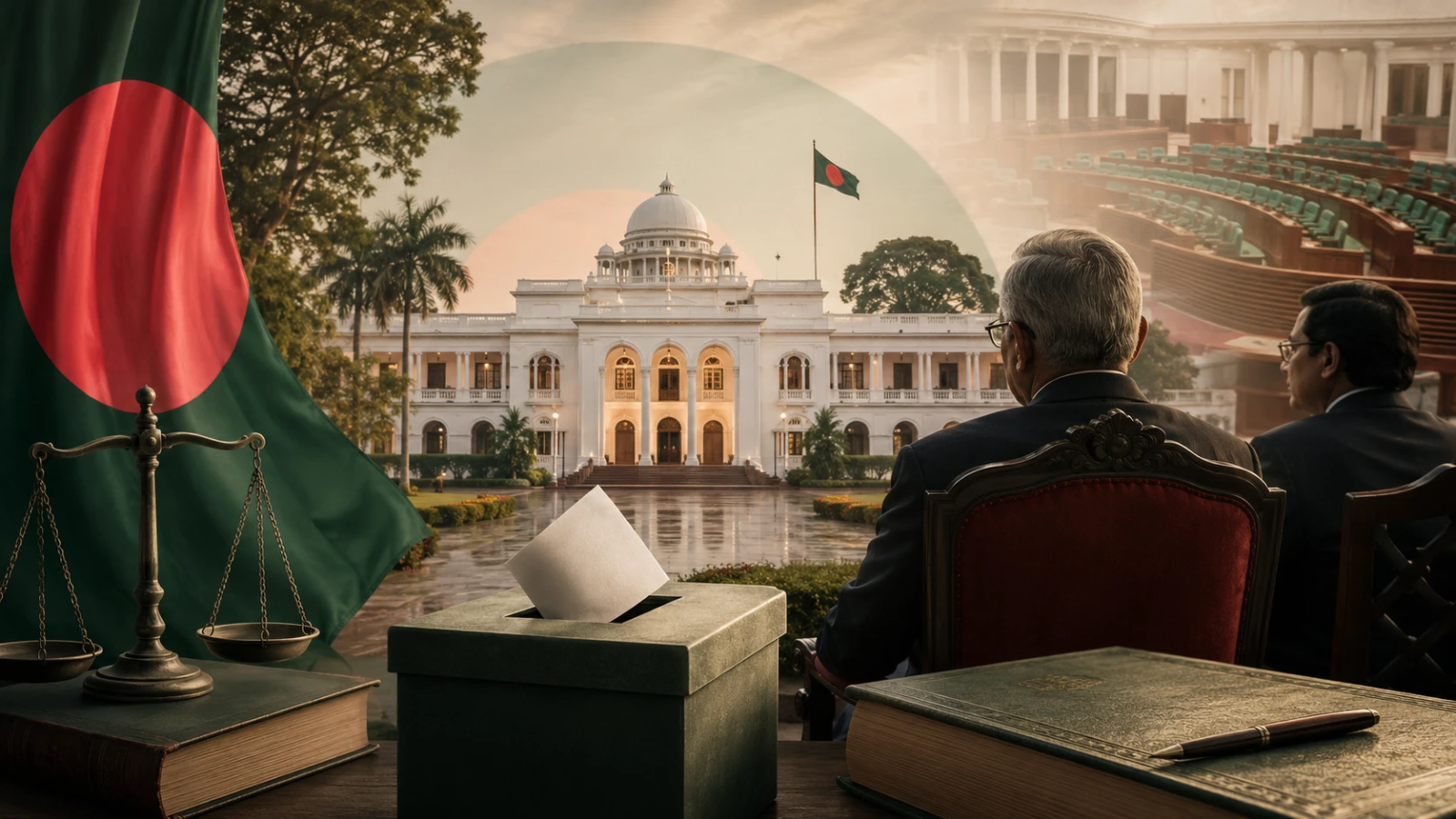
Voice Desk, DHAKA, August 20 – The presidential election cannot simply be viewed as a question of who will enter Bangabhaban, as doing so would overlook a significant feature of Bangladesh’s constitutional architecture.
How much power does the President actually have? How is the President elected? What salary and privileges come with the office? And why does a position with relatively limited executive authority continue to carry such enormous political and constitutional significance?
Not a Popular Vote: Parliament Elects the President
The president of Bangladesh is not elected directly by the people. Under the Constitution, the president is elected by members of Parliament.
The procedure is relatively straightforward. One member of Parliament nominates a candidate and another seconds the nomination. If there is more than one valid candidate, the person receiving the highest number of votes from lawmakers is elected president. In the event of an equal number of votes, the Constitution provides for the result to be determined by drawing lots.
The Election Commission is responsible for conducting the presidential election, with the Chief Election Commissioner serving as the returning officer.
This election is somewhat different from several recent presidential elections because there are two candidates and an actual parliamentary vote is therefore taking place. Yet the BNP’s commanding majority means that the political outcome is widely regarded as virtually predetermined.
A Presidential Candidate Does Not Have to Be an MP
Being a member of Parliament is not a prerequisite for becoming president. Oli Ahmed is an example. Although he is contesting the presidency, he is not a member of Parliament and therefore cannot cast a ballot in today’s parliamentary vote.
A presidential candidate must be at least 35 years old and must meet the qualifications required to be elected to Parliament. However, membership of Parliament itself is not mandatory.
A person previously removed from the presidency through impeachment is also constitutionally barred from being elected president again.
If a sitting member of Parliament is elected president, his or her parliamentary seat becomes vacant on assuming office. If Mirza Fakhrul Islam Alamgir becomes president, his parliamentary seat will consequently fall vacant and a by-election will eventually be required.
The Highest Constitutional Office, But Not the Head of Government
The president holds the highest constitutional office in Bangladesh. The Constitution places the president above all other persons in the state.
But this is where an important distinction in Bangladesh’s parliamentary system emerges.
The president is the head of state, but not the head of government.
Executive authority is exercised principally by the prime minister and the Cabinet. The presidency therefore carries enormous constitutional prestige and protocol, while its direct executive powers are comparatively limited.
Under Article 48(3) of the Constitution, except for the appointment of the prime minister and the chief justice, the president is required to exercise his or her functions in accordance with the advice of the prime minister.
The constitutional position is different in those two appointments.
Two Areas Where the President Has a Distinct Constitutional Role
In appointing the prime minister, the president normally appoints the leader who commands the confidence of the majority in Parliament. Where an election produces no clear parliamentary majority, however, the president’s constitutional role can become considerably more significant.
The appointment of the chief justice is another area in which the Constitution gives the president a distinct constitutional authority.
The prime minister is required to keep the president informed about domestic and foreign policy matters. If the president asks the prime minister to place a matter before the Cabinet for consideration, the prime minister must do so.
There is, however, an important constitutional protection: no court may inquire into whether any advice was given to the president, or what that advice was.
The Power to Grant Clemency
One of the president’s most significant constitutional powers is the authority to grant clemency.
Under Article 49 of the Constitution, the president may pardon, suspend, remit or commute a sentence imposed by a court, tribunal or other competent authority.
It is among the office’s most consequential constitutional powers. Yet within Bangladesh’s parliamentary system, its exercise is also situated within the broader constitutional framework governing the president’s relationship with the government.
Why Can the President Not Be Directly Prosecuted?
Another distinctive feature of the presidency is constitutional immunity.
While in office, the president enjoys constitutional protection in relation to official functions. Criminal proceedings cannot be instituted against the president during the term of office, nor can a court issue a warrant for the president’s arrest or imprisonment.
That immunity, however, is neither absolute nor permanent.
The Constitution provides for impeachment in cases of violation of the Constitution or gross misconduct. The president may also be removed on grounds of physical or mental incapacity.
In an impeachment proceeding, a written notice signed by members of Parliament is submitted to the Speaker, followed by a constitutionally prescribed parliamentary process. The president is entitled to defend himself or herself. Removal requires the support of at least two-thirds of the total membership of Parliament.
A similar constitutional process applies in cases of physical or mental incapacity.
One of the most notable episodes involving an attempted impeachment of a Bangladeshi president concerned A.Q.M. Badruddoza Chowdhury. In 2002, during the BNP-led government, an impeachment process was initiated against him, following which he resigned from office.
Once a person leaves the presidency, the constitutional protection attached to the office does not prevent subsequent legal proceedings.
A Five-Year Term, With a Two-Term Limit
The president serves a five-year term. However, the incumbent remains in office until a successor assumes the presidency.
No person may serve more than two terms as president. Mohammad Abdul Hamid was the first and, so far, the most prominent example of a president serving two consecutive terms in Bangladesh.
After leaving office, the constitutional immunity attached to the presidency no longer operates in the same manner.
A Salary of Tk120,000, But Privileges Extend Far Beyond the Paycheque
The president receives a monthly salary of Tk120,000, which is exempt from income tax. The salary was last revised in 2016, when it was increased from Tk61,200.
But the financial value of the presidency cannot be measured by salary alone.
The president’s official residence is Bangabhaban, with its maintenance, furnishing and operational costs borne by the state. Official vehicles and other transportation facilities are also provided.
The president is entitled to allowances at government-prescribed rates when travelling abroad on official business.
There is also an annual entertainment and hospitality allowance. Expenditure under this category is not subject to audit.
In other words, the economic package attached to the presidency extends well beyond the monthly salary, encompassing accommodation, transport, medical care, official travel, hospitality and other institutional facilities.
A Tk200 Million Discretionary Fund
The president also has access to a discretionary fund of Tk200 million a year.
The fund may be used, at the president’s discretion, to provide assistance to individuals and organisations.
Special medical benefits are also available to the president and members of the immediate family. Medical expenses at hospitals in Bangladesh are covered by the state, while overseas treatment may also be funded when recommended by physicians.
The president is also entitled to aviation insurance, currently valued at Tk2.7 million a year.
Taken together, the presidential package is therefore considerably broader than the salary figure suggests. It includes an official residence, transportation, medical care, official travel allowances, hospitality and aviation-related benefits, all supported through the state.
So, How Much Power Does the President Actually Have?
The answer depends partly on the political configuration of Parliament.
When one party commands a clear parliamentary majority, the president’s room for constitutional discretion is relatively narrow. The appointment of the prime minister, for example, is generally straightforward.
But when no party has an outright majority, the presidency can suddenly acquire much greater political significance.
Who can command the confidence of Parliament? Who is capable of forming a government? Which political leader can demonstrate majority support?
In such circumstances, the president’s constitutional position can become critical.
The practical influence of the presidency therefore depends not only on the text of the Constitution but also on the political arithmetic of Parliament.
The Grandeur of Bangabhaban, the Limits of Executive Power
This is ultimately what makes the presidency so intriguing in Bangladesh.
On one side stands the country’s highest constitutional office, backed by extraordinary protocol, the official residence at Bangabhaban, security, transportation, medical care and a range of state-funded privileges.
On the other stands a constitutional office whose direct control over the country’s day-to-day executive machinery is limited. That power rests primarily with the prime minister and the Cabinet.
The presidency therefore occupies a distinctive space in Bangladesh’s constitutional order: the pinnacle of state prestige, but not the centre of executive government.
What Happens When the Presidency Falls Vacant?
The Constitution also provides for continuity.
If the office of president becomes vacant, or if the president is unable to perform the functions of the office, the Speaker of Parliament assumes the president’s functions until a new president takes office.
This arrangement is designed to prevent a constitutional vacuum at the highest level of the state.
The Real Significance of Today’s Vote
Today’s election may not offer much suspense in terms of the final numbers. With 247 BNP lawmakers against 90 members of the 11-party alliance, the outcome appears largely foreseeable even before voting begins.
But the significance of the election extends far beyond the question of who wins today’s ballot.
It offers a revealing window into Bangladesh’s constitutional system.
The president is not elected directly by the people, but by a Parliament elected by the people. The president is the head of state, but not the head of government. The office carries important independent constitutional powers, yet in most matters the president acts on the advice of the prime minister.
That is why the question of Bangabhaban is ultimately about much more than who occupies the presidential palace.
It raises a deeper constitutional question:
How much authority should the person holding Bangladesh’s highest constitutional office exercise, and where should that authority end as it meets the executive power of the prime minister?
For Bangladesh’s parliamentary democracy, that boundary between constitutional dignity and executive authority remains one of the most important questions at the heart of the presidency.

COMMENTS