
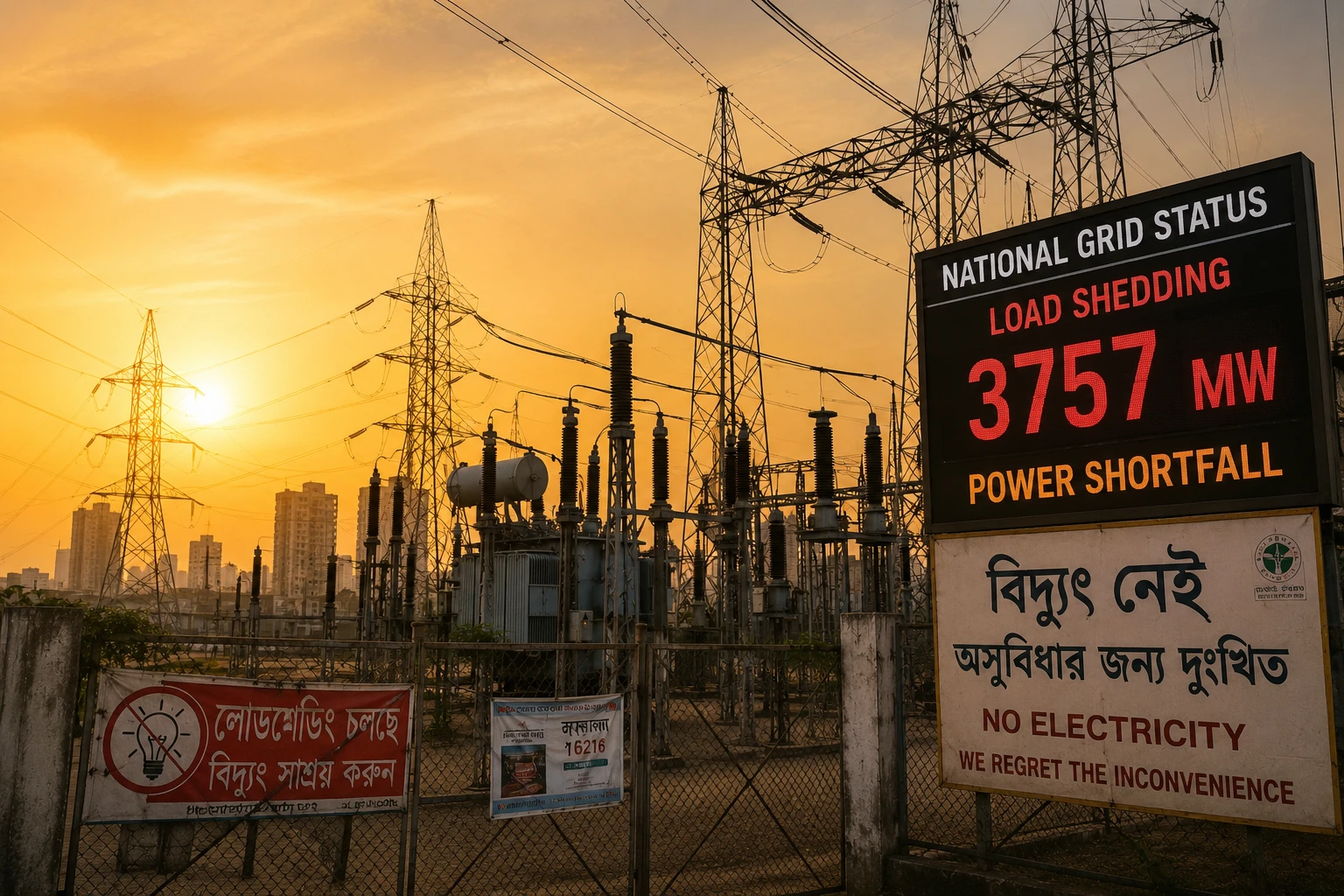
Bangladesh is experiencing record levels of load shedding as fuel shortages and maintenance problems have forced 41 power plants to remain completely shut, while many operational plants are unable to generate electricity at full capacity.
The worsening power crisis has affected industrial zones as well as rural areas, with some regions experiencing repeated outages every hour and others remaining without electricity for several hours at a stretch. The situation has caused severe hardship amid the ongoing heat.
According to officials of power distribution companies, average load shedding has recently reached around 3,000 megawatts. A new record was set within a 10-hour period last Sunday, when load shedding rose from 3,671MW at 3pm to 3,757MW at 1am.
The previous highest level was 3,512MW, recorded at 1am on August 3. During the previous Awami League government, the highest recorded load shedding was 3,419MW on June 27, 2023.
Gas Shortage Drives Power Generation Crisis
Officials and energy experts identify the shortage of natural gas as the main cause of the current electricity crisis. Power plants are receiving less than one-third of their daily gas requirement, while shortages of coal have further reduced generation.
According to Petrobangla data, gas-fired power plants require around 2.52 billion cubic feet (bcf) of gas per day. At least 1.0–1.1 bcf is considered necessary to keep load shedding under control. However, power plants are currently receiving only around 700 million cubic feet (mmcf) of gas per day.
Gas-fired plants once generated around 5,000MW of electricity. Their output has recently fallen to between 3,500MW and 4,000MW, meaning existing generation capacity cannot be fully utilised because of insufficient fuel.
Damaged LNG Terminal Yet to Return to Full Capacity
The gas shortage worsened after an LNG terminal operated by Excelerate Energy in Maheshkhali, Cox’s Bazar, was damaged on July 21. The disruption reduced gas supplies by around 600mmcf per day, bringing total national gas supply down to approximately 2.14bcf per day.
After around 15 days, partial repairs restored about 250mmcf of gas supply from the terminal. However, it has yet to return to full capacity.
Petrobangla Director (Operations) Engineer Md Shoaib said repairs could take another two to three days. If everything goes according to plan, gas supplies are expected to increase within the week. Once the terminal is fully operational, an additional 300–350mmcf of gas could be supplied daily.
Experts, however, warn that restoring the LNG terminal alone will not resolve Bangladesh’s longer-term energy crisis. Domestic gas production has been declining while dependence on imported LNG has increased, leaving the power sector vulnerable to disruptions in international energy supplies.
Coal Shortages Add to the Pressure
Coal shortages have also contributed to declining electricity generation.
At the 1,200MW Payra Thermal Power Plant, generation has fallen by around half. Bad weather has delayed the transfer of coal from large vessels to smaller vessels at Kutubdia, slowing deliveries to the plant.
Power supplies from Adani Power’s plant in Jharkhand, India, have also declined. Bangladesh normally receives around 1,400MW from the plant, but supplies have fallen to between 800MW and 1,000MW in recent days. Flooding in Jharkhand has reportedly caused coal to become wet, disrupting generation.
The company expects production to return to full capacity once coal supplies normalise.
Bangladesh’s coal-fired power plants have a combined generation capacity of around 7,945MW, but current output is only about 5,500MW. Although one unit of the Payra plant resumed operations after maintenance, generation has declined at the Rampal and Barapukuria plants. Two of Barapukuria’s three units are currently out of operation because of technical problems.
Some Areas Without Power for 10–12 Hours
The generation shortfall is directly affecting consumers. In many parts of the country, electricity outages are reportedly lasting 10 to 12 hours a day.
The prolonged outages are making it difficult for households to operate fans, air conditioners and water pumps amid extreme heat. Businesses, students and people working online are also facing disruptions.
In Sylhet, electricity demand stood at 247MW on Monday, while supply was only 202MW, leaving a 45MW shortfall. The deficit had reached 56MW the previous day. Frustrated by frequent outages, local residents blocked a road and staged a protest in the Tuker Bazar area of the city on Sunday night.
Similar complaints have emerged from Santahar in Bogura, where supply has reportedly fallen to less than half of demand during peak periods. Medical services, education and businesses have been affected by increased evening load shedding.
Industries Face Double Pressure
Industrial areas are facing a double burden as gas shortages are compounded by electricity shortages.
Factories are forced to halt production whenever electricity goes out, while restarting machinery after power returns can also take considerable time. Many businesses are relying on generators to maintain operations, increasing both fuel and production costs.
Authorities Seek More Gas for Power Plants
As load shedding worsens, the power and energy authorities have intensified coordination.
Officials said the Power Division Secretary has contacted the Petrobangla chairman to request increased gas allocations for power plants. Priority is being given to plants that can quickly add electricity to the national grid.
Officials believe increased gas supplies could raise generation and reduce load shedding, although the current gas supply situation remains inadequate.
Oil-Fired Plants Used to Bridge the Gap
Authorities are also trying to increase generation from expensive oil-fired power plants to compensate for shortages of gas and coal.
However, prolonged reliance on oil-based generation would increase production costs and put additional pressure on government subsidies. Delayed payments to private power producers have also created difficulties in importing fuel oil.
Power Development Board officials say oil-fired plants can help reduce the immediate shortfall, but restoring normal gas and coal supplies is essential for a sustainable solution.
Some Improvement Expected Within Days
Bangladesh Power Development Board Chairman Engineer Md Rezaul Karim expects the electricity supply situation to improve somewhat within one to two days.
He said shortages of both gas and coal had contributed to the recent increase in load shedding. Meetings have been held with officials from the Payra power plant and Adani Power to address the supply problems.
Petrobangla officials also expect gas supplies to increase within two to three days once the LNG terminal returns to full operation.
However, they caution that load shedding is unlikely to disappear completely because electricity demand is rising with temperatures. Without a stable fuel supply, the overall crisis will remain difficult to control.
Experts Call for Long-Term Energy Reform
Energy experts say the current electricity crisis is not a sudden development. Declining domestic gas production, increased dependence on imported LNG, fuel supply uncertainties and long-standing management problems have gradually deepened the crisis.
Experts recommend reducing unnecessary costs, expanding solar power, making better use of existing coal-fired plants, reducing gas and electricity wastage and intensifying domestic gas exploration.
Energy expert Professor M Tamim said the country’s energy shortage has become its biggest problem and cannot be resolved quickly. He stressed the need to increase LNG imports if necessary to keep the industrial and power sectors operational while simultaneously accelerating domestic gas exploration.
Weak Local Grid Infrastructure Worsens the Crisis
In addition to the national generation shortfall, weaknesses in local transmission infrastructure are worsening power disruptions in some areas.
In Rupganj and Araihazar of Narayanganj, demand is around 200MW while supply is approximately 140MW, leaving a deficit of about 60MW.
Construction of a 132/33kV grid substation in Araihazar began in 2020 and was expected to be completed in 2023, but the facility is still not fully operational. Officials say the remaining work could potentially be completed within seven to 10 days once a specialised engineering team arrives from South Korea.
Once the new grid is operational, pressure on the Bhulta grid will be reduced and an alternative transmission route will become available, potentially improving electricity supply in Rupganj and Araihazar.
However, officials and experts note that improving local transmission infrastructure alone will not eliminate load shedding nationwide as long as the country continues to face a major shortage in power generation.



COMMENTS