
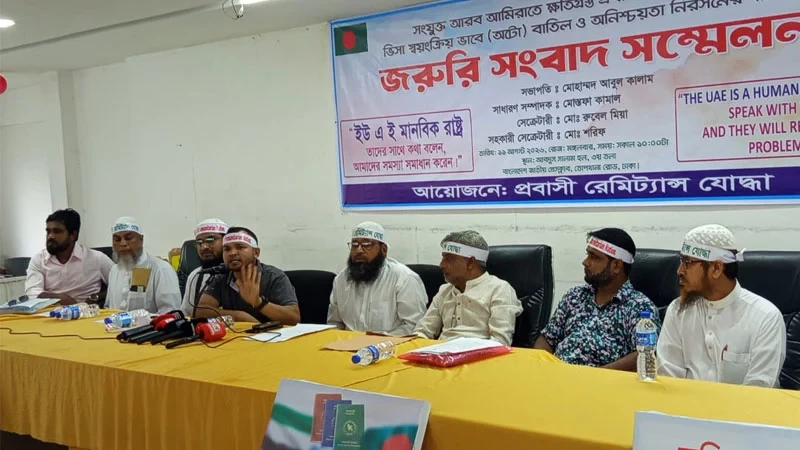
An organization representing Bangladeshi expatriates has called for urgent government intervention to restore and renew the visas of migrant workers in the United Arab Emirates who have been affected by automatic cancellations or other immigration complications, warning that prolonged uncertainty could cost workers their jobs and push their families into financial hardship.
The organization, Probashi Remittance Joddha, or “Expatriate Remittance Warriors,” raised the demand at a news conference held Tuesday at the Abdus Salam Hall of the National Press Club in Dhaka.
Md. Sharif, assistant secretary of the organization, presented a written statement detailing the difficulties faced by Bangladeshis whose UAE residence or employment visas have been canceled or become subject to complications.
The organization urged the Bangladesh government to intensify diplomatic engagement with Emirati authorities so that affected migrants can have their visas restored or renewed as quickly as possible.
According to the statement presented at the news conference, the visa complications have put some expatriates at risk of losing their jobs while creating significant financial and family pressures. Many migrant workers have dependents in Bangladesh whose household expenses, education and other costs rely heavily on income sent home from the Gulf.
Sharif also outlined the government’s ongoing diplomatic efforts to resolve the problem and called for those efforts to be accelerated.
Md. Shahidul Islam and Sirajul Islam were among others who addressed the news conference.
The appeal comes amid weeks of concern over reports of UAE residence visas being automatically canceled, including cases involving Bangladeshis who were outside the Emirates.
Shadow of the 2024 expatriate protests
Bangladesh-UAE migration relations came under unusual pressure during Bangladesh’s political unrest in July 2024, when Bangladeshi expatriates staged demonstrations in the Emirates in connection with events at home.
Public demonstrations without authorization are tightly restricted in the UAE. Fifty-seven Bangladeshis were convicted after participating in protests there in July 2024, receiving sentences ranging from 10 years to life imprisonment.
In September 2024, UAE President Sheikh Mohamed bin Zayed Al Nahyan pardoned the 57 Bangladeshis. The pardon annulled their sentences and that they were to be deported from the UAE.
Government says 626 Bangladeshis affected
The scale of the problem became clearer after the Bangladesh government publicly addressed the issue late last month.
On July 30, State Minister for Foreign Affairs Shama Obaed Islam said at a joint media briefing at the Ministry of Foreign Affairs in Dhaka that 626 Bangladeshi nationals had experienced visa “auto-cancellation,” rejecting reports suggesting that about 5,000 Bangladeshis had been affected.
“However, according to information received from our embassy and the UAE authorities, the actual number as of today’s inter-ministerial meeting is 626,” Shama told reporters following a meeting involving the foreign and expatriates’ welfare ministries.
State Minister for Expatriates’ Welfare and Overseas Employment Nurul Haque Nur recently said that his ministry would establish a dedicated hotline in Bangladesh for workers whose UAE visas were canceled after they returned home on leave.
Workers face potentially severe consequences
For individual migrants, however, the issue is about more than immigration paperwork.
A residence or employment visa problem can threaten a worker’s ability to return to the UAE, remain legally employed or continue earning the income on which family members in Bangladesh depend. Workers who have invested substantial sums in migration can face particularly serious losses if they suddenly become unable to return to their jobs.
UAE remains crucial to Bangladesh’s migrant economy
The controversy carries broader economic significance because the UAE is one of Bangladesh’s most important overseas employment destinations and sources of remittance.
Bangladesh Bank figures reported in July showed that Bangladesh received $32.77 billion in remittances during the first 11 months of the 2025-26 fiscal year, with approximately 62 percent coming from just five countries: Saudi Arabia, the United Kingdom, the UAE, Malaysia and the United States.
The economic implications of disruptions affecting migrant workers therefore extend well beyond individual visa holders. Reduced access to employment in a major Gulf market can affect families at home, foreign-currency inflows and Bangladesh’s wider overseas labor market.
The UAE has long hosted a large Bangladeshi expatriate population, ranging from construction and service-sector employees to professionals, entrepreneurs and domestic workers.
Labor relations between the countries have also evolved through bilateral agreements. In April 2018, for example, the UAE and Bangladesh signed a memorandum of understanding governing the recruitment of Bangladeshi domestic workers. The agreement established requirements covering employment contracts, salaries, benefits, accommodation and recruitment through licensed agencies.
Pressure for a rapid resolution
Against that background, Tuesday’s news conference adds pressure on Dhaka to turn its diplomatic discussions with Abu Dhabi into practical relief for migrants already affected.
For Probashi Remittance Joddha, the immediate priority is the restoration and renewal of visas rather than a prolonged administrative process that could leave workers unable to return to their jobs.
The organization is asking the government to treat the situation facing affected expatriates as an urgent labor and economic issue, given that delays could mean lost employment, accumulated debts and severe hardship for families dependent on remittance income.

COMMENTS