
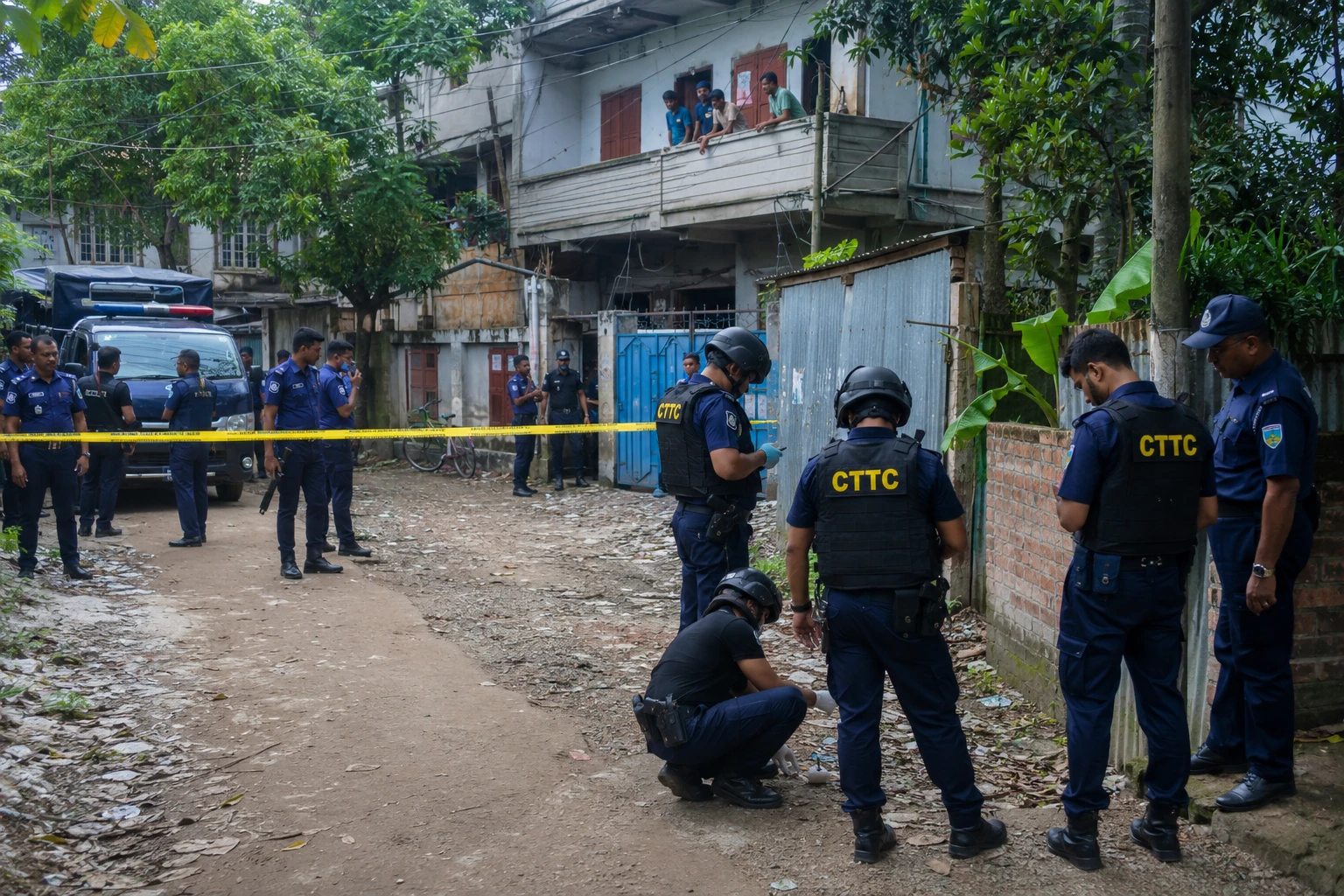
SAVAR, Bangladesh — Aug. 12, 2026: Bangladesh security forces have recovered hand bombs and materials allegedly used to manufacture explosives from a house in Savar, outside Dhaka, and arrested a man whom police identify as a member of the banned militant group Neo-JMB. Police initially recovered five pipe bombs from the building before discovering eight more, bringing the total to 13.
Authorities are investigating whether the explosives are connected to pipe bombs recently recovered at a metro rail station in Dhaka’s Motijheel area, as well as to several earlier bomb-related incidents.
Police have recovered five hand bombs and materials allegedly used to make explosives from a house in Shyampur area of Hemayetpur in Savar, raising suspicions of a possible connection with pipe bombs recently recovered from Motijheel in Dhaka.
A man identified as Mohammad Arif, whom police describe as a member of the banned militant outfit Neo-JMB, has been arrested in connection with the case.
The operation began on Tuesday night and continued into Wednesday morning, with members of the Dhaka Metropolitan Police’s Counter Terrorism and Transnational Crime (CTTC) unit, the National Security Intelligence (NSI), and Savar police taking part.
A police official involved in the operation said investigators found pipe bombs and evidence suggesting that explosives had been assembled at the house.
“The pipe bombs found here appear similar to those recovered from the Motijheel area,” the official said, adding that investigators were examining whether the two incidents were connected.
Police have also cordoned off the property while bomb-disposal specialists conduct searches.
Savar Model Police Station Officer-in-Charge Saiful Alam said the explosives were recovered following a tip-off.
Police believe additional hand bombs may have been hidden behind Shyampur Government Primary School, located near the house. The area has also been placed under security restrictions as bomb-disposal personnel continue their search.
Pressure Cooker Bomb Recovery in Savar
The recovery of another pressure cooker bomb in Savar has raised fresh concerns over a possible explosives network, with counterterrorism officials examining potential links to devices recently recovered in Ashulia and Motijheel.
Police recovered the device early Wednesday from a mosque field in Sadhapur under Bongaon Union. Wrapped in scotch tape, it was found inside a drum containing clothes and a copy of the Quran. Local residents discovered the device, removed it from the drum and alerted police.
Residents said three unidentified individuals were seen leaving the drum at the field beside Laltek Ghora Mosque at around 1:30am, prompting investigators to examine whether the incident was connected to a wider pattern of suspicious explosives-related activity in the Dhaka region.
Suspect rented house using another identity
The house is owned by Abdul Jalil, who is reportedly paralysed and bedridden. His daughters look after the property.
According to his eldest daughter, a man using the identity card of Abbas Ali rented a room on Aug 5 for Tk 4,000 a month. He reportedly told the family that he worked as a private-car driver and had chosen the house because he intended to enrol his children at the nearby primary school.
He paid Tk 1,000 as an advance and installed a fan in the room.
The family said they rarely saw him during the daytime after he moved in. They occasionally heard loud noises from the ground floor at night, apparently when materials were being brought into the house.
Police are now examining whether the rented room was being used as a clandestine location for storing or manufacturing explosives.
Possible links to Keraniganj and Ashulia incidents
A CTTC official said investigators also found TATP (triacetone triperoxide), an explosive-making substance, at the Savar location.
The official said the discovery appeared to have similarities with evidence recovered during an explosion at the Ummul Qura madrasa in Keraniganj last December.
Police had previously arrested madrasa director Al Amin following the Dec 26 explosion while explosives were allegedly being prepared. Investigators had also identified possible links to a militant named Mohammad Arif.
Police have subsequently alleged that Arif was involved in a series of incidents, including an attack on police during a search in Jatrabari in February, an explosion at a Shiva temple in Cumilla in March and another explosion during a police search in the Sayedabad area.
Investigators say they have not yet established all of the alleged links.
Officials also believe a pressure-cooker bomb recovered in Ashulia may have been manufactured at the Hemayetpur house. According to police, evidence from the Ashulia device helped them identify Arif.
The CTTC official said investigators were now conducting further raids based on information obtained from Arif.
“Arif has spoken about a mentor who is a homoeopathic doctor. We are conducting an operation at that location,” the official said.
Police are expected to provide more details at a press briefing.
Police to brief media on bomb cases
The Dhaka Metropolitan Police earlier said it would brief journalists on Wednesday about arrests and investigations into bomb recoveries in Motijheel and other parts of Dhaka.
The latest discoveries come amid heightened scrutiny of possible militant networks following a series of explosive-related incidents.
CTTC Chief Mohammad Shamsul Haque said in July that authorities had not detected any alarming nationwide resurgence of extremism, although security agencies continued round-the-clock monitoring through intelligence inputs, online surveillance, social media monitoring and databases.
Hasina government’s anti-militancy campaign
The latest investigation also recalls the extensive counter-militancy campaign pursued under the government of former Prime Minister Sheikh Hasina, particularly after a series of militant attacks in Bangladesh in 2015 and 2016.
Hasina’s government publicly adopted a “zero tolerance” policy towards terrorism and militancy and repeatedly called on law-enforcement agencies to prevent militant groups from using Bangladeshi territory. In 2017, she said her government would root out militancy and terrorism to ensure public security.
One significant institutional measure was the creation of the Counter Terrorism and Transnational Crime (CTTC) unit within the Dhaka Metropolitan Police in February 2016. The specialised unit was established to strengthen the police response to militancy, collect intelligence, monitor extremist activities and conduct operations against suspected militants.
The government also relied on coordinated operations involving agencies including the police, Rapid Action Battalion (RAB), intelligence services and other security forces. Following the July 2016 Holey Artisan Bakery attack, international security partners specifically recognised Bangladesh’s efforts and the establishment of the specialised CTTC unit.
Hasina’s government also pursued measures aimed at preventing radicalisation. She repeatedly urged teachers, parents and communities to monitor young people and prevent them from becoming involved in extremism. In a 2016 address to the United Nations General Assembly, she called for international cooperation to disrupt the financing, arms supplies and other support networks of militants and described programmes aimed at raising public awareness against radicalisation.
Bangladesh also moved to ban organisations accused of militant activities. In March 2017, for example, the government formally banned Ansar Al Islam, describing it as a militant organisation involved in activities threatening public security.
The government’s counter-terrorism strategy was described at the time as resting on four broad pillars: prevention, disruption, capacity building and respect for human rights.
Despite those measures, the recovery of explosives and the investigation into suspected militant networks in Savar indicate that security agencies continue to monitor the possibility of clandestine extremist activity.
The latest case remains under investigation, and the alleged connections among the Savar, Motijheel, Keraniganj and Ashulia incidents have yet to be conclusively established.



COMMENTS