
Bangladeshi journalists living in the United States staged a protest rally in New York City on May 3, marking World Press Freedom Day with a strong and coordinated demand for the unconditional release of detained journalists in Bangladesh and the immediate withdrawal of “false and politically motivated cases.”
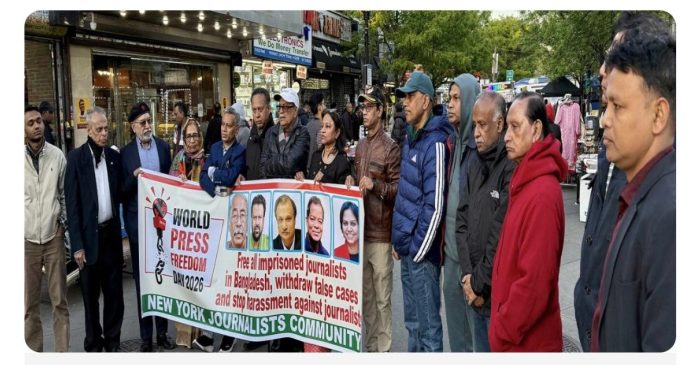
The demonstration, held at Diversity Plaza, drew a wide cross-section of expatriate media professionals under the banner of the “New York Journalist Community.”
Participants formed a human chain and displayed placards bearing images of prominent Bangladeshi journalists, including Shahriar Kabir, Shyamal Dutta, Mozammel Babu, and journalist couple Farzana Rupa and Shakil Ahmed.
Video Link: https://www.facebook.com/shah.faruk.12/videos/1866288560706698
A large banner carried at the front of the rally read: “Free all imprisoned journalists of Bangladesh, withdraw false cases and stop harassment against journalists”—a message that became the central theme of the protest and was repeatedly echoed throughout the event.
Unified demand ahead of Eid
Speakers at the rally placed particular emphasis on the urgency of releasing detained journalists before the upcoming Eid al-Adha, warning that continued detention without trial undermines both justice and democratic norms.
The event was moderated by journalist Pinaki Talukdar and supervised overall by senior journalist and The Voice News executive editor Sajjad Hossain Sabuj, reflecting a coordinated effort by diaspora media leaders to internationalize concerns over press freedom in Bangladesh.
Addressing the gathering as chief guest, Farida Yasmin, former president of the National Press Club Bangladesh and a former member of parliament, delivered a strongly worded speech at the rally in Jackson Heights on May 3.
“Cases as serious as murder charges are being filed against journalists for expressing differing opinions,” she said. “Senior journalists are being detained, while others are being intimidated—effectively blocking the path of independent journalism in the country.”
She further alleged that multiple forms of pressure are being applied to silence media voices. “Editors and journalists are seeing their bank accounts frozen. Passports are being held back to prevent travel. Some senior journalists have even been turned away from airports,” Yasmin told participants, describing the situation as “completely contrary to the principles of press freedom.”
She called for the immediate release of all detained journalists and the withdrawal of all cases filed against them.
“Unprecedented crackdown” alleged
Echoing these concerns, Shaban Mahmood, former secretary-general of the Bangladesh Federal Union of Journalists and a former press minister at the Bangladesh High Commission in New Delhi, said the current situation represents an unprecedented assault on media independence.
“We are witnessing media houses being taken over, hundreds of journalists losing their jobs, and more than 200 journalists having their accreditation cards revoked—something never seen before,” Mahmood said in his address at the same rally.
He urged authorities in Bangladesh to release detained journalists before Eid and to withdraw all cases filed against media professionals.
Speaking at the event, Sajjad Hossain Sabuj sharply criticized what he described as arbitrary legal actions against journalists.
“Journalists have been arrested on baseless allegations, and cases have been filed without credible evidence,” Sabuj said. “We urge the authorities to withdraw these cases immediately and ensure press freedom in Bangladesh.”
Democracy and press freedom intertwined
Veteran journalist Mohammad Fazlur Rahman emphasized the structural importance of media freedom in democratic governance.
“No country can develop a strong and functioning democracy without a free press and professional security for journalists,” he said, calling on journalists worldwide to unite against repression.
Senior journalist Mujahidul Islam Ansari drew comparisons with global trends, stating that while the highest number of journalist fatalities in recent years occurred in Gaza, Bangladesh has seen a significant rise in arrests and alleged harassment of journalists.
Broad participation from diaspora community
The rally featured participation from a wide range of journalists, academics, cultural figures, and community leaders, underscoring the breadth of concern within the diaspora.
Among those who addressed the gathering were educator Professor Hosne Ara, journalist Shahidul Islam, cultural organizer Akhtar Hossain, and community figure GM Hirak.
Other participants included Pragya editor Uttam Saha, journalists Shah Faruk Rahman, Shibbir Ahmed, Dipak Acharya, Shamima Dola, Wasiur Rahman Imon, and freedom fighter Abul Bashar Chunnu and others from the expatriate Bangladeshi community.
The diversity of voices reflected a shared concern that the space for independent journalism in Bangladesh is narrowing rapidly.
Mounting international concern
The New York protest comes at a time of heightened international scrutiny over press freedom and human rights conditions in Bangladesh.
Since August 2024, the country has been governed by an interim administration led by Nobel laureate Muhammad Yunus following the ouster of former Prime Minister Sheikh Hasina. On February 12, 2026, the Yunus administration arranged a one-sided election, barring all secular parties, including the Awami League, and enabling the Bangladesh Nationalist Party, led by Tarique Rahman, to come to power, with Jamaat-e-Islami positioned in the opposition.
Rights groups have reported widespread allegations of abuses since the takeover by the Islamists-backed interim government on August 5, 2024. Ain O Salish Kendra documented at least 318 deaths between August 5 and 8, 2024, while the Bangladesh Hindu, Buddhist, Christian Unity Council reported more than 2,000 incidents of violence against minorities in the weeks following the political transition.
Journalists, according to activists and media leaders, have been among the most affected groups, facing arrests, legal harassment, loss of accreditation, and professional restrictions.
Call for global action
Concluding the rally, speakers urged the international community, including global media watchdogs and human rights organizations, to closely monitor developments in Bangladesh and advocate for the protection of journalists.
They also pledged to continue mobilizing diaspora networks to raise awareness and sustain pressure for reforms aimed at restoring press freedom and democratic accountability.
The demonstration ended with a renewed commitment from participants to stand in solidarity with detained journalists and to keep their demands at the forefront of international discourse.