
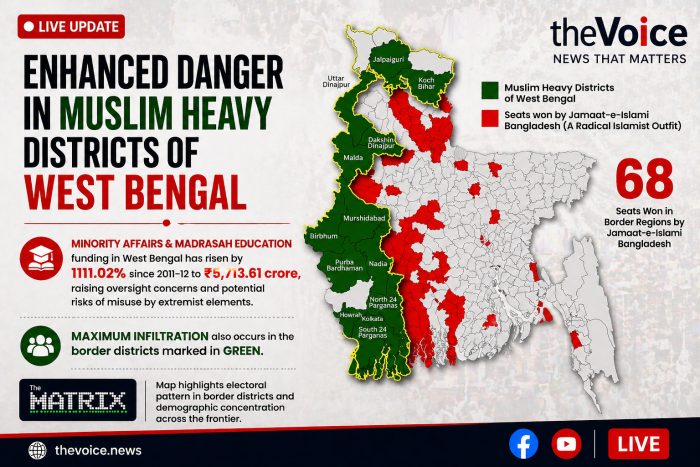
A new infographic circulating online has raised concerns about demographic concentration and security risks in India’s eastern border state of West Bengal, particularly in districts with significant Muslim populations.
The graphic, shared by a platform identified as “The Matrix,” highlights what it describes as “enhanced danger” in Muslim-majority or Muslim-heavy districts along the India–Bangladesh border. It claims that funding for minority affairs and madrasa education in West Bengal has increased by more than 1,111 percent since 2011–12, reaching approximately ₹5,713.61 crore.
According to the infographic, such a sharp rise in funding has triggered concerns among some observers about oversight, transparency, and the potential misuse of resources. However, the claims have not been independently verified by official government data in this context.
The map included in the graphic marks several districts—such as Murshidabad, Malda, North 24 Parganas, and parts of South Bengal—as areas with high Muslim population concentration. These same regions are also identified as border zones, where the infographic alleges “maximum infiltration” risks.
Another key claim made in the visual is that Jamaat-e-Islami Bangladesh, described in the graphic as a “radical Islamist outfit,” has won 68 seats in border regions across Bangladesh. The infographic attempts to draw a connection between electoral outcomes across the border and demographic patterns within West Bengal.
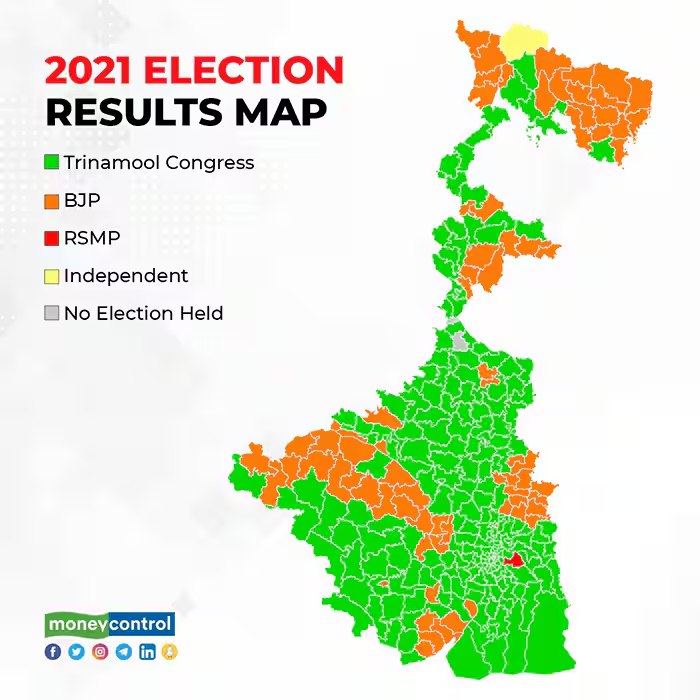
Security analysts have long noted that border districts between India and Bangladesh require careful monitoring due to issues such as illegal migration, smuggling, and cross-border crime. However, experts also caution against drawing direct conclusions between demographic composition and security threats without rigorous data and official verification.
The Government of West Bengal has consistently maintained that its minority welfare programs, including madrasa education funding, are aimed at social inclusion, education, and economic development. Officials argue that such initiatives are essential for reducing inequality and improving access to education among marginalized communities.
At the same time, political debates in India have increasingly focused on issues of identity, migration, and national security, particularly in border states. West Bengal, given its long and porous border with Bangladesh, remains at the center of these discussions.
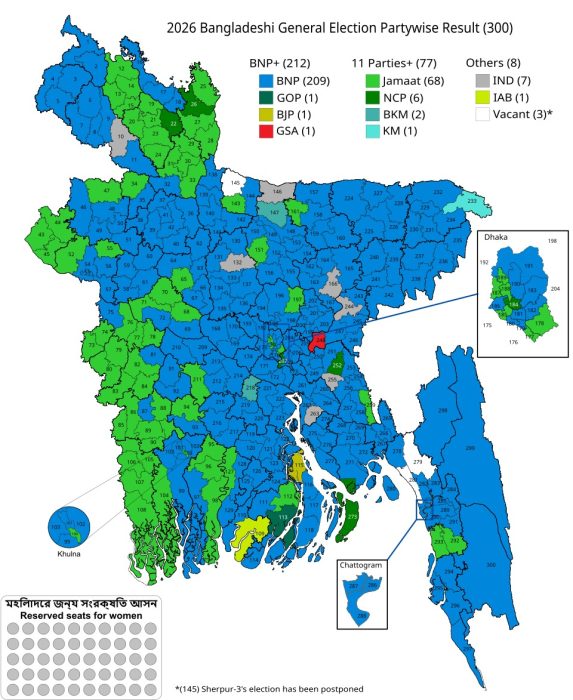
It is important to note that while infographics like this can influence public opinion, they often present selective data or interpretations. Independent verification, official statistics, and balanced analysis are essential to fully understand the complex realities of border security and demographic change.
The circulation of such visuals highlights the growing role of digital media in shaping narratives around sensitive political and social issues in South Asia.